Inside India's RSS, the legion of Hindu ultranationalists / Photo: © AFP

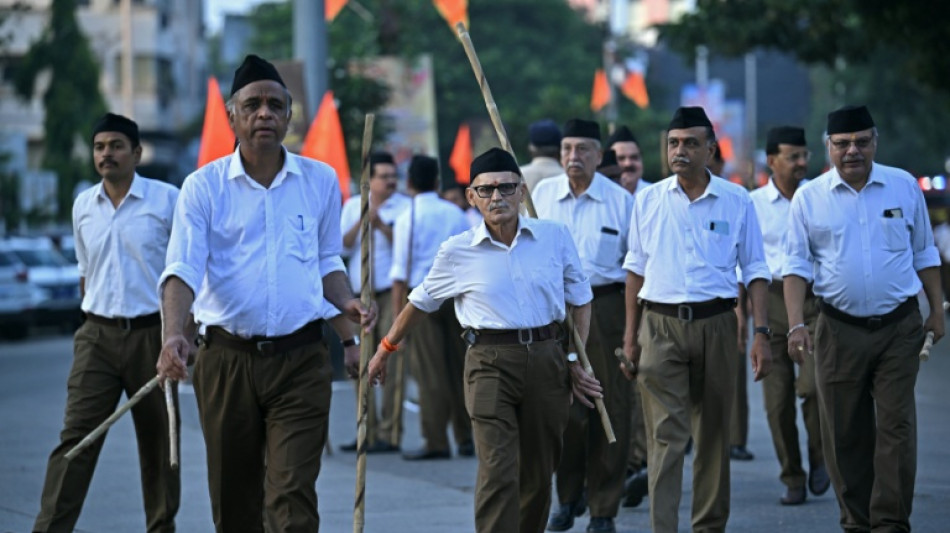
Brandishing bamboo sticks and chanting patriotic hymns, thousands of uniformed men parade in central India, a striking show of strength by the country's millions-strong Hindu ultranationalist group.
The Rashtriya Swayamsevak Sangh -- the National Volunteer Organisation, or RSS -- marked its 100th anniversary this month with a grand ceremony at its headquarters in Nagpur.
AFP was one of a handful of foreign media outlets granted rare access to the group, which forms the ideological and organisational backbone of Prime Minister Narendra Modi's Bharatiya Janata Party (BJP), in power since 2014.
Like the 75-year-old prime minister, critics accuse it of eroding the rights of India's Muslim minority and undermining the secular constitution
At the parade, RSS volunteers in white shirts, brown trousers and black hats marched, boxed and stretched in time to shrill whistles and barked orders.
"Forever I bow to thee, loving Motherland! Motherland of us Hindus!" they sang, in a scene that evoked paramilitary drills of the past.
"May my life... be laid down in thy cause!"
- 'Proud' -
Hindus make up around 80 percent of India's 1.4 billion people.
Founded in 1925, the RSS calls itself "the world's largest organisation", though it does not give membership figures.
At the heart of its vision is "Hindutva" -- the belief that Hindus represent not only a religious group but are India's true national identity.
"They are willing to fight against those who will come in their way... that means minorities, Muslims, Sikhs, Christians and other Hindus who do not subscribe to the idea," historian Mridula Mukherjee said.
RSS chief Mohan Bhagwat uses softer language, saying that minorities were accepted but that they "should not cause division".
Anant Pophali, 53, said three generations of his family had been involved with the group.
"The RSS made me proud to be an Indian," the insurance company worker said.
- Bloody origins -
The RSS was formed during the imperial rule of the British.
But it diverged sharply from that of independence efforts by Mahatma Gandhi and the Congress Party, whose leader Jawaharlal Nehru considered them "fascist by nature".
Mukherjee said archives showed "a link between the RSS and fascist movements in Europe".
"They have said, very clearly, that the way the Nazis were treating the Jews should be the way our own minorities should be treated," she told AFP.
The RSS does not comment directly on such parallels, but Bhagwat insisted that "today we are more acceptable".
The RSS was an armed Hindu militia during the bloody 1947 partition of India and the creation of Muslim-majority Pakistan.
Hindu extremists blamed Gandhi for breaking India apart.
A former RSS member assassinated him in 1948, and the group was banned for nearly two years.
But the RSS rebuilt quietly, focusing on local units known as "shakhas" to recruit.
Today, it claims 83,000 of them nationwide, as well as over 50,000 schools and 120,000 social welfare projects.
At a shakha in Nagpur, Alhad Sadachar, 49, said the unit was "meant to develop togetherness".
"You can get a lot of good energy, a lot of good values, like helping those in need", he said.
At a shaka that AFP was allowed to attend, dozens of members –- many middle-aged or elderly, and not in uniform –- gathered for an hour of calisthenics and song.
But in a show of symbolism, they congregated beneath a saffron flag -- the colour of Hinduism -- rather than India's tricolour.
- 'A country that is one' -
The RSS remains deeply political.
The group re-emerged in the late 1980s, spearheading a movement that ended with a violent mob demolishing a centuries-old mosque in Ayodhya -– now replaced by a gleaming temple to the Hindu god Rama.
"That was the turning point," said Mukherjee, the historian, adding that the RSS was "able to create a mass mobilisation on religious issues, that became at its heart clearly anti-Muslim".
The group helped deliver Modi's BJP party an electoral landslide in 2014.
Since then, Modi -– a former RSS "pracharak", or organiser -- has pursued policies that critics say marginalise India's estimated 220 million Muslims, 15 percent of the population.
"There has been a clear increase in terms of violence, lynching and hate speech since Modi has taken over," said Raqib Hameed Naik, director of the US-based Center for the Study of Organized Hate.
RSS leaders deny it has participated in atrocities.
"Those allegations are baseless," Bhagwat said.
"Atrocities were never done by the RSS. And if it happens anyway, I condemn that."
Under Modi, it has expanded its reach.
"The RSS has been able to stir Indian society in a direction that is more nationalistic, less liberal in a Western sense," said Swapan Dasgupta, a former nationalist parliamentarian.
But volunteer Vyankatesh Somalwar, 44, said the group only pushed "good values".
"The most important thing is to contribute to your country," he said. "A country that is one, above all."
A.Maldonado--TFWP