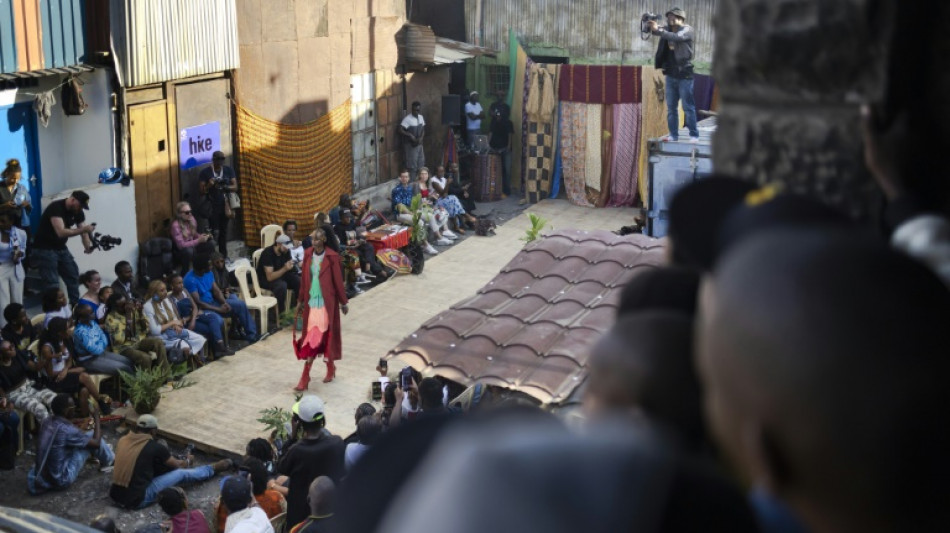
From waste to runway: Kenyan designers transform used clothes into art / Photo: © AFP

In a dusty alley in the heart of Kenya's largest open-air market, fashion models strut down a makeshift runway in bold, upcycled outfits made from waste collected at dumpsites and market cast-offs -- proof that even trash can dazzle.
Every year, thousands of tonnes of used clothes from Europe, the United States, and beyond make their way to Kenya.
In 2023, Kenya overtook Nigeria to become Africa's largest importer of second-hand clothing according to a study from the US-based Massachusetts Institute of Technology (MIT).
Thousands of these bales land in Gikomba market near central Nairobi where tin-roofed stalls stretch across a five-acre labyrinth, one of the city's major economic hubs.
On a sunny afternoon last week, a huge crowd gathered to watch models sashay and pivot, showcasing pieces from bales once discarded as unwearable or unsellable.
"What? They've upgraded our clothes," one of the traders said with delight as he watched the show.
Gikomba Runway Edition brought together young, underground Kenyan designers and stylists for the first time, including 25-year-old "upcycling" specialist Morgan Azedy.
"I always see the environment around me dirty... I wanted to control pollution," he told AFP as he prepared his avant-garde outfits in his single-room home before the show.
His "Kenyan Raw" collection featured streetwear denim and a gothic flair crafted entirely from recycled leather sourced from dumpsites and fashion rejects.
- 'Just garbage' -
Kenya imported about 197,000 tonnes of second-hand clothes worth $298 million in 2023, according to the MIT study.
The Environment for Development, a global research network, estimates that around a third are unusable items that end up in landfills -- mostly made from plastic-based materials like nylon and polyester that does not biodegrade.
Olwande Akoth, a designer showcasing her upcycled kimonos at the fashion show, once traded in second-hand bales but often felt disheartened by their poor quality.
"It's just garbage... the clothes you can't even wear, you wouldn't even give to a beggar," Akoth said.
The influx of second-hand clothes has employed hundreds of thousands of people across East Africa, from port handlers to traders, and provided a lot of affordable clothing.
But it has also made it hard for domestic textile firms to get off the ground.
The East African Community of eight regional countries tried to impose a ban in 2016 in the hope of boosting local textile production.
But it was opposed by recycling lobbyists in the United States, and Washington threatened to kick the East African nations out of a lucrative trade deal called the African Growth and Opportunity Act (AGOA) that allowed them to sell products duty-free into the US.
Kenya, Tanzania, Uganda and others backed down. Only Rwanda held firm and was punished with a suspension from selling clothes under AGOA's preferential rates.
President Donald Trump's administration allowed AGOA to expire last month for the whole continent, although talks are under way to revive it.
- 'Uniqueness' -
For Azedy, the downside of the trade deals -- mountains of discarded clothes piling up in dumpsites -- is a treasure trove for his creative eye.
Buying new fabric, he said, is simply "too expensive".
On the runway, what was once an oversized pair of denim trousers has been transformed into a tiered, layered jacket paired with flared trousers and platform shoes.
His drive for "uniqueness" in repurposed pieces earned him a place at Berlin Fashion Week last year.
Having styled several regional musicians with his collection, Azedy now dreams of taking what others consider trash to the grand stages of New York and Paris.
T.Mason--TFWP