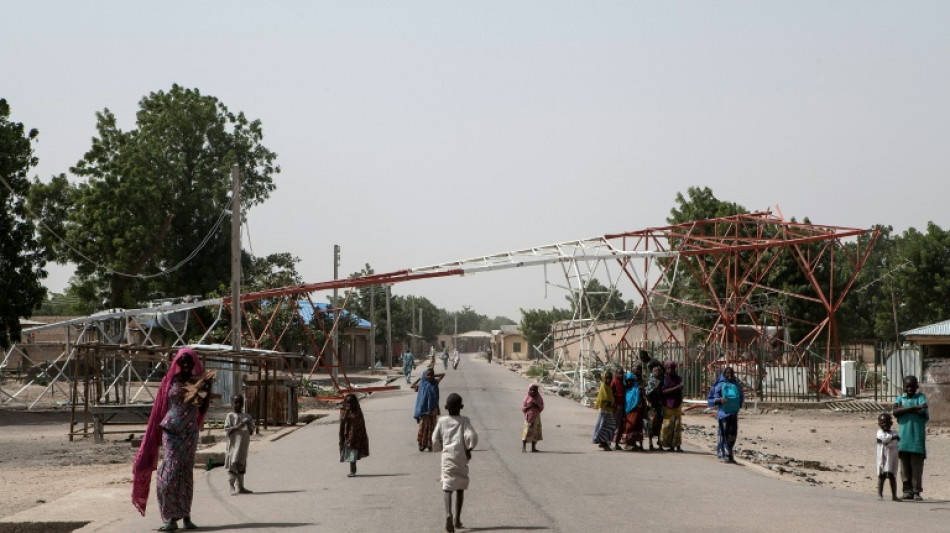
Vandalism hobbles Nigeria's mobile telephone services / Photo: © AFP/File

When cell phone and internet networks went down across nine states in Nigeria earlier this summer, leaving millions without service, telecoms officials pointed to an increasingly familiar culprit: vandalism.
Destruction of telecoms infrastructure is rife in Africa's most populous country, from jihadist groups aiming to create communications blackouts to outright theft of cables and parts, as well as generators and diesel from substations.
But now some Nigerian telecoms operators worry incidents like the summer blackout will become increasingly common as the country's economic crisis triggers more cable thefts and vandalism and pushes up the costs of repairs.
With consumers turning to solar alternatives to get away from unreliable power supplies, experts say some batteries stolen from telecoms substations end up powering people's homes.
In the June outage, businesses and professionals that depended on data services for their operations scrambled to find alternatives in an incident that Gbenga Adebayo, chairman of the Association of Licensed Telecom Operators of Nigeria (ALTON), blamed on a vandalised fibre-optic cable in Lekki, an upscale neighbourhood in the economic capital Lagos.
Vandals regularly steal cables to sell. Accidental damage by construction workers adds to the problem, and the cost of repairing or replacing stolen equipment has seen overheads balloon.
Between 2018 and 2022, there were at least 50,000 cases of major destruction to telecom infrastructure and facilities, according to the Nigerian Communications Commission.
It is a headache for customers and telecoms companies -- and also a quick way to make money in Africa's fourth-largest economy, where wealth remains concentrated among the political and economic elite.
"The users do not know the outages are due to acts of vandalism, they just blame the poor network," Adebayo told AFP.
In 2023, Nigeria's largest telecommunications provider, MTN, reported more than 6,000 incidents of fibre cable damage, with repairs costing the entire industry an estimated $23 million.
Airtel, the country's second-largest operator, said it experiences about 40 cases of fibre vandalism every day.
- Fuelled by solar -
In many rural areas, mobile phones are the only link to family, financial services or emergency help, and fibre cuts can leave entire communities offline for days.
Nigeria's digital economy contributed about 18 percent of GDP in the last quarter of 2024, yet small traders, students and commuters are often the hardest hit when networks collapse and everything from mobile banking -- integral to the economy as physical cash loses value due to inflation -- to ride-hailing apps shuts down.
Last year, President Bola Tinubu issued an executive order classifying "information and communications technology systems" and "networks and infrastructure" as critical national infrastructure.
Adebayo said the order effectively puts telecom installations on the same security level as "military barracks and national hospitals".
In its 2024 annual report, IHS Holdings Limited, a major international telecoms operator and developer, flagged fuel theft from its base stations as a recurring problem, alongside "corruption, policy uncertainty and collapsing infrastructure", all of which it described as significant risks to business operations.
"Any disruption... has far-reaching implications for service delivery, economic stability and national security," Nigeria's national security adviser Nuhu Ribadu said in a statement earlier this month.
With households increasingly turning to generators and solar power to cope with electricity outages from creaking utilities, telecom equipment has become a tempting target, especially in commercial hubs across the south and in the capital Abuja.
"Batteries from substations end up in people's homes and offices as second-hand inverter batteries. Generators and diesel are not safe either," Adebayo said.
To deter theft, large corporations have begun installing trackers on batteries and generators.
- Held for ransom -
Telecom firms also face a different kind of pressure: extortion and labour disputes.
In some communities, residents demand legally dubious ground rent before allowing substations to be built or before granting access to existing structures.
The sector has likewise been entangled in union disputes, where suppliers of essential services threaten to halt operations.
A recent strike threat by the Natural Oil and Gas Suppliers Association of Nigeria, which delivers diesel to telecom substations, had to be mediated at the top levels of Nigeria's national security service, by Ribadu himself.
M.Cunningham--TFWP