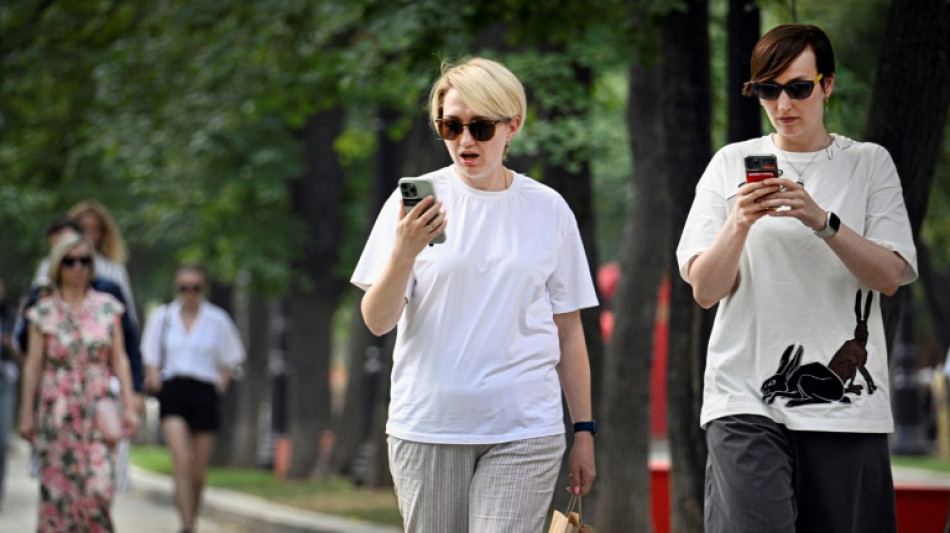
Online behaviour under scrutiny as Russia hunts 'extremists' / Photo: © AFP

Just like his peers, Russian teenager Artyom spends "half his life" online -- something that could soon become risky as a ban on searching for "extremist" content comes into force.
Since launching its offensive in Ukraine in 2022, Russia has drastically restricted press freedom and freedom of speech online.
But the new legislation takes digital surveillance even further.
It will slap fines on internet users who search for web pages, books, artwork or music albums that the authorities deem "extremist".
The term has a very broad definition and in Russia can refer to terrorist groups and political opponents alike.
Browsing information on the late opposition leader Alexei Navalny or on the "international LGBTQ movement", both classified as "extremist", could lead to fines of up to 5,000 rubles ($63).
Artyom, who spoke to AFP in one of Moscow's parks, said he was interested in "the future of our country, the policies of our leaders, those of foreign governments."
He suspected his life would "change" after the new law comes into effect in September, forcing him to be careful with every click.
Artyom said he would for example stay away from "sites from so-called 'unfriendly' countries," a term often used to refer to Western states.
And these sites were "the ones that interest me the most," he said bitterly.
Another resident of Moscow, Sergei, said the new law made him "afraid".
Like most of Russians AFP spoke to, he did not want to give his full name.
"Just yesterday, I did some research freely, and tomorrow I could be found guilty," the 33-year-old jewellery designer said.
- 'Censorship' -
The new legislation has raised concerns even among Kremlin supporters, drawing rare opposition from around 60 lower house State Duma lawmakers.
"Even young pro-government figures oppose this censorship," a history professor at a Moscow university told AFP, speaking on condition of anonymity.
A computer security expert who also wanted to remain anonymous said that the law "violates the principle enshrined in the constitution, according to which reading cannot be punishable."
"Searching on the Internet is now simply dangerous," he said, adding: "The government wants to make everyone afraid."
According to the expert, Russia is inching closer to Chinese levels of surveillance and control.
A prominent Russian rights activist Svetlana Gannushkina, who has been classified by Moscow as a "foreign agent", said the Kremlin's goal was to "sow fear and stifle any will of resistance."
She said the conflict in Ukraine "causes natural annoyance" for the authorities which, "are afraid and begin to take these hysterical measures," the 83-year-old told AFP.
The law also bans advertising for virtual private networks (VPNs), widely used in Russia to get around state blocks on Western sites and circumvent censorship.
YouTube is already only accessible in Russia via VPN, as are the social media platforms of the Meta group: Facebook and Instagram, declared "extremist".
- Extremist gardening? -
Separate legislation, also taking effect in September, will allow an entire online community to be branded "extremist" if one of its members has been classified as such.
Several communities, particularly those for writing to political prisoners, have already had to close or reorganise in response to the changes.
For Natalia, a 50-year-old school administrator, "this law is just stupid."
She said an entire group "cannot be held responsible" for the activities of a single member.
"So I have to check every time I open my gardening group page to see if one of the grannies has been declared an 'extremist' by any chance?" she said.
But the digital security expert pointed out that internet censorship on a national scale "will be difficult to implement."
According to him, the law would primarily target individuals who had already been targeted by the authorities for their political views.
"We know well that the severity of Russian laws is often mitigated by the possibility of their non-enforcement," the expert said.
B.Martinez--TFWP