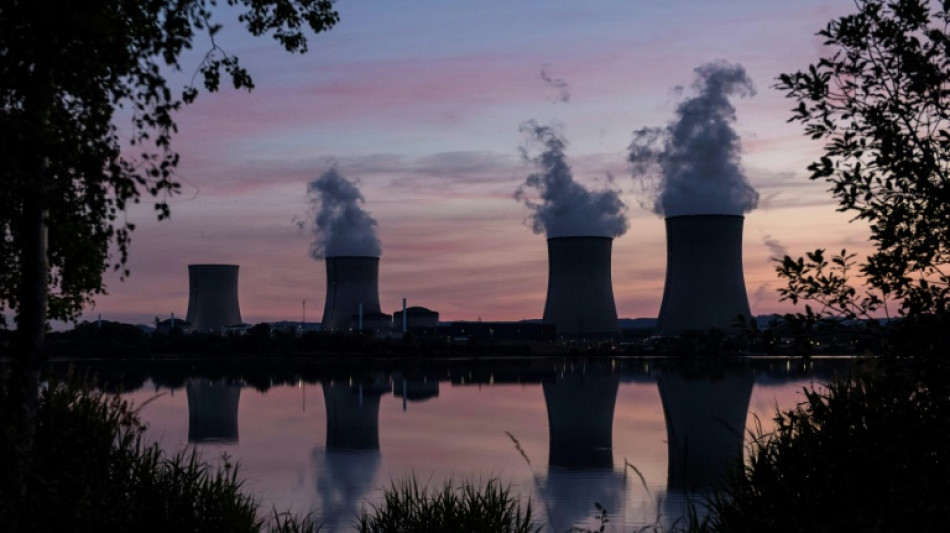
Atomic Brussels? Support for nuclear power gains ground in EU / Photo: © AFP/File

Long a taboo, Brussels opened the door to EU funding for nuclear power this month in a sign of the growing support atomic energy is enjoying within the bloc.
The European Commission listed "nuclear fission energy" among the sectors eligible to receive EU money in its 2028-2034 budget proposal unveiled last week -- reversing a previous ban.
The commission declined to say if that meant Brussels was prepared to fund the building of new nuclear reactors, with a spokeswoman stressing that the proposal was "still to be discussed" with member states.
Nuclear's eligibility remained only potential, she said, and fission was listed alongside other related fields such as decommissioning nuclear facilities, management of radioactive waste and nuclear research.
But the change in tack -- given atomic energy was explicitly excluded from funding under the current European Union budget -- marked a victory for the pro-nuclear camp, which has been steadily gathering steam.
Europe has long been divided on nuclear.
While France has championed it, Germany has led the opposition since former chancellor Angela Merkel accelerated a phase-out in 2011, after the meltdown at the Fukushima nuclear plant in Japan.
The two economic powerhouses even captain rival informal clubs of countries that vie for influence in Brussels.
Paris leads the "European Nuclear Alliance" while Berlin is top dog in the "Friends of Renewables" group.
Informal breakfast talks of the two groups are normally held ahead of meetings of EU energy ministers, with representatives of some countries shuttling between the two gatherings.
- 'Unavoidable' topic -
France's club has been gaining members, with Belgium and Italy announcing this year they would join, and Greece also expressing interest.
This came after Rome opened the door to a return to atomic power, and Belgium officially abandoned a two-decades-old pledge to phase it out.
Other members of the club include Bulgaria, Croatia, Finland, the Netherlands, Poland and Sweden.
Germany's grouping includes Austria, Spain, Portugal, Ireland, Denmark, and the Baltic states, among others.
"The enlargement of the alliance makes the subject somewhat unavoidable," Neil Makaroff, a climate transition expert at Strategic Perspectives, a think tank, said of the pro-atomic faction.
After years of EU ostracism, these countries want to "make nuclear power politically neutral", he added.
Opposition is weaker than a couple of years ago, with more and more governments emphasising the need for a complementary energy mix to speed-up the electrification of the continent.
France is even hoping for a more lenient approach from Germany under new leader Friedrich Merz.
In May, the chancellor co-signed an opinion piece with French President Emmanuel Macron backing "technological neutrality" and the "non-discriminatory treatment of all low-carbon energies within the European Union".
French Energy Minister Marc Ferracci later said the Germans were ready to end "the religious war over nuclear power".
Yet, opinions on the matter within Germany's ruling coalition differ and whether Berlin -- a net contributor to the bloc's budget -- would go so far as to greenlight EU funding for nuclear remains to be seen, said Makaroff.
Tensions might bubble up again in the coming months, as countries discuss European rules on renewable energy -- a package France would rather be called "decarbonised" energy and include nuclear power.
Paris claimed a first victory this month when the commission included the concept of "technological neutrality" dear to the French in its 2040 climate target proposal.
Still, even in the most nuclear-heavy scenarios, wind and solar power are projected to dominate the European energy mix in the coming decades.
In 2024 renewables accounted for 47 percent of electricity production in Europe, compared with 23 percent for nuclear energy, according to EU data agency Eurostat.
"In the short term, most of the work on electrification will be done through renewables," said Makaroff.
A.Nunez--TFWP