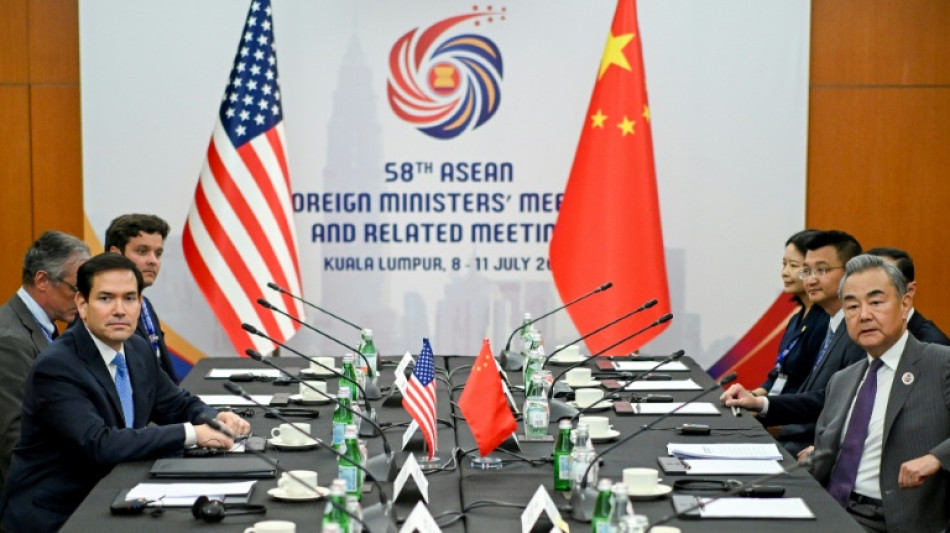
Rubio meets China's Wang on sidelines of ASEAN talks / Photo: © POOL/AFP

US Secretary of State Marco Rubio met his Chinese counterpart Wang Yi Friday on the sidelines of ASEAN talks in Malaysia, where Washington's tariffs are in sharp focus.
Rubio and Wang's first face-to-face meeting since US President Donald Trump returned to office comes as Washington and Beijing are locked in disputes ranging from trade to Taiwan -- and both powers vie for greater influence in the region.
Wang and Rubio, a longtime China hawk, are in Kuala Lumpur for a gathering of foreign ministers from the Association of Southeast Asian Nations, which Japan, South Korea and Australia and other nations are also attending.
US officials said ahead of Rubio's first trip to the region as secretary of state that Washington was "prioritising" its commitment to East and Southeast Asia.
Rubio said Thursday the United States has "no intention of abandoning" the Asia-Pacific region.
But US tariffs have overshadowed the conference, and Rubio has sought to placate Asian trade partners, saying talks were ongoing and might result in "better" rates than for the rest of the world.
Trump has threatened punitive tariffs ranging from 20 to 50 percent against more than 20 countries, many of them in Asia, if they do not strike deals with Washington by August 1.
- 'Indispensable relationship' -
This included long-time US ally Japan which faced a 25 percent across-the board levy, separate from similar charges for cars, steel and aluminium that have already been imposed. Seoul faced a similar tariff percentage.
Earlier Friday Rubio met his Japanese and South Korean counterparts, with his spokeswoman Tammy Bruce calling it an "indispensable relationship."
Malaysian Prime Minister Anwar Ibrahim, however, said this week that tariffs were being used as "sharpened instruments of geopolitical rivalry".
Wang on Thursday said the US tariff drive "undermines the free trade system".
"The United States' imposition of high tariffs on Cambodia and Southeast Asian countries is an attempt to deprive all parties of their legitimate rights to development," Wang said.
Tensions between Washington and Beijing have ratcheted up since Trump took office in January, with both countries engaging in a tariff war that briefly sent duties on each other's exports sky-high.
At one point the United States hit China with additional levies of 145 percent on its goods as both sides engaged in tit-for-tat escalation. China's countermeasures on US goods reached 125 percent.
Beijing and Washington agreed in May to temporarily slash their staggeringly high tariffs -- an outcome Trump dubbed a "total reset".
- Taiwan, South China Sea -
Before becoming Secretary of State in January, Rubio had already been one of the most vocal critics of China on the American political stage for many years.
Rubio and Wang are also likely to discuss US concerns over China's expansionary behaviour in the South China Sea and Beijing's growing military pressure on Taiwan.
China claims the democratic self-ruled island as part of its territory and has threatened to use force to bring it under its control.
Like most countries, Washington has no formal diplomatic relations with the island.
However, the United States is Taiwan's biggest arms supplier and has shown increasing support for Taipei in the face of Beijing's growing military pressure on the island in recent years.
US Defense Secretary Pete Hegseth accused China in late May of "credibly preparing to potentially use military force to alter the balance of power" in the Asia-Pacific region.
In response, Chinese diplomats accused the United States of using the Taiwan issue to "contain China" and called on Washington to stop "playing with fire".
M.McCoy--TFWP