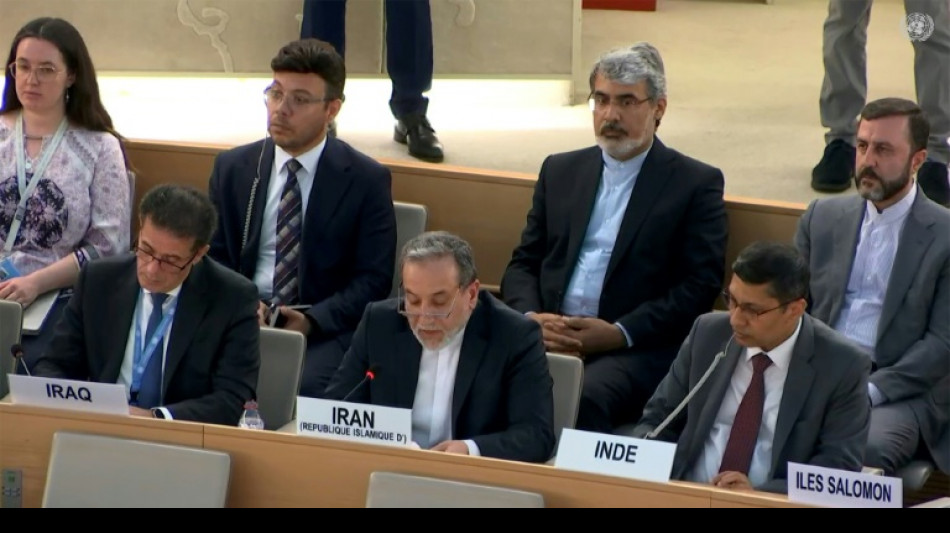
Iran's nuclear programme: from its origins to today's dispute / Photo: © UNITED NATIONS/AFP

A week ago, Israel launched an unprecedented attack against Iran, saying the country was on the verge of developing a nuclear weapon, a claim Tehran has always denied.
Western powers have repeatedly expressed concerns about the rapid expansion of Iran's nuclear programme, questioning in particular the country's accelerated uranium enrichment.
The following is a recap of the main developments regarding Iran's nuclear programme, as European foreign ministers are holding nuclear talks with their Iranian counterpart in Switzerland on Friday.
- 'Structured programme' -
Iran laid the foundation for its nuclear programme in the late 1950s with technical assistance from the United States, when Iran's ruling shah, Mohammad Reza Pahlavi, signed a civilian nuclear cooperation agreement with the US.
In 1970, Iran ratified the Treaty on the Non-Proliferation of Nuclear Weapons (NPT), committing it to declare its nuclear material to the International Atomic Energy Agency (IAEA).
But revelations in the early 2000s about undeclared nuclear sites raised concerns. An 2011 IAEA report, collating "broadly credible" intelligence, said that at least until 2003 Iran "carried out activities relevant to the development of a nuclear explosive device".
- Historic accord left in tatters -
After suspending enrichment activities, Iran began talks with European and then international powers that would later culminate in a historic deal.
On July 14, 2015, Iran and the five permanent members of the UN Security Council -- Britain, China, France, Russia and the United States -- plus Germany reached an accord in Vienna.
The deal, called the Joint Comprehensive Plan of Action (JCPOA), placed significant restrictions on Iran's nuclear programme in exchange for sanctions relief after 12 years of crisis and 21 months of protracted negotiations.
But the hard-won deal began to unravel when the US under President Donald Trump walked away from it on May 8, 2018, and reimposed sanctions on Iran.
- 'Nuclear escalation' -
Following the US withdrawal, Iran retaliated by stepping up its nuclear activities as if "a red cape had been waved in front of a bull," said Clement Therme, associate researcher at the Rasanah International Institute for Iranian Studies.
According to Therme, Iran "embarked on a strategy of escalation" in a bid to up pressure and obtain help to circumvent sanctions. But Tehran's moves were unsuccessful and came at an "exorbitant economic cost".
Iran first began enriching uranium to five percent -- breaching the limit of 3.67 percent imposed by the deal -- before it raised the enrichment levels to 20 and then to 60 percent in 2021, which is a short step from the 90 percent required for use in a weapon.
Iran has also increased its stockpiles of enriched uranium, which was set at 202.8 kilogrammes under the deal. Iran's total enriched uranium stockpile is currently believed to be more than 45 times that limit.
And Tehran has since exceeded the number of centrifuges -- the machines used to enrich uranium -- it is allowed to have while beginning to produce more material faster by using advanced models at its plants.
Efforts to revive the deal have been fruitless so far, with European-led talks on hold since summer 2022.
After Trump's return to the White House, talks between Washington and Iran and mediated by Oman resumed in April.
While the US president has voiced confidence that Iran would eventually sign a nuclear deal, Tehran has said that Israeli strikes that targeted a slew of military and nuclear sites "dealt a blow" to diplomacy.
- 'No indication' -
Faced with Iran's rapidly expanding nuclear programme, the IAEA expressed "serious concern" in its latest quarterly report at the end of May.
According to the UN agency, Iran is the only non-nuclear weapon state to enrich uranium to 60 percent. It theoretically has enough near-weapons-grade material, if further refined, for more than nine bombs.
However, the manufacturing and delivering of a nuclear bomb requires many other steps, including mastering both ballistics and the miniaturisation of the nuclear charge.
The IAEA has said it currently has "no indication" of the existence of a "systematic programme" in Iran to produce a nuclear weapon.
US Director of National Intelligence Tulsi Gabbard testified to a Senate committee in March that Iran was not actively building a nuclear bomb.
Iran has always denied having such ambitions, regularly referring to a long-standing fatwa, or religious edict, by Iran's supreme leader Ayatollah Ali Khamenei prohibiting atomic weapons.
M.Cunningham--TFWP