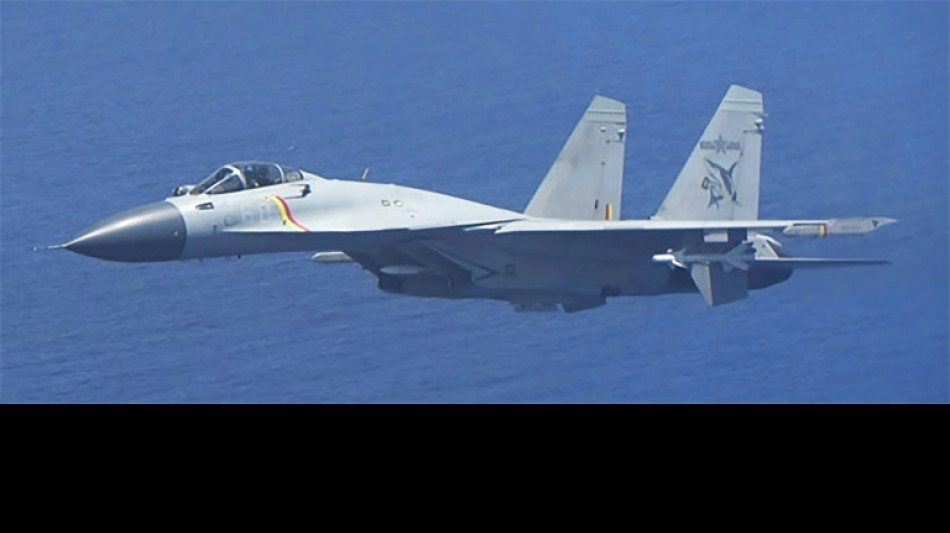
Japan, China trade barbs over fighter jet manoeuvres / Photo: © Japan's Ministry of Defense/AFP

Beijing condemned on Thursday what it called "dangerous behaviour" by a Japanese military plane over the Pacific after Tokyo said Chinese fighter jets flew unusually close to its aircraft at the weekend.
The Japanese government had complained to China over the incident, in which no Japanese military personnel were reported injured.
A Chinese J-15 fighter jet from the Shandong aircraft carrier followed a Japanese P-3C patrol plane for 40 minutes on Saturday, according to the Japanese defence ministry.
Two J-15 jets then did the same for 80 minutes on Sunday.
"During these long periods, the jets flew unusually close to the P-3C, and they flew within 45 metres" of the patrol plane on both days, an official from the Japanese ministry told AFP.
Also on Sunday, Chinese jets cut across airspace around 900 metres (3,000 feet) ahead of a P-3C Japanese patrol plane at the same altitude -- a distance a P-3C can reach within a few seconds at cruising speed, Tokyo said.
"We do not believe that this approach was made by mistake," the Japanese military's chief of staff Yoshihide Yoshida told reporters on Thursday.
"Given it happened for 40 minutes and 80 minutes, for two days in a row, our understanding is that it was done on purpose," he said.
Beijing's foreign ministry spokesman Lin Jian hit back at the Japanese description of the events.
"The root cause of the risk to maritime and air security was the close reconnaissance of China's normal military activities by a Japanese warplane," he said.
"The Chinese side urges the Japanese side to stop this kind of dangerous behaviour."
- 'Abnormal approaches' -
The incident followed the sighting in recent days of two Chinese aircraft carriers sailing in the Pacific simultaneously for the first time.
Japan said this week the aircraft carriers' activity -- described by China as "routine training" -- showed the expanding geographic scope of Beijing's military.
Yoshida said on Thursday loosening Japan's surveillance, information-gathering or countermeasures against intrusion "would encourage attempts to change the status quo by force".
Tokyo's top government spokesman Yoshimasa Hayashi earlier told reporters in regard to the fighter jet incident that "such abnormal approaches can lead to an accidental collision, so we have expressed serious concerns" to the Chinese side.
US ambassador to Japan George Glass said on social media platform X that the manoeuvres by a Chinese fighter "put Japanese crewmembers' lives in peril".
"Whether it's harassing Philippine ships, attacking Vietnamese fishermen, or firing flares at Australian aircraft, Beijing knows only reckless aggression. Not so much a charm offensive as offensive harm," Glass said.
Similar incidents were last reported in May and June 2014, when Chinese Su-27 fighter jets flew within 30 metres (100 feet) of Japanese military planes in the East China Sea.
Japan summoned the Chinese ambassador at the time, while the two sides traded accusations of blame.
Daisuke Kawai, director of the University of Tokyo's economic security and policy innovation programme, told AFP this week that the timing of the aircraft carrier movements could be linked to US-China economic tensions.
"Beijing calculated that the United States would be less willing or able to respond militarily at this precise moment, seeing it as an opportune time to demonstrate its expanding military capabilities," he said.
S.Jones--TFWP