Rice prices Japan's hot political issue, on and off the farm / Photo: © AFP

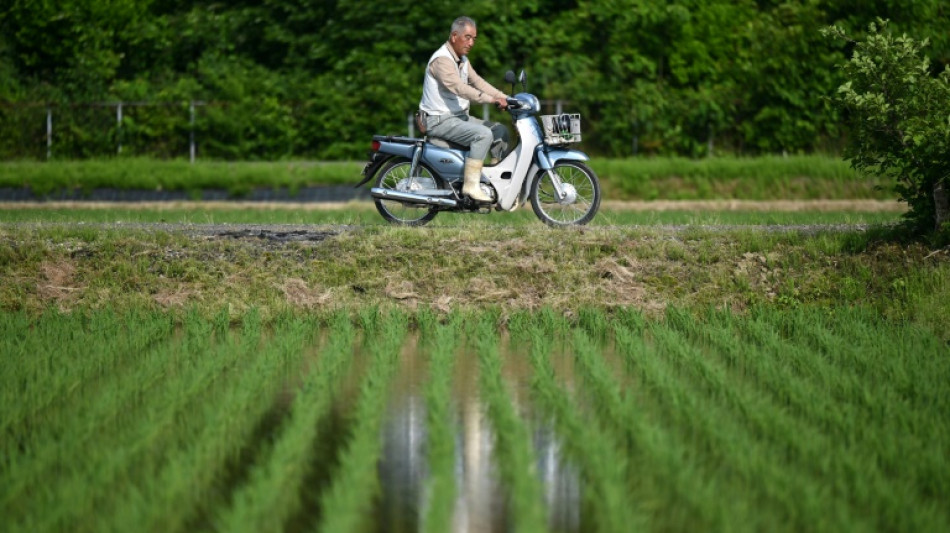
All is calm at Satoshi Yamazaki's rice farm, with its freshly planted rows of vivid-green seedlings, but a row over the cost of the staple in Japan is threatening to deal the government a blow at the ballot box.
Shortages of the grain caused by a supply chain snarl-up have seen prices almost double in a year, fuelling frustration over inflation -- and voters could let their anger be known in upper house elections due next month.
To help ease the pain for consumers and restaurants, the government started tapping emergency stockpiles in March, having only previously done so during disasters.
Yamazaki, who grows about 10 percent of his rice organically using ducks to eat pests, said he understands high prices are "troubling" for ordinary people.
But he stressed that thin profits are a concern for many of those who produce it.
"There's a gap between shop prices and what farmers sell rice for to traders and the like," he told AFP in the northern Niigata region.
"Not all the money paid at shops becomes our income," said Yamazaki, a 42-year-old father of seven.
A mosaic of factors lies behind the shortages, including an intensely hot and dry summer two years ago that damaged harvests nationwide.
Since then some traders have been hoarding rice in a bid to boost their profits down the line, experts say.
The issue was made worse by panic-buying last year prompted by a government warning about a potential "megaquake" that did not strike.
- 'Old' rice -
Meanwhile, the rising price of imported food has boosted the popularity of domestic rice, while record numbers of tourists are also blamed for a spike in consumption.
Farm minister Shinjiro Koizumi has pledged to cut prices quicker by selling stockpiled rice directly to retailers -- attracting long queues to some shops.
It appears to be working: the average retail price has edged down for a second week to 4,223 yen ($29) for five kilograms (11 pounds), down from a high of 4,285 yen in May.
That hasn't stopped opposition politicians -- with an eye on the elections -- and online critics branding the reserve rice "old", with some likening it to animal feed.
But analysts also blame Japan's decades-old policy of cutting rice-farming land. The policy was introduced to support prices that were being hit by falling demand brought about by changes in the Japanese diet.
Under the 1971 policy, farmers were told to reduce the amount of space used to grow the grain in favour of other crops.
That saw the amount of land used for rice paddies -- not including for livestock feed -- plunge below 1.4 million hectares (3.5 million acres) in 2024, from a peak of 3.3 million hectares in 1960.
While the policy was officially abolished in 2018, it has continued in a form of incentives pushing farmers towards other commodities like soybeans.
Adding to the crisis is Japan's ageing population. Many rice farmers are old and their children have no interest in taking over.
Eighty percent of rice farmers are part-time with less than two hectares of fields but they account for only 20 percent of production, said agronomy expert Kazunuki Oizumi, professor emeritus of Miyagi University.
Their main revenue comes from other jobs or pensions, he added.
- Agriculture 'destroyed' -
Toru Wakui, chairman of a large-scale farm in the northern Akita region who has for decades fought against the acreage reduction, said Japan should "seek an increase in rice production and exports to foreign markets".
"If you only think about the domestic market while increasing output, of course prices will fall," he told AFP. "We need to look for markets abroad."
"The 55 years of acreage reduction destroyed Japan's agriculture," said Wakui, 76, who urged Koizumi in a letter last month to "declare an expansion in rice production".
He also said Japan should consider a scheme to help young people start agriculture businesses without the burden of initial investment in fields and machinery, by involving other sectors including banks and trading companies.
Public support for Prime Minister Shigeru Ishiba's government has tumbled to its lowest level since he took office in October, which local media say was partly caused by the surge in inflation and soaring rice costs.
He has told parliament that increasing production is "an option" to temper prices, but said food security and the livelihood of producers was also important.
For the farmer Yamazaki, "wanting cheap rice with high quality" is a pipe dream.
"We farmers are a little baffled by the limelight that suddenly shifted to us," he said.
"But I think it's a good opportunity for the public to think about how rice is produced."
S.Jordan--TFWP