Japan says two Chinese aircraft carriers seen in Pacific / Photo: © AFP

Two Chinese aircraft carriers were operating in the Pacific for the first time, according to Japan, whose defence minister said Tuesday the move revealed the expansion of Beijing's military activities.
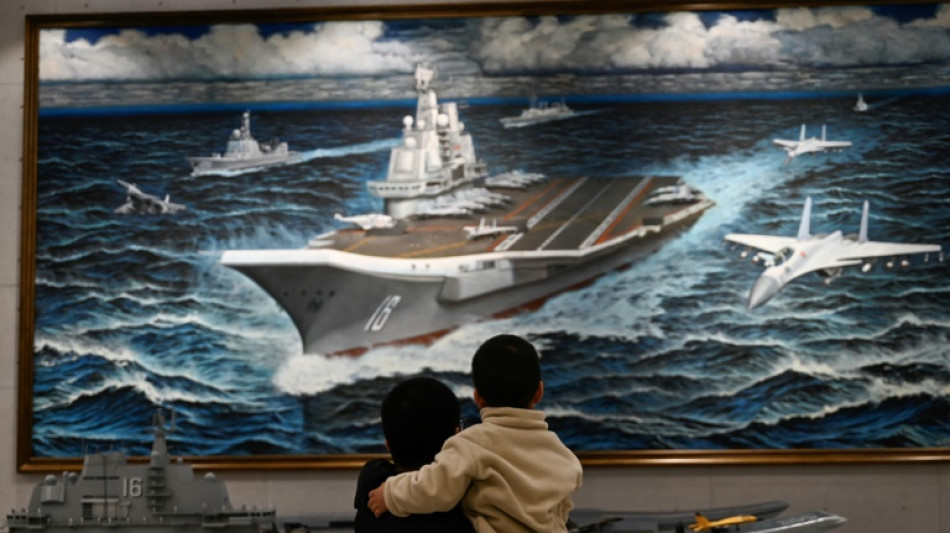
China's Shandong and Liaoning carriers -- its only two currently in operation, with a third undergoing sea trials -- were both spotted with their fleets in recent days, Tokyo said.
"We believe the Chinese military's purpose is to improve its operational capability and ability to conduct operations in distant areas," a defence ministry spokesman told AFP.
Defence Minister Gen Nakatani told reporters the sightings show that the Chinese military's "activity area is expanding".
"Japan has expressed its position that the Chinese activities should not threaten Japan's safety" through diplomatic routes to Beijing, Nakatani said.
The Japanese military would continue to closely monitor and patrol the operations of Chinese naval warships, he added.
China's use of naval and air assets to press its territorial claims has rattled the United States and its allies in the Asia-Pacific region.
When asked about the moves at a regular news briefing, Chinese foreign ministry spokesman Lin Jian reiterated a statement given the previous day about the Liaoning's trip.
"The activities of Chinese warships in the relevant sea areas are fully in line with international law and international practice," he said, adding that Japan should "take an objective and rational look at this issue".
- Island chains -
On Monday, the Shandong sailed inside the Japanese economic waters surrounding the remote Pacific atoll of Okinotori, Tokyo's defence ministry said.
It was accompanied by four other vessels including a missile destroyer, and fighter jets and helicopters conducted take-offs and landings there, having also been seen sailing through Pacific waters on Saturday.
The ministry previously said that China's other operational carrier Liaoning and its fleet entered Japan's exclusive economic zone (EEZ) in the Pacific over the weekend, before exiting to conduct drills involving fighter jets.
Japanese and US defence officials say China wants to push the American military out of the so-called "first island chain" from Japan down through the Philippines.
Eventually, its strategy is to dominate areas west of the "second island chain" in the Pacific between Japan's remote Ogasawara Islands and the US territory of Guam, they say.
The Liaoning's recent cruise eastwards marked the first time the Japanese defence ministry has said a Chinese aircraft carrier had crossed the second island chain.
Daisuke Kawai from the University of Tokyo's economic security research programme told AFP these activities represent "a highly significant strategic escalation".
"China's naval incursions into Japan's EEZ are unquestionably provocative, strategically designed to test Japan's reaction thresholds without crossing the legal line into outright illegality under international law," he said.
- Third carrier -
In September, the Liaoning sailed between two Japanese islands near Taiwan and entered Japan's contiguous waters, an area up to 24 nautical miles from its coast.
At the time, Tokyo called that move "unacceptable" and expressed "serious concerns" to Beijing.
Under international law, a state has rights to the management of natural resources and other economic activities within its EEZ, which is within 200 nautical miles (370 kilometres) of its coastline.
Kawai said the anticipated commissioning of Beijing's third aircraft carrier, named Fujian, later this year means that "China's maritime operational tempo and geographic scope of influence will significantly increase".
And the timing of the sailings could be linked to the broader context of US-China economic tensions.
"Senior US policymakers, including President Trump himself, have shifted their focus from strategic containment of China toward securing economic compromises," Kawai said.
"Thus, Beijing calculated that the United States would be less willing or able to respond militarily at this precise moment, seeing it as an opportune time to demonstrate its expanding military capabilities."
H.M.Hernandez--TFWP