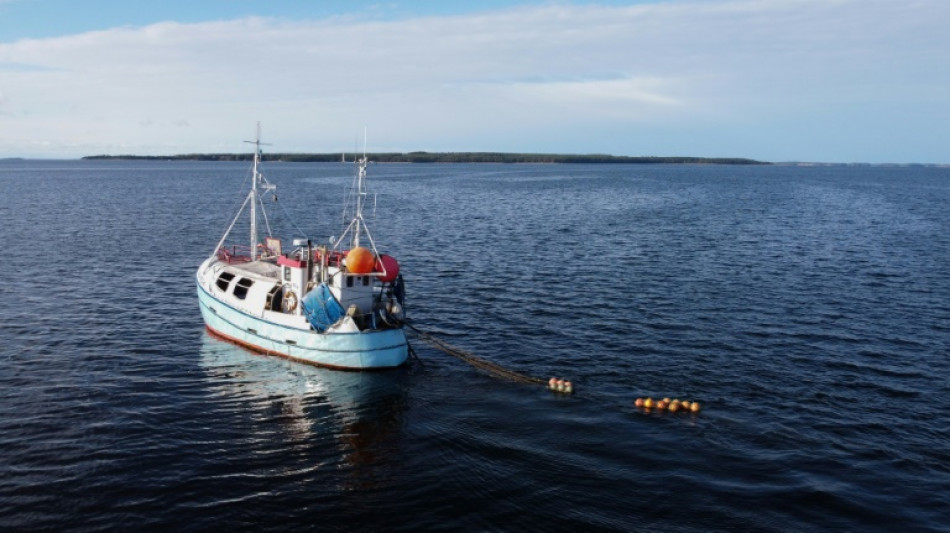
Ailing Baltic Sea in need of urgent attention / Photo: © AFP/File

Decades of pollution and climate change have caused fish to disappear from the Baltic Sea at an alarming rate, with the European Union on Thursday vowing to make the sea an "urgent priority".
Unveiling its road map to protect Europe's seas, the European Ocean Pact, Brussels announced a summit on the state of the Baltic Sea in late September.
The semi-enclosed sea is surrounded by industrial and agricultural nations Germany, Poland, Russia, Finland, Sweden, Denmark and the three Baltic states.
Connected to the Atlantic only by the narrow waters of the Danish straits, the Baltic is known for its shallow, low-salinity waters, which are highly sensitive to the climate and environmental changes that have accumulated over the years.
"Today, the once massive Baltic cod stocks have collapsed, herring stocks in several sub-basins are balancing on critical levels, sprat recruitment is at a record low and wild salmon stocks are in decline," Swedish European MP Isabella Lovin, rapporteur for the EU Committee of Fishing, warned in a report, calling the situation "critical".
- Dead marine zones and climate change -
The Baltic Sea is home to some of the world's largest dead marine zones, mainly due to excess nutrient runoff into the sea from human activities on land -- a challenge the sea has long grappled with.
The runoff has primarily been phosphorus and nitrogen from waste water and fertilisers used in agriculture, as well as other activities such as forestry.
It causes vast algae blooms in summer, a process known as eutrophication that removes oxygen from the water, leaving behind dead seabeds and marine habitats and threatening species living in the Baltic.
Today, agriculture is the biggest source of nutrient pollution.
Marine biodiversity in the relatively small sea has also deteriorated due to pollution from hazardous substances, land use, extraction of resources and climate change, according to the Baltic Marine Environment Protection Commission (HELCOM).
"The state of the Baltic Sea is not good," Maria Laamanen, a senior advisor at the Finnish environment ministry, told AFP.
Climate change poses "a massive additional challenge" for the marine environment, she said.
Of the world's coastal seas, the Baltic Sea is warming the fastest.
A 2024 study said sea surface and sea floor temperatures have increased by 1.8 and 1.3 degrees Celsius respectively in the Finnish archipelago in the northern Baltic Sea, in the period from 1927 to 2020.
The consequences of rising temperatures already affect species, while increased rainfall has led to more runoff from land to sea.
Better waste water treatment and gypsum treatment of agricultural soil, as well as an expansion of protected marine areas in Finland, have had a positive effect on the maritime environment, according to Laamanen, who said environmental engagement had grown in recent years.
"The situation would be much worse without the measures already implemented," she said.
- Fisheries -
In her report, Lovin called for an ambitious reform of fisheries, with stronger attention paid to environmental and climate change impacts.
The report also questioned whether the Baltic could continue to sustain industrial-scale trawling, and suggested giving "priority access to low-impact fisheries and fishing for human consumption".
The head of the Finnish Fishermen's Association (SAKL) Kim Jordas said eutrophication was to blame for the declining fish stocks in the Baltic Sea, not overfishing.
"Looking at cod for example, it is entirely due to the state of the Baltic Sea and the poor oxygen situation," Jordas told AFP.
In Finland, the number of commercial fishermen has been declining, with a total of around 400 active today.
A.Maldonado--TFWP