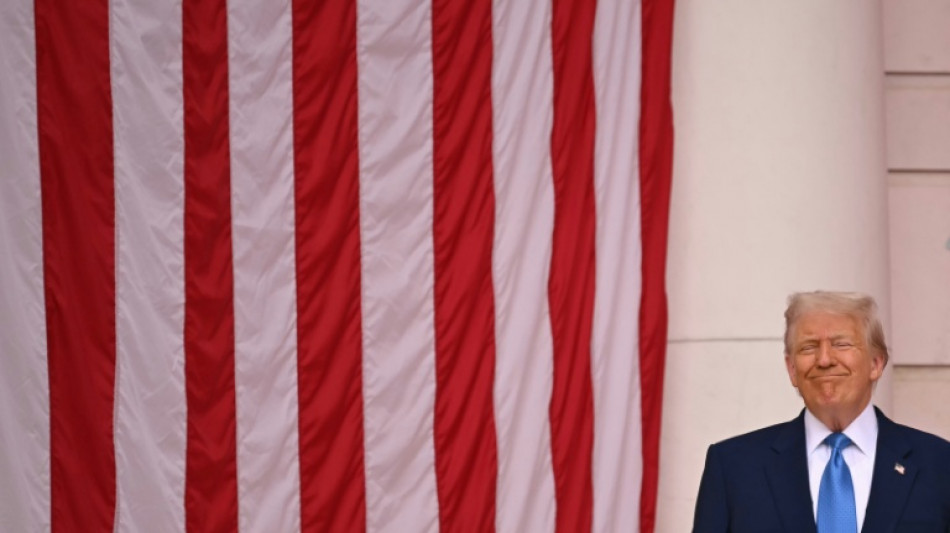
Trump's drive for ocean bed mining threatens law of the sea / Photo: © AFP

US President Donald Trump's move to sidestep global regulations and begin pushing for seabed mining in international waters could pose a wider threat of competing countries claiming sovereignty over the ocean, experts say.
Trump last month signed an executive order to accelerate the permit-granting process for deep-sea mining in domestic and international waters, citing an obscure 1980 US law.
And the Canadian deep-sea mining frontrunner The Metals Company has already filed an application in the United States to conduct commercial mining on the high seas -- bypassing the International Seabed Authority (ISA). This is the body entrusted by a United Nations convention with managing the ocean floor outside of national jurisdictions.
Ocean law is largely guided by that accord -- the United Nations Convention on the Law of the Sea (UNCLOS), first signed in 1982 to prevent "a competitive scramble for sovereign rights over the land underlying the world's seas and oceans," according to Maltese diplomat Arvid Pardo, the convention's forebearer.
The United States never ratified the convention, which took effect in 1994, though it has applied many of its clauses.
Coalter Lathrop, an attorney at the US law firm Sovereign Geographic, told AFP that the United States is "a huge beneficiary of the parallel set of customary international law rules" despite not being a party to UNCLOS.
For instance, the United States has one of the largest Exclusive Economic Zones (EEZ) which gives states sovereignty over maritime areas up to 200 nautical miles (370 kilometers) from their coastline -- protecting them from foreign fishing boats, among other extractive industries.
If the US enjoys the benefits of ocean law, Lathrop argues, "but then you disregard the other part of the package deal -- that the seabed and its minerals in areas beyond national jurisdiction are the common heritage of humankind -- that is going to be destabilizing, to say the least, for the general legal order of the oceans."
"US unilateral permitting could lead to the disintegration of a system that has been carefully curated and created by the United States, largely for its own benefit," he added.
- 'Unraveled' -
The US and Canadian moves sparked an international outcry from ISA member states, including China, whose foreign ministry spokesman warned it violates international law.
ISA secretary general Leticia Carvalho expressed similar concern, saying that "any unilateral action... sets a dangerous precedent that could destabilize the entire system of global ocean governance."
The Metals Company does maintain contracts with ISA members like Japan -- where it has a partnership with smelting company Pamco. And experts note such ISA member states could invoke their obligation to UNCLOS to enforce maritime law on The Metals Company via these proxies, even if it ultimately receives a permit from the Trump administration.
Guy Standing, an economist at the University of London, told AFP: "It's the most dangerous thing he's done so far," referring to Trump.
If marine laws "were to come sort of unraveled," Standing said, "you could have a carve up in different parts of the world, with Russia, China and America carving up the Arctic."
However, not all scholars in the field are in agreement.
James Kraska, a professor of international maritime law at US Naval War College, said "it's naive to think the United States has that kind of influence."
"I just disagree with the people that are saying that it's somehow a legal obligation to comply with a treaty that you never joined," he told AFP.
"I just can't see any way that it's unlawful. I understand that there's sort of political opposition to it, but I would just distinguish between politics and the law."
J.P.Cortez--TFWP