'It's in our blood': how Vietnam adopted the Latin alphabet / Photo: © AFP

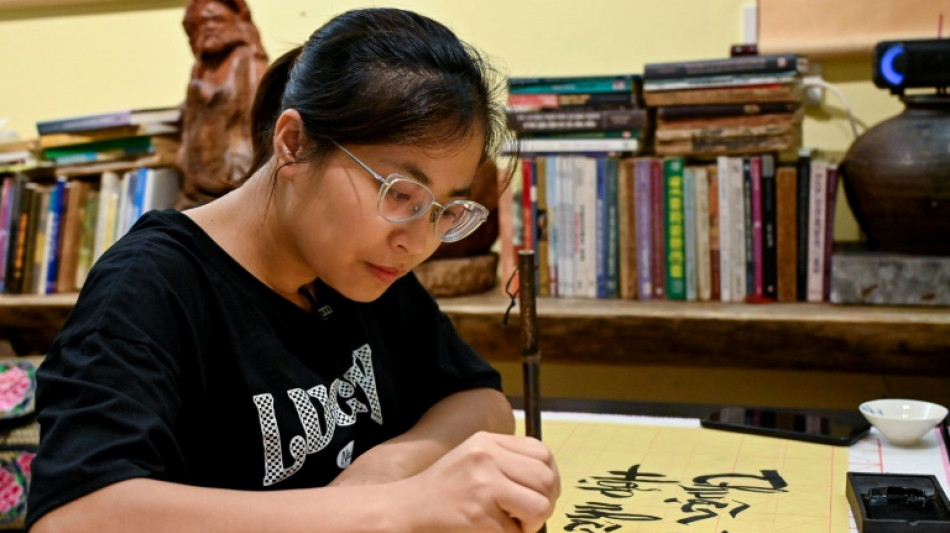
At a calligraphy class in Hanoi, Hoang Thi Thanh Huyen slides her brush across the page to form the letters and tonal marks of Vietnam's unique modern script, in part a legacy of French colonial rule.
The history of romanised Vietnamese, or "Quoc Ngu", links the arrival of the first Christian missionaries, colonisation by the French and the rise to power of the Communist Party.
It is now reflected in the country's "bamboo diplomacy" approach of seeking strength through flexibility, or looking to stay on good terms with the world's major powers.
A month after China's Xi Jinping visited, French President Emmanuel Macron will arrive on Sunday.
Huyen, 35, takes weekly calligraphy classes alongside six others at her teacher's tiny home as "a way to relax after work".
"When I do calligraphy, I feel like I'm talking to my inner self," she told AFP, her head bent in concentration.
- Missionaries, civil servants -
On Monday, Macron is due to visit Hanoi's star attraction, the Temple of Literature, whose walls and explanatory panels are decorated with calligraphy in both traditional Chinese-influenced characters and Quoc Ngu.
Colonisation led to the widespread use of Quoc Ngu -- which uses accents and signs to reflect the consonants, vowels, and tones of Vietnamese -- but it was created two centuries earlier on the initiative of Catholic priests.
When the Avignon-born Jesuit Alexandre de Rhodes published the first Portuguese-Vietnamese-Latin dictionary under his own name in 1651, it was primarily intended for missionaries wishing to spread their religion in what was then called "Dai Viet".
The French then spread the Latin alphabet while training the civil servants who helped them govern Indochina, explained Khanh-Minh Bui, a doctoral student at the University of California, Berkeley, specialising in 19th- and 20th-century Vietnamese history.
Another motive was "severing connections with an older civilisation, which has greatly influenced the elites", in this case China, she said.
- Artistic freedom -
Compared to the characters that had been in use for centuries, Quoc Ngu was far easier to learn.
Its adoption fuelled an explosion in newspapers and publishing which helped spread anti-colonial ideas that ultimately led to the rise of the Communist Party.
"Quoc Ngu carried the promise of a new education, a new way of thinking," said Minh.
When Ho Chi Minh proclaimed independence in 1945, it was "unthinkable" to turn back the clock, she added.
Today, a Western tourist lost in the alleys of Hanoi can read the street names, but would have a hard time pronouncing them correctly without understanding the diacritics used to transcribe the six tones of Vietnamese.
Calligraphy teacher Nguyen Thanh Tung, who has several young students in his class, says he has noticed rising interest in traditional Vietnamese culture.
"I believe that it's in our blood, a gene that flows in every Vietnamese person, to love their traditional culture," he said.
Calligraphy in Quoc Ngu offers more artistic freedom "in terms of colour, shape, idea" than that using characters, he believes.
"Culture is not the property of one country, it's an exchange between regions," added Tung, 38.
"English and French borrow words from other languages, and it's the same for Vietnamese."
M.McCoy--TFWP