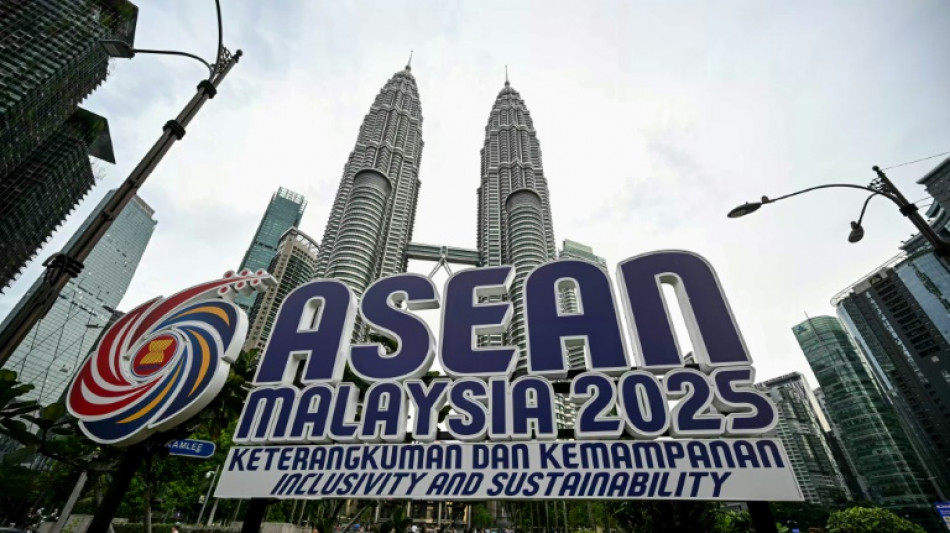
US tariff tensions test Southeast Asian leaders at regional summit / Photo: © AFP

Southeast Asian leaders will express deep concern over US President Donald Trump's tariff blitz when they meet at a summit Monday, warning that the unilateral move posed huge challenges to economic growth and stability in the region, according to a draft statement seen by AFP.
Trump's tariffs has roiled global markets and upended international commerce, and left leaders from the 10-member ASEAN bloc scrambling for ways to limit the fallout on their trade-dependent economies.
The bloc is also caught between the trade battle between their biggest trading partners, the United States and China, on which Washington has heaped the highest tariffs.
According to a draft statement expected to be issued by ASEAN leaders after they meet on Monday, they express "deep concern... over the imposition of unilateral tariff measures".
Trump's measures "pose complex and multidimensional challenges to ASEAN's economic growth, stability, and integration", according to the draft of the ASEAN chairman's statement seen by AFP.
The leaders also "reaffirmed ASEAN's collective commitment" to the global free trading system, it said.
After the bloc's meeting on Monday, the leaders are to hold a one-day summit with China and Middle Eastern oil producers.
The diplomatic dance continues later in the week in neighbouring Singapore, where the Shangri-La Dialogue forum is expected to draw defence chiefs including US Defence Secretary Pete Hegseth, while French President Emmanuel Macron was due to give the keynote speech.
ASEAN, with Malaysia holding its rotating chair this year, has traditionally kept a neutral stance in global power contests but that policy is under strain because of Trump's protectionist moves, analysts say.
Malaysian Prime Minister Anwar Ibrahim has called for a joint ASEAN action plan to address the growing tariff threat.
Anwar said at a pre-summit briefing that, while bilateral talks between member states and the United States would continue, the bloc must present a united front.
"We also have one position as ASEAN in our talks," he said.
The group, Anwar said, "had very practical policies... and what to me is of critical importance is to build that cohesion within ASEAN".
The pressure to shift ASEAN's "friend to all" posture will likely intensify during the follow-up summit on Tuesday when Chinese Premier Li Qiang joins the bloc's leaders and officials from oil-rich Gulf states, observers said.
-'Principled friend' -
Beijing has been courting closer ties with Southeast Asia, positioning itself as a "reliable trading partner" despite tensions with ASEAN members over rival claims in the South China Sea.
Li will attend the first-time summit between ASEAN, Beijing and oil-producing nations including Bahrain, the United Arab Emirates, Qatar and Saudi Arabia.
That follows Chinese President Xi Jinping urging greater cooperation between Beijing and Malaysia "to safeguard the bright prospects of our Asian family" during a Southeast Asian diplomatic charm offensive in April.
Anwar said in return that Malaysia would "remain an unwavering and principled friend to China".
However, anger over US tariffs also meant that ASEAN countries "won't automatically fall in China's arms", a diplomatic source, who asked not to be identified, told AFP.
"It's not a binary situation. ASEAN knows that China is just like the US in that it's a big power which will bully them when it wants to," the source said.
And "while the general consensus is that they are angry at the US... nobody wants to offend Washington either".
James Chin, professor of Asian studies at the University of Tasmania, warned that playing to both the United States and China was a "high-risk strategy".
The danger of staying neutral is "that every single foreign policy action that you take will then be scrutinised" by each opposing power, Chin said.
Others said ASEAN's policy of neutrality remained valid.
"The rest of the world should not have any problem with ASEAN's position to 'be friends with everyone'," said S. Munirah Alatas, a geopolitics specialist at the University of Malaya's Allianz Centre for Governance.
However, she said the bloc still faced tough unresolved challenges, including "hostilities in Myanmar and recurring tensions in the South China Sea".
"But successfully addressing these are not premised on ASEAN's neutral geopolitical position," she said.
S.Jones--TFWP