Germany's infrastructure push needs more than money / Photo: © AFP

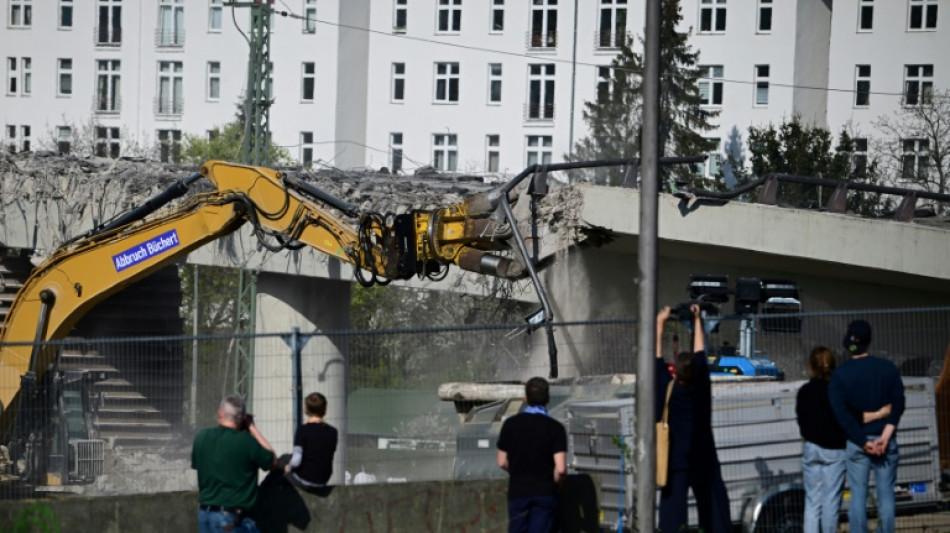
As construction crews using heavy excavators demolished a major highway bridge in Berlin, pensioner Guido, like many Germans, greeted the dusty spectacle with grim satisfaction.
"For once, it was very quick, it took about a month," said the 65-year-old, who only gave his first name, adding that "we're not used to our projects going according to plan".
A crack first appeared a decade ago in a support structure of the concrete and steel bridge built in 1963 that forms part of the capital city's busy A100 ring road.
After the crack recently widened alarmingly, work to take down the bridge finally started in March, leaving piles of rubble below.
Thousands watching the demolition on an internet livestream were happy to see the start of a multi-million-euro renovation project but were upset it took so long.
The case is symptomatic of a problem facing the world's third-biggest economy: an enormous backlog of crumbling infrastructure that needs replacing at a cost of hundreds of billions.
Thousands of roads and bridges, many from the 1960s and 1970s, are reaching the end of their lifespans, and little has been done for years as governments have shied away from major spending.
Germany's new Chancellor Friedrich Merz has pledged to give Europe's top economy a facelift that is also set to include new railway tracks, school buildings and telecom lines.
Even before he took office, his coalition managed to have the previous parliament pass a gigantic 500-billion-euro ($563 billion) infrastructure fund dubbed a spending "bazooka".
- Wake-up call -
After years of fiscal restraint, Germans are crying out for action: an end to patchy mobile phone signals, late trains, slow internet and potholed roads.
A dramatic wake-up call came in September, when a 400-metre-long (1,300-foot-long) bridge collapsed in the eastern city of Dresden, with large sections crashing into the Elbe river.
Luckily it happened overnight, averting a potentially deadly disaster, but the incident made Germany's infrastructure malaise a major election campaign theme.
Germany's bridges need 100 billion euros' worth of repairs and upgrades, according to the European Federation for Transport and Environment (T&E).
Along German motorways and major roads, one third of bridges need to be reconstructed entirely, said the Brussels-based group.
The need is all the more pressing since the last government "embellished" progress, according to a report from the Federal Court of Audit, which found that just 40 percent of bridge renovations planned for 2024 were actually completed.
The new government's fund, intended to be spent over 12 years, should help -- but many local politicians aren't holding their breath.
"Money alone solves nothing," scoffed Steffen Scheller, mayor of the eastern town of Brandenburg an der Havel, an hour's drive from Berlin.
Scheller is hoping for 90 million euros from the fund but said there is another, major problem: "We have a shortage of qualified project managers and engineers."
Bureaucracy can also slow down the process, he said.
A new bridge was built in 2023 over a congested level crossing outside of the city, but has stood unused since. Before it can open, safety barriers must be built.
But the project was pushed back to 2026 after some companies complained that proper procedure had not been followed in the tender process.
- 'Fanciful projects' -
"I've given up all hope of ever using the bridge," said motorist Fransiska, stuck in a traffic jam caused by the closure.
The 38-year-old hospital worker said her commute takes about an hour longer than it used to.
Most of the town's 70 bridges were built back in East Germany's communist days, using substandard steel. Several of them are now closed to heavy goods vehicles, causing problems as they reroute.
Brandenburgers are particularly distraught at the delay in rebuilding a bridge in the town centre that had been promised for 2022.
The delay means "local business really struggles with transport" while the town faces higher pollution, Scheller said.
Benedikt Heyl, author of the T&E report, said Merz had demonstrated "ambition" to tackle the problem.
But Heyl said the new transport minister, Patrick Schnieder, should do better than renovate the 4,000 bridges he has promised by 2030.
Merz should put "fanciful projects" for new motorways on pause, Heyl said, and work on the basics, such as making sure construction companies have long-term contracts that allow them to plan for the future.
First of all, he said, the central government must take a thorough stocktake of the scale of the problem.
"The data is often very poor," Heyl said. "Local authorities often know how bridges are doing. But nobody has an overview at the national level."
J.Barnes--TFWP