EU to lay out plan to cut last Russian gas supplies / Photo: © AFP/File

The EU on Tuesday is due to unveil a keenly anticipated plan to phase out its remaining gas ties to Moscow, a challenge given Europe's longstanding dependence on Russian fossil fuels.
EU energy chief Dan Jorgensen will set out the measures, which were delayed as Brussels waited to see whether talks between Russia and the United States yielded a deal to end the war in Ukraine.
Responding to Moscow's attack on its neighbour, the European Union enacted a ban on Russian oil in late 2022 and has since sought to wean itself off Russian gas supplies.
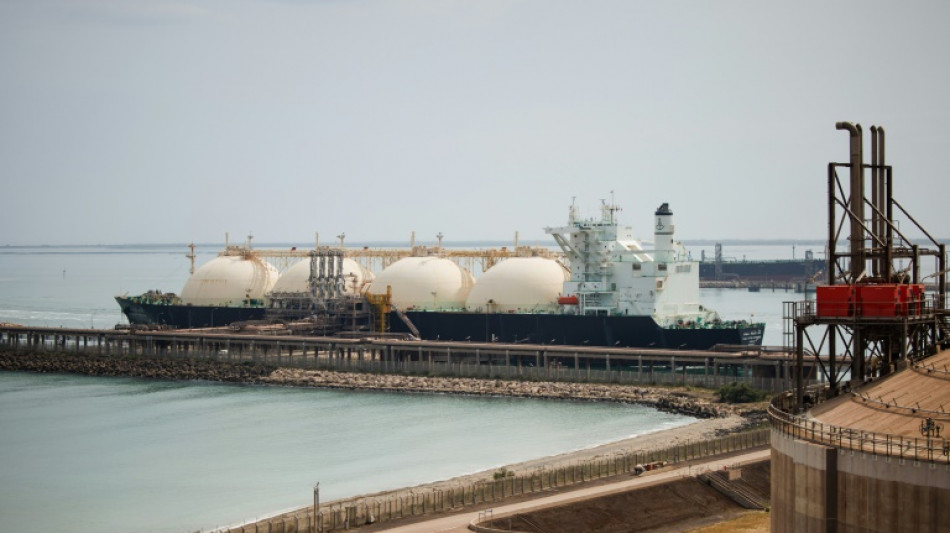
Although imports via pipeline have fallen sharply, several European countries have increased their purchases of Russian liquefied natural gas (LNG), transported by sea, and the bloc now wants to turn the tap off completely.
That would pave the way for Europe to buy more LNG from the United States -- something both Brussels and Donald Trump have floated as a way to resolve the standoff sparked after the US president targeted European exports with tariffs.
EU trade chief Maros Sefcovic told The Financial Times that the dispute could be resolved "very quickly" through LNG and soybean purchases -- as a way to reduce the 27-country bloc's trade surplus with its US partner.
The United States is already the bloc's largest LNG supplier, making up 45.3 percent of the market, with Russia supplying 17.5 percent based on EU data, and as much as 19 percent according to the Institute for Energy Economics and Financial Analysis (IEEFA).
To do without Russian energy, "the guiding principle is diversification", European Commission chief spokeswoman Paula Pinho said last week.
- 'Very difficult' -
But phasing out Russian energy is easier said than done, EU officials acknowledge, as some member states are more dependent on Moscow's LNG than others, while others like Hungary have friendly ties with the Kremlin.
France for example would face a heavier impact from any move away from Russian LNG since it has five terminals for its delivery in Europe.
France increased its Russian LNG imports by 81 percent between 2023 and 2024, giving Russia 2.68 billion euros ($3 billion) in income, according to the Institute for Energy Economics and Financial Analysis.
A key question is whether the EU's roadmap will propose a Russian LNG ban in the long term.
"The option might be very difficult to pursue given the unanimity requirement", which means all 27 member states must back such a ban, said Simone Tagliapietra of the Bruegel think tank.
"Given this constraint, applying a tariff on all imports of Russian gas (both pipeline and LNG) might be the most viable option for the EU," he said, since that would not require unanimity.
But Yvan Verougstraete, a centrist lawmaker who follows the energy file in the EU parliament, nonetheless expects the commission could propose phasing out Russian gas entirely by 2027.
The commission has highlighted its efforts to reduce dependence on Russian fossil fuels since the 2022 invasion of Ukraine.
Over a few years, "we went from 45 percent of our gas imports coming from Russia, down to 18 percent. We went from one-in-five barrels of oil down to one-in-fifty, a tenfold reduction", EU chief Ursula von der Leyen said last month.
But, she admitted, "we all know that there is so much more to do".
G.George--TFWP