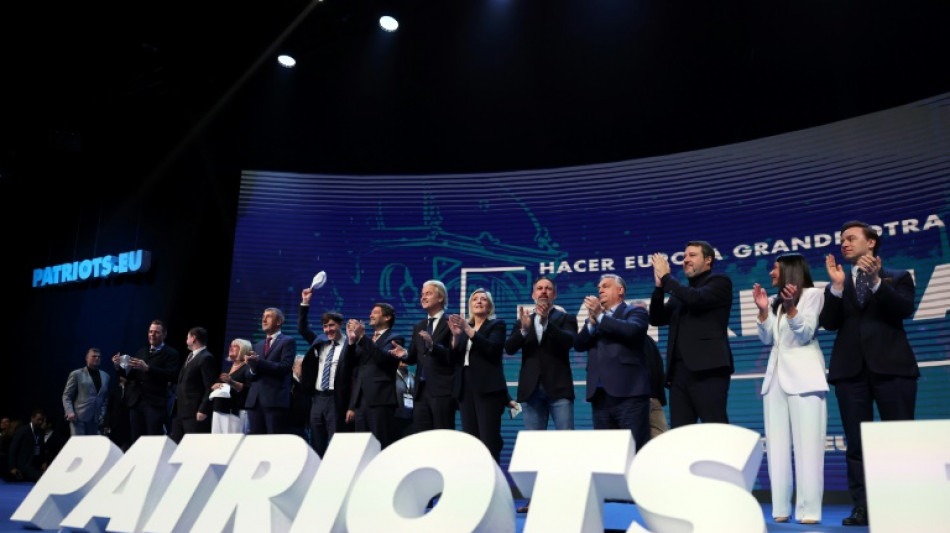
Europe far-right surge masks divisions / Photo: © AFP

Hard-right and far-right parties are riding high in polls across Europe but their electoral success conceals divisions which could become major sources of tension if they win power, according to analysts.
Against the background of US President Donald Trump's first 100 days in office, far-right parties in Europe are in power in some countries, support incumbent governments in others and are mounting serious challenges elsewhere.
But their policies can be strikingly different on issues ranging from the economy to Ukraine and even on traditional far-right causes like immigration and social rights.
In Italy, Prime Minister Giorgia Meloni, leader of the post-fascist Brothers of Italy party, has emerged as a key player in the European Union, while Hungarian Prime Minister Viktor Orban and his Slovak counterpart Robert Fico continue to sow trouble within the bloc.
The leader of the anti-immigration Reform UK party Nigel Farage is still riding a wave that helped force Britain's exit from the EU in a 2016 referendum, with polls putting it level or even ahead of the Labour government.
In Sweden, the far-right Sweden Democrats prop up a right-wing government while in France polls project the far-right coming first in the first round of the presidential election, regardless of whether Marine Le Pen stands or her protege Jordan Bardella takes part due to her conviction.
- 'Pure political expediency' -
"The common ground is the rejection of immigration and a certain vision of national identities in each country. But as soon as we move away from that, we tend to have differences," Mathieu Gallard, research director at France's Ipsos institute, told AFP.
In a sign of discord, the EU parliament has three separate far-right groups -- Patriots for Europe, Europe of Sovereign Nations and the European Conservatives and Reformists (ECR).
Following Russia's February 2022 full-scale invasion of Ukraine, the issue of relations with the Kremlin has become particularly thorny.
After displaying its strong sympathy for Vladimir Putin even in the wake of the annexation of Crimea in 2014, France's National Rally (RN) of Le Pen has tried to convince people of its independence from Moscow since the invasion.
Conversely, in Hungary and Slovakia, Orban and Fico have openly demonstrated their closeness to the Kremlin and oppose military aid for Ukraine.
In Romania, the leading candidate in the November 2024 presidential election, Calin Georgescu, expressed similar views. The election was annulled by the Romanian Constitutional Court due to Russian interference, with Georgescu disqualified from running the repeat poll in May.
"It's a matter of pure political expediency: the most powerful parties, or those with a chance of coming to power, have no interest in dwelling on the issue too much," said Gallard.
Meloni, for instance, has confounded doubters by emerging as a staunch ally of Kyiv, "but her priority is to be well-regarded by European institutions, which means she cannot be ambiguous", he said.
On the economy, Meloni and Germany's Alternative for Germany (AfD) -- which won 20.8 percent in February's national elections -- espouse an unabashedly liberal stance.
They echo Argentina's President Javier Milei, who famously brandished a chainsaw to symbolise public spending cuts, but are at loggerheads with France's RN on state intervention in the economy.
Le Pen, a three-time presidential candidate, has made state interventionism one of the pillars of her platform.
Differences also exist on gender equality or the rights of gender and sexual minorities.
Le Pen's party approved the inclusion of the right to abortion in the French constitution, refused to join protests against same-sex marriages and, like the Dutch Party for Freedom (PVV) of Geert Wilders which won 23.5 percent in a 2023 legislative election, avoided wading too far into debates over culture war issues.
But their counterparts in eastern and southern Europe have made such conservative values a point of principle.
- Dialogue appears possible -
Even migration is a source of division, with the far right in Austria, Germany and Sweden talking about removing migrants and even nationals deemed "poorly assimilated" -- something the French RN opposes.
Some far-right parties in Europe have actively rejected accusations of anti-Semitism and distanced themselves from their World War II collaborationist pasts, especially after the attacks by Palestinian militants Hamas on Israel of October 7, 2023.
The RN under Le Pen, who has sought to eradicate the legacy of its openly anti-Semitic founder Jean-Marie Le Pen, her father, has portrayed itself as a friend of Israel.
Bardella went to Israel for an anti-Semitism conference this year.
But in Hungary, Orban has attacked the Hungary-born Jewish philanthropist George Soros in campaigns which critics say have anti-Semitic overtones. And even in Germany AfD representatives have on occasion made comments seen as anti-Semitic.
For Catherine Fieschi, a researcher at the Robert Schuman Centre at the European University Institute of Florence, the divide between pro- and anti-Russian far right factions could fade following Trump's return to the White House.
"The Atlanticists are going to be stuck, since they find themselves with an American president who is pro-Putin," she said.
While the divergence in positions towards the Kremlin was one of the main obstacles to the formation of a single far-right group in the European Parliament, dialogue appears possible again, she said, as "choosing Trump will mean choosing Putin".
M.T.Smith--TFWP