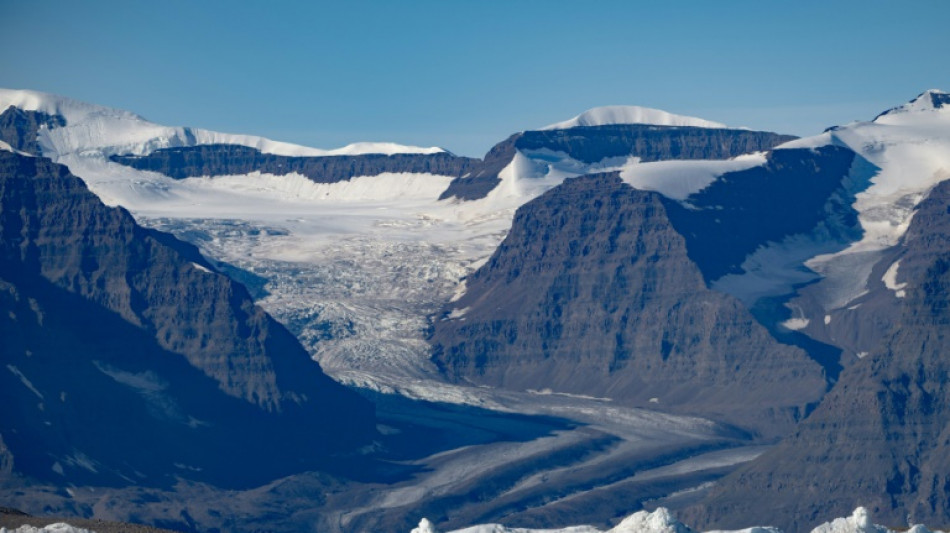
World's glacier mass shrank again in 2024, UN says / Photo: © AFP/File

All 19 of the world's glacier regions experienced a net loss of mass in 2024 for the third consecutive year, the United Nations said Friday, warning that saving the planet's glaciers was now a matter of "survival".
Five of the last six years have seen the most rapid glacier retreat on record, the UN's World Meteorological Organization said on the inaugural World Day for Glaciers.
"Preservation of glaciers is a not just an environmental, economic and societal necessity: it's a matter of survival," said WMO chief Celeste Saulo.
Beyond the continental ice sheets of Greenland and Antarctica, more than 275,000 glaciers worldwide cover approximately 700,000 square kilometres (270,000 square miles), the WMO said.
But they are rapidly shrinking due to climate change.
"The 2024 hydrological year marked the third year in a row in which all 19 glacier regions experienced a net mass loss," the WMO said.
Together, they lost 450 billion tonnes of mass, the agency said, citing new data from the Swiss-based World Glacier Monitoring Service (WGMS).
It was the fourth-worst year on record, with the worst being in 2023.
- Huge loss over 50 years -
"From 2022-2024, we saw the largest three-year loss of glaciers on record," Saulo said.
Glacier mass loss last year was relatively moderate in regions such as the Canadian Arctic and the peripheral glaciers of Greenland, but glaciers in Scandinavia, Norway's Svalbard archipelago and North Asia experienced their worst year on record.
Based on a compilation of worldwide observations, the WGMS estimates that glaciers -- separate from the continental ice sheets in Greenland and Antarctica -- have lost more than 9,000 billion tonnes since records began in 1975.
"This is equivalent to a huge ice block of the size of Germany with a thickness of 25 metres," said WGMS director Michael Zemp.
At current rates of melting, many glaciers in western Canada and the United States, Scandinavia, central Europe, the Caucasus and New Zealand "will not survive the 21st century", the WMO said.
The agency said that together with ice sheets, glaciers store around 70 percent of the world's freshwater resources, with high mountain regions acting like the world's water towers. If they disappear, that would threaten water supplies for millions of people downstream.
- 'Ignoring the problem' -
For the UN, the only possible response is to combat global warming by reducing greenhouse gas emissions.
"We can negotiate many things in the end, but we cannot negotiate physical laws like the melting point of ice," said Stefan Uhlenbrook, the WMO's water and cryosphere director.
He declined to comment on the return to office of US President Donald Trump, a climate change sceptic who has pulled the United States out of the landmark 2015 Paris climate accords.
However, Uhlenbrook said that "ignoring the problem" of climate change "is maybe convenient for a short period of time", but "that will not help us to get closer to a solution".
For the inaugural World Day for Glaciers, the WGMS named a US glacier as its first Glacier of the Year.
The South Cascade Glacier in Washington state has been monitored continuously since the 1950s and provides one of the longest uninterrupted records of glaciological mass balance in the western hemisphere.
The US Geological Survey, the government body that studies the natural environment, has measurements there going back to 1958, while WGMS's records there began even earlier, in 1952.
J.P.Cortez--TFWP