Spurred by Trump turnabout, European nations debate conscription / Photo: © AFP

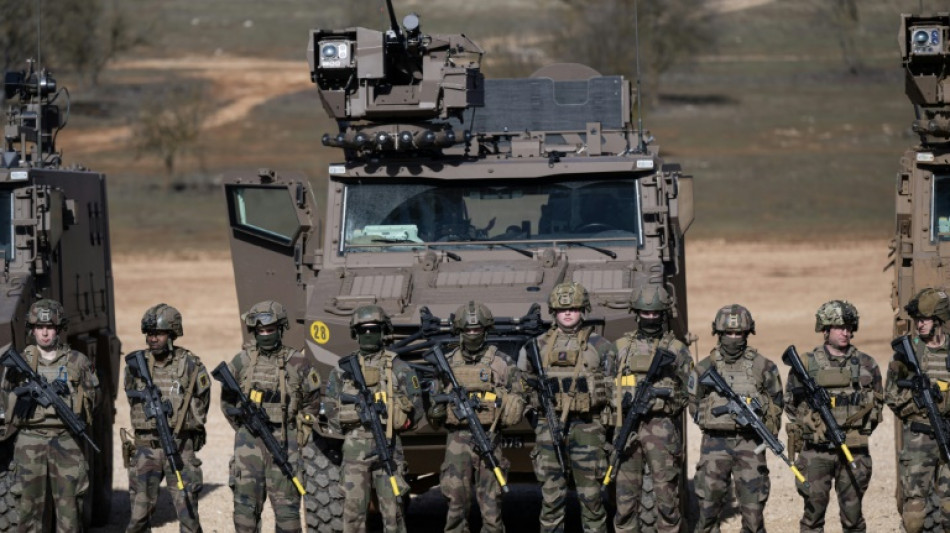
Frightened by the prospect of US security disengagement and three years of Moscow's war against Ukraine, European countries are debating reinstating compulsory military service to boost their defences in the face of Russian aggression.
Russian leader Vladimir Putin's invasion of Ukraine in 2022 caught Europe off guard, and fears about the strength of NATO surged further after US President Donald Trump upended the transatlantic alliance, saying Europe must take care of its own security.
Both military analysts and European governments acknowledge that the threat of Russian aggression is real, today even more so than three years ago.
"The Russian military today is larger and better than on February 24, 2022. The Russians have hostile intent against the Baltic states and the EU's eastern flank," said Alexandr Burilkov, a researcher at the Institute of Political Science (IPW) at Heidelberg University.
According to a study Burilkov co-authored for think tank Bruegel and the Kiel Institute, Europe could need 300,000 more troops to deter Russian aggression, in addition to 1.47 million active-duty military personnel.
"Conscription would have to play a role in any such large numbers of new troops," he said.
From Paris to Warsaw, leaders have been looking to boost defence spending in the face of US threats to withdraw its European security guarantees.
But many countries, including France and Britain, have struggled with recruiting and retaining troops. Reintroducing some form of national service -- compulsory or voluntary -- might be even more difficult.
According to a YouGov poll, most people in France (68 percent) and Germany (58 percent) support mandatory military service for young people. Italian and British people are divided, while a majority of Spaniards (53 percent) are against it.
But studies also show that many Europeans are not prepared to defend their countries on the battlefield.
"In a liberal society, the imposition of military constraints has become nearly impossible to implement," said Benedicte Cheron, a French expert who studies links between society and the armed forces.
"As long as there is no invasion of the territory, accepting the political costs of imposing sanctions on those who do not comply with the call-up seems unthinkable."
- 'Incentives' -
After the Cold War, most European countries ended compulsory conscription. Just nine countries -- Greece, Cyprus, Austria, Switzerland, Denmark, Estonia, Finland, Norway and Turkey -- never suspended it.
Lithuania reintroduced conscription in 2015, a year after Russia annexed Crimea. Sweden followed suit in 2017 and Latvia in 2023.
But mindful of political and economic costs, most of NATO's five biggest European spenders -- France, Germany, the UK, Italy and Poland -- are not planning to make participation in armed forces mandatory.
But Poland, which ended conscription in 2008, recently announced plans to offer military training to 100,000 civilians a year, starting in 2027. The scheme will be voluntary but the authorities are planning a system of "motivations and incentives", said Prime Minister Donald Tusk.
Germany's likely future chancellor, Friedrich Merz, has said he favours the reintroduction of a compulsory year in which young people could perform either military or community service.
In Britain, the last national servicemen were demobilised in 1963 and the government does not plan to reverse course.
"We're not considering conscription, but, of course, we've announced a major increase in defence expenditure," said Cabinet Office minister Pat McFadden.
In France, where compulsory military service ended in 2001, President Emmanuel Macron has been looking for ways to encourage young people to serve.
In comments to reporters published Saturday, he said France no longer had the "logistics" to re-introduce compulsory service, but he wanted to "look at ways to mobilise civilians" and would be making an announcement in the coming weeks.
Reintroducing national service "would mean transforming a large part of the army into training centres", said French military historian Michel Goya.
In Italy, Defence Minister Guido Crosetto has ruled out reintroducing national service but spoken in favour of a reserve force.
- 'East-wide divide' -
Researchers say Western European politicians should learn from Nordic and Baltic countries, particularly Finland and Sweden.
Finland, which shares a long border with Russia and was invaded by the Soviet Union in 1939, has one of the largest reserve forces in Europe.
"The east-west divide is still a problem. Few people in western Europe are willing to fight," said Burilkov. Convincing Europeans to volunteer would require advocacy campaigns, he said.
"There is also a relationship between whether people see the war as winnable and whether they want to serve, so dramatically improving European military capabilities will make people more confident in them."
Goya said Europeans had been suddenly struck by their vulnerability.
"It's only when the tide goes out that you learn who's been swimming naked," he said.
"The American sea is receding, and many European countries are saying to themselves that yes, in the end, they are a little bit exposed."
burs-dla-as/sjw/yad-jj/sco
T.M.Dan--TFWP