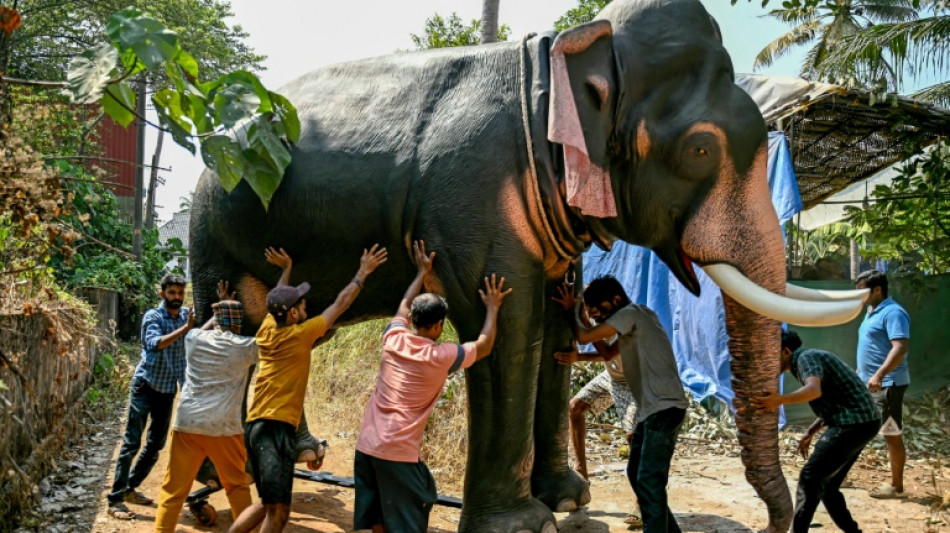
Model behaviour: India's anti-cruelty robot elephants / Photo: © AFP

It flaps its ears and squirts water from a waving trunk, but this elephant is a life-size mechanical replica rolled out to replace the endangered animals in India's Hindu temples.
Made of fibreglass and rubber, and trundling on a wheeled metal frame strong enough to hold a rider, the model is one of dozens that animal rights campaigners are trumpeting as an alternative to keeping elephants in captivity in India.
Elephants are used during many Hindu temple ceremonies, paraded through packed crowds with flashing lights, thumping drums and ear-splitting music.
Deadly attacks by panicked pachyderms are common.
"It is a wild animal, it likes to live in jungles," said C.G. Prakash, 68, a former official at the popular Chakkamparambu Bhagavathy temple in India's southern Kerala state.
"We are capturing it and torturing it. It's totally unethical".
Prakash was instrumental in bringing the robot elephant to the temple.
It was donated by the Voice for Asian Elephants Society, which said it would aid "cruelty-free temple traditions".
- 'Remain with their families' -
Campaigners from the People for the Ethical Treatment of Animals (PETA) India say the more than 2,700 captive elephants in the country often face "severe physical and psychological stress".
Despite being herd animals, they are often kept alone and chained up for much of the day.
PETA has funded more than a dozen models since 2023, donated on the condition that temples move their elephants to approved sanctuaries.
"Mechanical elephants help retain age-old traditions in a modern way," said PETA's Khushboo Gupta.
"They help ensure real elephants can remain with their families in their natural jungle habitats".
Like the real thing, models are draped with a golden headdress and bedecked with flower garlands.
Modelmakers say a luxury version -- complete with electric motors powering a nodding head, rolling eyes and a lifelike swishing tail -- can cost more than $5,500.
Professional model maker Prasanth Prakasan, 42, said he and three friends began making elephant models as an art project, but are pleased they are now helping protect real animals.
"What we are doing is saving elephants, and we are happy about it," he said.
The team has made nearly 50 such elephants -- with a production line at the workshop building several more.
For those keen on an elephant at their wedding, models can be rented without the cumbersome permits required for a costly real one, he pointed out.
- 'Exploited' -
Accidents involving spooked elephants trampling crowds are common and some temples switching to models cite the safety of their worshippers.
In February alone, PETA recorded incidents in Kerala involving nine captive elephants losing control, with five people killed.
In one, an elephant at a festival was spooked by fireworks, jabbed its companion with a tusk and triggered a stampede that killed three people and injured dozens.
"Those who take care of them, many don't follow the rules", said V.K. Venkitachalam, 60, from the Heritage Animal Task Force rights group.
Animal welfare is also gaining growing attention.
In November, Kerala's High Court issued guidelines for the better treatment of captive elephants.
"Their use is often sought to be justified on the touchstone of tradition and religious practice," the court wrote.
But "animals are being commercially exploited without any care or concern for their well-being", it said.
The guidelines were later stayed by the Supreme Court saying guidelines were impractical.
- 'Non-violence' -
There are fewer than 50,000 Asian elephants in the wild, according to the World Wildlife Fund, the majority in India, with others in Sri Lanka and Southeast Asia.
The species is endangered, according to the International Union for Conservation of Nature.
As elephant habitats shrink, conflict between humans and wild elephants has grown -- 629 people were killed by elephants across India in 2023-2024, according to parliamentary figures.
Over the same period, 121 elephants were killed -- the vast majority by powerful electric fences, as well as by poaching, poisoning, and being hit by trains.
For animal rights activists, the model elephants are a safe solution that fits with religious principles.
"This initiative honours ahimsa, or non-violence, a tenet of Hinduism", PETA's Gupta told AFP.
Among some worshippers, the placid models are a relief.
"When it is a live elephant, there's a fear amongst us. What if it runs amok?" 58-year-old teacher Jayasree Sivaraman Narayaneeya said.
"Since it's a robotic elephant, we feel much safer."
T.Gilbert--TFWP