For world's poorest, fears for long-term setbacks after Trump aid cut / Photo: © AFP/File

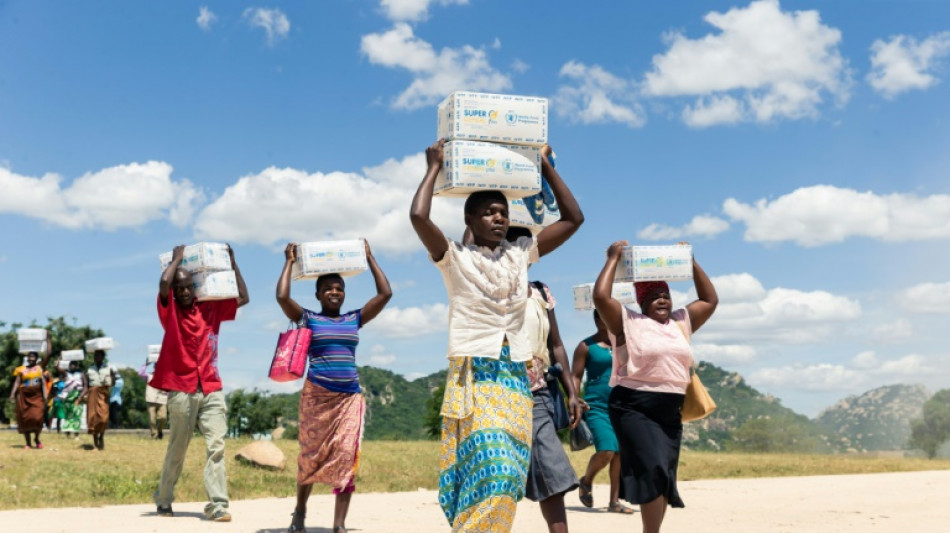
In Uganda, millions of schoolchildren have benefitted from a universal education program backed by the United States. In South Sudan, US assistance has helped thousands of flood victims at risk of cholera.
With one swoop of the pen, President Donald Trump froze the bulk of US foreign assistance for three months on returning to office, demanding a review to ensure all money meets his "America First" principles.
The Trump administration has since issued waivers for food and other humanitarian aid. But aid workers say uncertainty reigns -- and that the impact is already being felt by some of the world's most vulnerable.
Even if US assistance returns after the 90-day review, aid workers fear long-term consequences from the cutoff, and some observers see a lasting blow to US credibility as China and other powers woo the developing world.
"Even if the funding eventually turns back on, great damage will have been done," said Peter Waiswa, an accountant in Kamuli, Uganda who coordinates aid as part of a network known as the Compassion Connectors.
"Missing drugs for days for the HIV/AIDS patients can cause death," he said.
Waiswa said that some schools in the universal education program that relied on US assistance have already given notices for children not to report to school.
In Aweil in the northern reaches of impoverished South Sudan, orphanage teacher James Akoon Akot said that 3,000 people who lost their homes in floods were promised relief by international groups backed by US assistance.
"The problem is that aid is used for both immediate relief and reconstruction," he said.
"If this decision to cut off funds is not reconsidered soon, there is a very real possibility that people will begin to die of hunger and diseases in South Sudan," he said.
- Uncertainly reigns -
The United States has long been the world's largest provider of development aid, giving $64 billion in 2023.
Among its most prominent programs is PEPFAR, the anti-HIV/AIDS initiative started under former president George W. Bush that is credited with saving some 26 million lives.
Secretary of State Marco Rubio in a memo signed on January 24 froze all US assistance with waivers for "emergency food" and, outside of development, weapons for Israel and Egypt.
In a follow-up memo, he exempted other humanitarian assistance including shelter and medicine, appearing to give the greenlight for anti-retroviral drugs funded by PEPFAR.
But Suzy Dzimbiri, a nurse in Zumba, Malawi, said she heard of people stockpiling whatever medicine they can and that one local charity that administered HIV/AIDS treatment, named Lighthouse, quickly closed down.
In Washington, a congressional aide who follows humanitarian assistance said that even a nine-day shutdown in theory affects one million daily doses of HIV/AIDS medication -- and that guidance was still murky.
"It sounds like people expect PEPFAR to go ahead, but we have nothing in terms of specifics," the aide said.
"We do know of cases where there has been medicine sitting on the shelf and ready to go and that it's been ordered to stay on the shelf" pending guidance from Washington, the aide said on condition of anonymity.
"PEPFAR was supposed to be our Marshall Plan. The idea that we would just flip a switch and it would all turn off shows us to be capricious -- we don't actually care -- and that going forward they probably do need to look to countries like China," the aide said.
- 'We don't want to see people die' -
Explaining his decision to issue further waivers, Rubio said, "We don't want to see people die and the like."
But he said that the waiver process was rightfully forcing groups to justify spending as "historically we've gotten very little cooperation."
"We have this thing that I've called the foreign aid industrial complex -- all of these entities around the world that are getting millions and millions of dollars from the United States," Rubio said in an interview with SiriusXM.
"We have to make sure that it's aligned with our national interest."
A senior official from a US-based organization feared that the priority on "emergency" assistance was part of a broader plan to say eventually that the United States need not fund anything else.
"Even the term 'emergency food' is a contradiction in terms. You go without food for a few days, and I'll tell you what emergency food looks like," said the official, who requested anonymity so as not to upset US government contacts.
The official said that the most affected by the cutoff were local groups that did not have financial reserves -- exactly the types of organizations that US officials want to build up.
"This is essentially like burning down the foundations with the professed aim of renovating your house."
M.Cunningham--TFWP