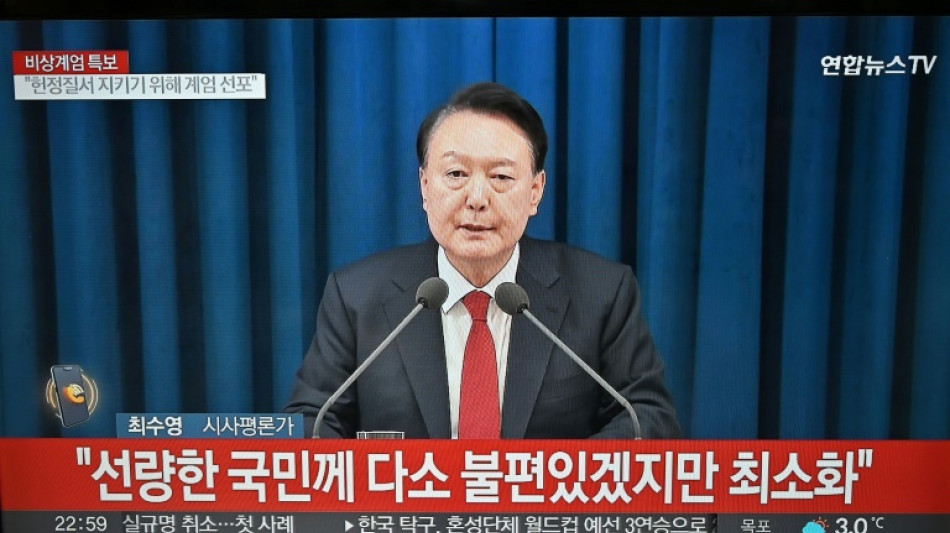
What we know about South Korea's martial law / Photo: © AFP

South Korea's President Yoon Suk Yeol on Tuesday declared martial law, blasting the opposition as "anti-state forces" threatening the country's democracy.
The unexpected move from Yoon -- the first time martial law has been declared in South Korea in more than four decades -- has alarmed the United States and the country's other allies.
What do we know about the imposition of martial law, and what might come next?
- What was the declaration? -
In a dramatic, late-night emergency television address to the nation, Yoon announced that he was imposing martial law in South Korea, as he accused the opposition of paralysing the government with "anti-state activities".
A six-point decree from the new martial law commander, army chief General Park An-su swiftly followed, banning political activities and parties, "false propaganda", strikes and "gatherings that incite social unrest".
The order also brings all media outlets under the authority of martial law and directs all medical staff, including striking doctors, to return to work within 48 hours.
- What happened at parliament? -
Security forces sealed the National Assembly, helicopters landed on the roof and troops entered the building for a short time, seemingly in a bid to prevent lawmakers from getting inside.
But 190 lawmakers managed to enter and voted unanimously to reject Yoon's declaration and call for martial law to be lifted.
Outside, hundreds of protesters gathered, many raising chants calling for Yoon to be arrested.
- What happens next? -
Under South Korea's constitution, the parliamentary vote to lift martial law has to be respected -- but it is not immediately clear whether this will happen.
Military officials said that despite the vote, martial law would remain in place until Yoon himself lifted it, according to local media reports.
This sets up potentially explosive standoff between parliament on one side and Yoon and the military on the other.
- Why did Yoon do this? -
Yoon said he was acting to safeguard his country's liberal democracy from "anti-state elements" and "threats posed by North Korea" -- but gave little detail.
While unexpected, the announcement came in the context of a festering budget row between Yoon and the opposition Democratic Party.
The opposition has slashed around 4.1 trillion won ($2.8 billion) from Yoon's proposed 677 trillion won budget for next year, prompting the president to complain that "all key budgets essential to the nation's core functions" were being cut.
"What is clear is that Yoon has been a deeply unpopular, ineffectual leader and he is having a hard time getting any kind of public support for anything he’s trying to do," said Alan Yu, a former US diplomat in Asia now at the Center for American Progress.
"The use of martial law feels almost like a desperation move to try to break out, both in a political and policy sense, but it is really poorly played on both fronts."
- What has the reaction been? -
South Korea is a key Western ally in Asia, seen as an important democratic bulwark in a region dominated by authoritarian regimes, and the drama is being watched with concern.
Washington voiced "grave concern" about the situation and called for it to be resolved "peacefully and in accordance with the law", while Britain said it was "closely monitoring".
China, a key ally of nuclear-armed North Korea, urged its citizens to exercise caution, while Russia -- itself increasingly close to Pyongyang -- called the situation "alarming".
burs-pdw/kma
G.Dominguez--TFWP