'A chance to survive': Ukraine's fortress steel mills / Photo: © AFP

Food and water stockpiles, generators, toilets, stacks of mattresses and even wood-burning stoves in bunkers deep underground -- the Soviets built this Ukrainian steelworks with war in mind.
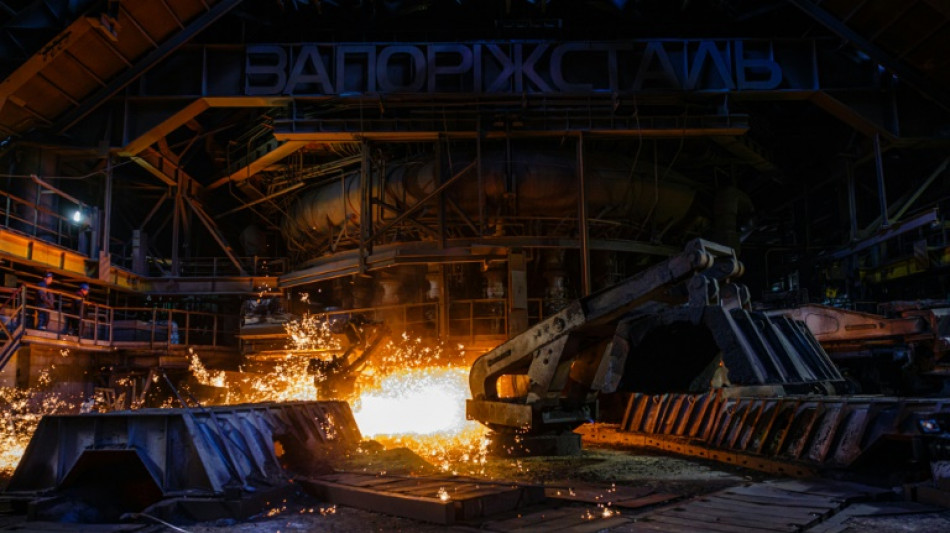
A sister plant of the Azovstal mill that's the last redoubt of Ukrainian forces in the port city of Mariupol, the Zaporizhstal factory shows how these Stalin-era sites are designed to defy Russia's invasion.
"We can stay in the shelters for a long time," said Zaporizhstal employee Ihor Buhlayev, 20, in his hooded silver safety gear as molten metal flowed and sparked behind him. "I think it will give us the chance to survive."
Buhlayev's workplace in the southern city of Zaporizhzhia was not taken in Russia's internationally condemned attack, though the plant had to halt operations as the front drew dangerously closer.
The bunkers underneath the giant Azovstal and Zaporizhstal plants were built in the early 1930s, when the world recovered from one war while plodding towards another, and they are intended to shelter thousands of workers.
Both plants are under Metinvest Holding, which is controlled by Ukraine's richest man Rinat Akhmetov.
There are 16 bunkers at the Zaporizhstal works, and the one AFP visited was about 10 metres (about 30 feet) underground and protected by a roughly 10 centimetre-thick blast door.
The long, brightly lit room has rows of wooden benches and is supposed to be able to hold 600 people.
Tanks of water can flush the toilets, emergency food and bottled water are stacked in a storage room, and there are chest-high stacks of firewood for the oil barrel-sized metal stove.
- Another kind of war -
The bunkers under Azovstal sheltered hundreds of civilians, many of whom left the site in an international rescue operation, and still offer refuge for the holdout forces resisting full Russian control of Mariupol.
"God forbid we find ourselves in a situation like our colleagues from Azovstal, metalworkers like us, who ended up staying for so long (in the shelter)... I wouldn't wish that on anyone," Alexander Lotenkov, communications department head, said inside the bunker.
Above that shelter, the roughly 5.5-square-kilometre site has about half the footprint of Azovstal but is still massive and the only way to efficiently get between its units is on a vehicle with wheels.
The size of the site is one thing, but the sheer number of places to hide among rows of buildings and tunnels below the site, as well as observation posts from its tall structures, is another.
But war, in this case, has not been good for business.
Reduced operations have been back up and running since the beginning of April, the same period when the Russians were forced by fierce Ukrainian resistance to retreat from areas around Kyiv.
Some good news came this week with an American announcement to suspend tariffs on Ukraine-made steel, but the situation is still dire.
Ukraine accounts for only about one percent of US steel imports, according to American authorities, who had imposed the 25 percent protective tariff, and logistics is a major challenge for Ukrainian exporters with the usual transport routes shattered by the war.
"We won't be able to compete with other producers, because their logistic expenses are lower and for us to export to the US we need now to get our production from Zaporizhzhia to Poland," the site's general director Alexander Mironenko told AFP.
Steel exports have plunged to a fraction of their pre-war levels and getting back up to speed and to market will be key for the Ukrainian economy.
"It was one of the primary export-oriented industries in Ukraine and around 50 percent of foreign currency income was generated by the metallurgical and mining sectors of Ukraine," Mironenko added.
F.Garcia--TFWP