The Fort Worth Press - Fuel shortages a bitter pill for Cuba's sugar cane producers

USD -
AED 3.672504
AFN 64.503991
ALL 81.046102
AMD 360.780113
ANG 1.789785
AOA 917.000367
ARS 1523.143125
AUD 1.433486
AWG 1.8025
AZN 1.70397
BAM 1.745704
BBD 2.012675
BDT 123.586379
BGN 1.747831
BHD 0.377114
BIF 2995.403222
BMD 1
BND 1.277279
BOB 11.766859
BRL 4.965204
BSD 0.999331
BTN 94.818583
BWP 13.766234
BYN 2.934172
BYR 19600
BZD 2.009729
CAD 1.40025
CDF 2316.000362
CHF 0.825078
CLF 0.025212
CLP 986.459589
CNY 6.67805
CNH 6.670604
COP 3171.419646
CRC 456.018209
CUC 1
CUP 23.982684
CVE 98.420137
CZK 21.719504
DJF 177.944392
DKK 6.67165
DOP 61.293346
DZD 134.335699
EGP 55.079216
ERN 15
ETB 162.538225
EUR 0.89267
FJD 2.237204
FKP 0.747807
GBP 0.747692
GEL 2.590391
GGP 0.747807
GHS 11.586558
GIP 0.747807
GMD 74.000355
GNF 8843.664926
GTQ 7.638684
GYD 209.291739
HKD 7.84235
HNL 26.828223
HRK 6.728204
HTG 130.968001
HUF 327.370388
IDR 18093.85
ILS 3.10555
IMP 0.747807
INR 94.945504
IQD 1514.883742
IRR 1832375.000352
ISK 121.780386
JEP 0.747807
JMD 158.593297
JOD 0.70904
JPY 156.860385
KES 129.754095
KGS 87.448604
KHR 4082.652742
KMF 439.503794
KPW 899.999961
KRW 1323.525039
KWD 0.31069
KYD 0.832775
KZT 453.715357
LAK 22486.722899
LBP 89486.053465
LKR 331.81595
LRD 170.375329
LSL 16.556076
LTL 2.95274
LVL 0.60489
LYD 6.399786
MAD 9.815504
MDL 18.037221
MGA 4519.123488
MKD 54.987281
MMK 2100.106238
MNT 3599.160205
MOP 8.073191
MRU 39.936627
MUR 47.160378
MVR 15.460378
MWK 1732.762083
MXN 18.668404
MYR 4.085304
MZN 63.903729
NAD 16.556076
NGN 1332.060377
NIO 36.774222
NOK 9.35739
NPR 151.709734
NZD 1.750854
OMR 0.38297
PAB 0.999241
PEN 3.431874
PGK 4.475387
PHP 63.618038
PKR 276.527424
PLN 3.92999
PYG 5779.443924
QAR 3.642612
RON 4.779804
RSD 104.87794
RUB 80.331771
RWF 1476.413621
SAR 3.753249
SBD 8.07458
SCR 13.982238
SDG 601.503676
SEK 9.931804
SGD 1.276904
SHP 0.7473
SLE 22.950371
SLL 20969.504398
SOS 571.07154
SRD 37.628038
STD 20697.981008
STN 21.868166
SVC 8.743696
SYP 13001.999685
SZL 16.555541
THB 33.770369
TJS 9.208462
TMT 3.51
TND 2.983978
TOP 2.40776
TRY 49.703804
TTD 6.789842
TWD 32.585804
TZS 2645.601821
UAH 45.239791
UGX 4402.195742
UYU 40.076762
UZS 11958.762887
VES 879.788904
VND 25842.5
VUV 118.622996
WST 2.767791
XAF 585.553409
XAG 0.018551
XAU 0.000250266221
XCD 2.70255
XCG 1.800955
XDR 0.707052
XOF 585.553409
XPF 106.448878
YER 236.103589
ZAR 16.57373
ZMK 9001.203584
ZMW 20.091043
ZWL 321.999592
SSP 5745.299755
MXV 2.106972
  • RIO

    -0.3300

    97.04

    -0.34%

  • CMSC

    -0.0400

    20.67

    -0.19%

  • RELX

    0.0000

    33.41

    0%

  • RBGPF

    0.0000

    67.95

    0%

  • BCE

    -0.0700

    21.99

    -0.32%

  • BCC

    -0.0300

    75.66

    -0.04%

  • GSK

    0.8600

    51.08

    +1.68%

  • JRI

    -0.0300

    11.52

    -0.26%

  • NGG

    -0.1200

    76.68

    -0.16%

  • CMSD

    0.0900

    20.54

    +0.44%

  • BTI

    -0.0800

    55.75

    -0.14%

  • AZN

    2.0200

    168.1

    +1.2%

  • BP

    -1.4200

    43.16

    -3.29%

  • RYCEF

    0.4600

    19.7

    +2.34%

  • VOD

    0.0700

    17.02

    +0.41%

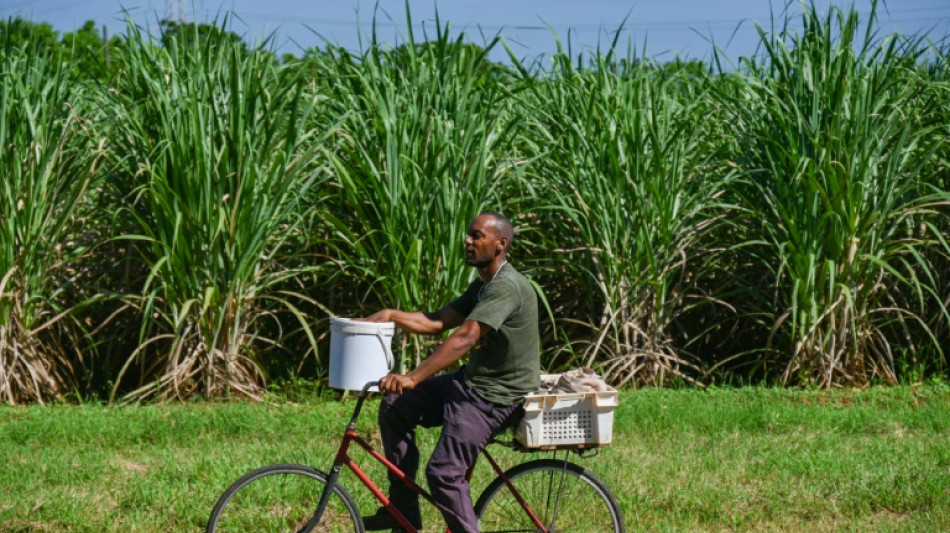
Fuel shortages a bitter pill for Cuba's sugar cane producers
Fuel shortages a bitter pill for Cuba's sugar cane producers / Photo: © AFP

Fuel shortages a bitter pill for Cuba's sugar cane producers

Cuba's sugar cane industry, once the world leader, first lost the United States as its main client 60 years ago, then the Soviet Union three decades later.

Text size:

Today, the industry is teetering on the brink with Cuba in the grips of a crushing economic crisis marked by frequent power blackouts and severe shortages of basic supplies such as fuel, fertilizer and pesticides.

"It is the worst time in the history" of the industry, said Reinaldo Espinosa, the 54-year-old boss of a sugar cane-producing cooperative in the province of Artemisa, southwest of the capital Havana.

"Recovering our national sugar production will take years," Espinosa told AFP as he described preparing for the planting season "with zero resources."

He said his cooperative's output has fallen from 84 to 28 tons of cane per hectare in the past five years as he rattled off a long list of obstacles: "Zero fertilizer, zero herbicide," a dire shortage of fuel and power blackouts "quite often in the productive hours."

"It's really hard" to keep going, Espinosa said.

- Plummeting production -

Agricultural cooperatives were set up by the communist state 30 years ago in a bid to revitalize the industry after the fall of the Soviet Union, which was Cuba's main ally, investor and client.

It had replaced the United States as Cuba's main sugar importer until the 1960s, when sanctions kicked in as the island shifted towards communism.

When the USSR collapsed 30 years later, Cuba abruptly lost 75 percent of its exports and its main source of credit.

Most state-owned farms were converted into cooperatives that remained in government hands.

But sugar prices plummeted at about the same time and US sanctions left the industry -- and others -- in dire straits.

The number of sugar mills in Cuba has since dropped from 156 to 56, and the 2022-2023 harvest barely reached 350,000 tons -- 4.4 percent of what the country produced until the early 1990s.

- 'We are paralyzed' -

Since the coronavirus pandemic, which hit its tourism sector hard, Cuba has experienced its worst economic crisis since the 1990s.

Structural weaknesses in the centralized economy have meant it has been unable to adapt, and limited economic opening in recent years has not done enough to create stability or raise foreign reserves.

Since March, Cuba has faced a fresh wave of power blackouts as the government is unable to import sufficient fuel or the equipment needed to repair the country's aging thermoelectric plants.

For producers, it has meant hardship and uncertainty.

"We must work with hoes... and with machetes because we have nothing else," said Leonardo Hernandez, 64, a co-manager at the Artemisa cooperative, whose irrigation and weeding machines sit unused without fuel.

"We are idle... we have nothing to work with," added Jose Clavijo, a 59-year-old machinist. "We are paralyzed and we want to work because we need to."

S.Jones--TFWP