High-risk Russian strategy targets Ukraine's nuclear plants

Russia is directly targeting Ukraine's nuclear facilities in a strategy to undermine Ukrainian resistance to the Russian invasion but the tactic carries grave risks, observers say.
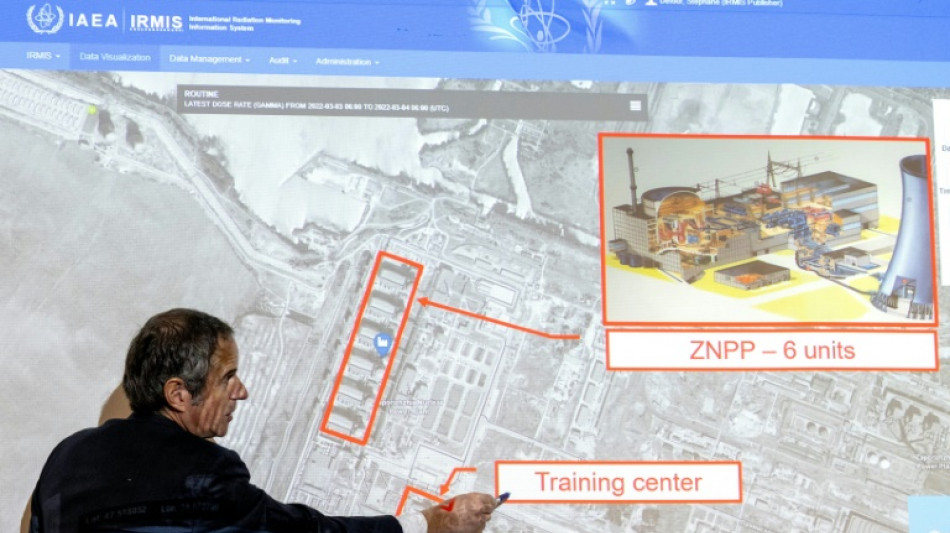
After advancing Russian forces seized Ukraine's defunct nuclear plant at Chernobyl and the still-operational reactors at Zaporizhzhia, their sights could be on a third facility, Konstantinovka, in the south.
French President Emmanuel Macron said Monday a key priority of the West was to avoid "catastrophes" with Ukraine's nuclear power plants in the Russian invasion.
With 15 operational reactors, Ukraine is the seventh-largest producer of nuclear electricity in the world, according to International Atomic Energy Agency (IAEA) figures for 2020.
The country, which relies on nuclear energy for more than half of its power supply, has made significant improvements in safety over the years, experts say.
Zaporizhzhia alone has six reactors of a more modern, safer design than the one that melted down at Chernobyl in 1986 in the world's worst-ever nuclear disaster.
- 'Cut off power' -
Russia has likely made taking Ukraine's nuclear stations a priority as "that allows them to cut off power to the large cities," international relations analyst Jean-Marc Balencie told AFP.
"One of the Russians' objectives is to get people to leave, to exhaust the resisters' ability and will to defend," Balencie said.
"No more electricity means no more heating, no running water, no fridges or freezers."
A French military source told AFP that "they'll want to take all of the nuclear plants to increase the pressure" on Ukrainians.
But Russian leader Vladimir Putin told Macron that he "had no intention of attacking nuclear power stations" and that he was "ready to act in line with IAEA norms", Paris said.
Russian forces could be within artillery range of the three reactors at Konstantinovka in southern Ukraine, situated between Kherson -- the first major city captured -- and the Black Sea port of Odessa, a possible future target.
- Taking control -
Most of Ukraine's reactors "were planned by the Soviets, they have the blueprints in Moscow," a French military source said.
Once the army has control of a site, the Russians "can bring in their own teams of engineers to take care of the power plant," the source added.
Another option is forcing local staff to continue operating the site, as appears to be the case at Chernobyl.
The IAEA has warned that more than 200 security and maintenance staff there have been prevented from leaving since Russian forces took over on February 24.
"Russians took over Chernobyl while the night shift was finishing its shift. The day shift was never able to come back" to the plant, Natasha, whose father works at the reactor and asked her real name be withheld, told AFP.
That poses a problem given the strict division of tasks between the night and day shifts, she added.
"There is nuclear fuel which is kept in a special pool, in certain conditions in terms of temperature, quantity of minerals, and so on," Natasha said.
"But the night shift doesn’t have access to this data. If the fuel is not maintained properly, this could generate a risk, like a local explosion," she fears.
Round-the-clock work with only one meal per day, no medicine or hygiene facilities and lack of sleep are also beginning to take their toll.
On Monday, "an employee ran away in some exclusion zone and nobody can find him," Natasha said -- leaving him stranded up to 60 kilometres from the nearest town in the depths of winter.
- 'Unprecedented danger' -
The Russian capture of Zaporizhzhia, around 170 kilometres (105 miles) north of the annexed Ukrainian peninsula of Crimea, raised the spectre of nuclear disaster around the world, as shelling hit the plant and caused damage.
It is unclear for now whether the nuclear plant was hit on purpose or by accident, although vital structures appear to remain intact.
"We don't get the impression that (the Russians) wanted to bombard the power station, but neither did they take particular care," the French military source told AFP.
The International Atomic Energy Agency says that radiation levels remained "normal" in the latest data.
A fire broke out at the plant's training facility but there appears to have been no damage to the reactors.
IAEA chief Rafael Grossi nevertheless warned Monday that "military operations at nuclear power facilities have caused unprecedented danger of a nuclear accident, risking the lives of people living in Ukraine and in neighbouring countries, including Russia."
He has offered to visit Ukraine to assess the safety situation.
Beyond intentional or unintentional shelling or bombing, analyst Balencie told AFP that a nuclear mishap could still occur if Ukrainian staff seek to sabotage plants.
Resistance fighters could even attack a nuclear plant in Russia, he added.
"We're in a world where things that seem impossible one evening become very real the next day," Balencie said.
L.Davila--TFWP