Baidoa: Crossroads of despair in drought-ravaged Somalia

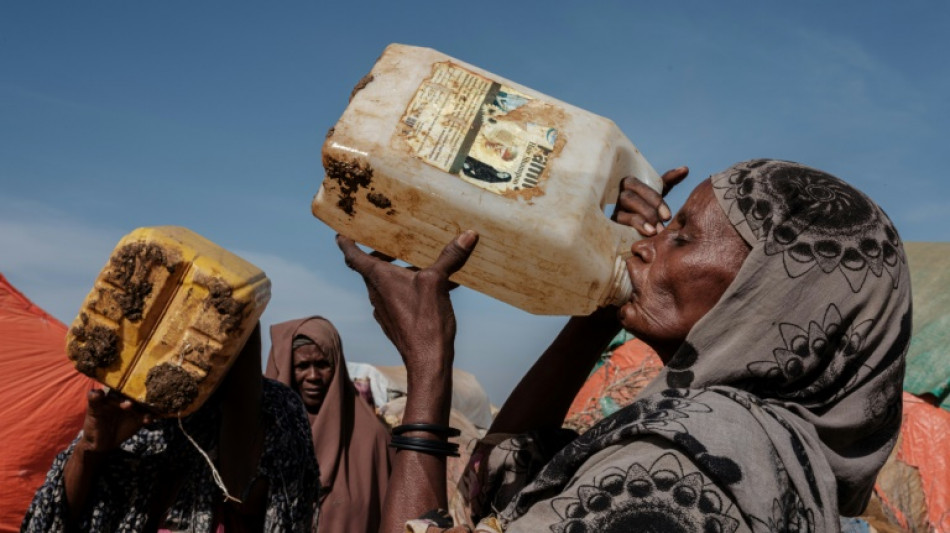
Under the blazing sun, Salado Adan Mohamed puts the finishing touches to her makeshift shelter, cobbled together from branches and fragments of discarded cloth.
She has just arrived in the southwestern Somali city of Baidoa, the last refuge for people fleeing the worst drought in the country in a decade.
Along with her three children, the 26-year-old mother walked for five days "without eating" to make the 70-kilometre (43-mile) trek from her village to Baidoa.
She settled in Muuri, one of 500 camps for displaced people in the city, where aqals -- traditional dome-shaped huts -- have been hastily built in recent weeks.
Desperate, hungry and thirsty, more and more people are flocking to Baidoa from rural areas of southern Somalia, one of the regions hardest hit by the drought that is engulfing the Horn of Africa.
According to the UN's World Food Programme, nearly 13 million people, mostly farmers and herders, are going hungry in the region: 5.7 million in Ethiopia, 2.8 million in Kenya and 4.3 million in Somalia -- a quarter of the country's population.
In Somalia, the UN's humanitarian agency OCHA said this month that the number of people who have left their homes in search of water, food and pasture has doubled to more than 554,000.
- 'We have nothing left' -
Mohamed says she and her husband saw their crops devoured by swarms of locusts that have ravaged many parts of East Africa in recent years.
Within just a few months, what little they had left was wiped out when the rains failed for a third straight time since the end of 2020.
"We had three camels which died during the drought season, 10 goats -- we ate some, others died and the rest were sold -- and all five cattle perished because of the lack of water and pasture," she says.
"We have nothing left."
With her husband and children, Mohammed started out from her home village for Baidoa, the last hope for many in the stricken region.
But her husband, who has tuberculosis, did not make it all the way. Too weak to continue, he turned back. She has not heard from him since.
The countryside around Baidoa is under the control of the Al-Qaeda linked Al-Shabaab Islamist group, which held the city itself for several years at the height of the insurgency before being driven out in early 2012 by Somali-led forces.
But the persistent insecurity means almost no aid can be sent out of the city.
Even in Muuri, Mohamed says she struggles to provide even one meal a day for her children.
"Sometimes we get something to eat, sometimes not... If there's not enough, I sacrifice for my children," she says, a weary look on her face.
- Spectre of 2011 -
Humanitarian organisations have been ringing alarm bells on the deteriorating situation in the Horn of Africa for weeks, with fears of a repeat of the 2011 famine in Somalia that cost the lives of 260,000 people.
Insufficient rainfall since late 2020 has come as a fatal blow to populations already suffering from locust invasions between 2019 and 2021 and the Covid-19 pandemic.
"We had our usual reserves of sorghum, but we have eaten through them in the last three years. They are now finished," says Ibrahim Mohamed Hassan, a blind 60-year-old who walked about 60 kilometres with his family to Garas Goof camp in Baidoa.
He says 30 of the 50 families in his home village have fled.
"The others will follow," he predicts, adjusting his sunglasses which are held together with a rubber band.
- Malnutrition and disease -
Over the past decade, Baidoa -- which lies about 250 kilometres northeast of the capital Mogadishu -- has become accustomed to large population influxes.
At least 60 percent of its population -- now estimated to be between 700,000 and 800,000 -- are displaced and the number of informal settlements has exploded from 77 in 2016 to 572 now.
But at the medical centre in Tawkal 2 Dinsoor camp, the scale of the current influx is worrying.
"Before, we used to receive about 1,000 internally displaced people, or even less, per month. Today, we host about 2,000 to 3,000," says the centre's supervisor Hassan Ali Amin.
He says he has observed cases of malnutrition and diarrhoea among children, as well as measles and pneumonia among weakened adults.
"If the situation continues to worsen, we expect to receive thousands, hundreds of thousands of people," adds Mohamednur Mohamed Abdirahman, field director of the British charity Save The Children in Baidoa.
- 'Sad and skinny' -
Abdulle Kalar Maaney says he does not want to imagine the worst-case scenario: a fourth season of poor rainfall.
He says he is "very hopeful" that the rains will return in March and that he will be able to return to his home village.
He arrived in Muuri with his wife and 10 children having lost his last precious possessions: his donkey and his cart.
He was counting on the beast to earn some money after they arrived in Baidoa, but the donkey died during the 90-kilometre journey to the city and he abandoned the cart.
"I never thought I would end up like this," sighs the slender 48-year-old, clad in an oversized shirt.
"I was big and strong when I had my cattle," he says. "I've become sad and skinny since the drought killed them all off."
J.P.Estrada--TFWP