The Fort Worth Press - US restricts import of Afghan cultural items to prevent 'pillage'

USD -
AED 3.672504
AFN 64.000368
ALL 80.660025
AMD 364.155001
ANG 1.790365
AOA 918.000367
ARS 1524.750402
AUD 1.417435
AWG 1.8
AZN 1.70397
BAM 1.716593
BBD 2.014833
BDT 123.096502
BGN 1.683441
BHD 0.377145
BIF 3013.033747
BMD 1
BND 1.278097
BOB 12.259622
BRL 5.188104
BSD 1.000307
BTN 95.794093
BWP 13.621802
BYN 3.022425
BYR 19600
BZD 2.011937
CAD 1.41495
CDF 2340.000362
CHF 0.828271
CLF 0.024357
CLP 961.770396
CNY 6.71325
CNH 6.734304
COP 3348.488173
CRC 454.820731
CUC 1
CUP 24.008426
CVE 96.778865
CZK 21.384404
DJF 178.136657
DKK 6.562804
DOP 59.49006
DZD 133.78604
EGP 51.914688
ERN 15
ETB 162.282003
EUR 0.87791
FJD 2.24725
FKP 0.754924
GBP 0.754689
GEL 2.61504
GGP 0.754924
GHS 11.618906
GIP 0.754924
GMD 73.503851
GNF 8797.998859
GTQ 7.639444
GYD 209.30355
HKD 7.84345
HNL 26.849519
HRK 6.613804
HTG 130.916751
HUF 320.61504
IDR 17914.1
ILS 3.04806
IMP 0.754924
INR 95.817504
IQD 1310.484048
IRR 1374575.000352
ISK 120.260386
JEP 0.754924
JMD 158.265678
JOD 0.70904
JPY 157.28504
KES 129.644095
KGS 87.448204
KHR 4068.10901
KMF 433.00035
KPW 900.000318
KRW 1355.185039
KWD 0.30864
KYD 0.833633
KZT 443.156186
LAK 22438.232325
LBP 89581.428007
LKR 330.293588
LRD 172.063018
LSL 16.32106
LTL 2.95274
LVL 0.60489
LYD 6.395752
MAD 9.599596
MDL 17.756616
MGA 4416.553298
MKD 54.043972
MMK 2099.36214
MNT 3596.164164
MOP 8.082152
MRU 40.243999
MUR 47.530378
MVR 15.450378
MWK 1734.585509
MXN 17.679204
MYR 4.074104
MZN 63.910377
NAD 16.32106
NGN 1326.380377
NIO 36.810462
NOK 9.50785
NPR 153.270725
NZD 1.749629
OMR 0.385571
PAB 1.000307
PEN 3.395971
PGK 4.456927
PHP 62.347038
PKR 277.197262
PLN 3.83775
PYG 5896.344407
QAR 3.646377
RON 4.629204
RSD 103.085092
RUB 84.346338
RWF 1478.474569
SAR 3.752852
SBD 8.000512
SCR 13.902664
SDG 601.503676
SEK 9.91775
SGD 1.277904
SHP 0.755002
SLE 24.650371
SLL 20969.491881
SOS 571.729495
SRD 37.667504
STD 20697.981008
STN 21.503489
SVC 8.753236
SYP 13002.000254
SZL 16.317198
THB 33.375038
TJS 9.228244
TMT 3.51
TND 2.961425
TOP 2.40776
TRY 48.942504
TTD 6.803879
TWD 31.728704
TZS 2654.934831
UAH 44.794751
UGX 3918.023434
UYU 40.075482
UZS 11839.206565
VES 852.43145
VND 25976
VUV 118.388248
WST 2.745723
XAF 575.871484
XAG 0.015553
XAU 0.000233347179
XCD 2.70255
XCG 1.80287
XDR 0.707052
XOF 575.871484
XPF 104.673717
YER 236.650363
ZAR 16.304245
ZMK 9001.203584
ZMW 19.513758
ZWL 321.999592
SSP 5712.591904
MXV 2.00344
  • RIO

    -0.3300

    97.04

    -0.34%

  • CMSC

    -0.0400

    20.67

    -0.19%

  • RELX

    0.0000

    33.41

    0%

  • RBGPF

    0.0000

    67.95

    0%

  • BCE

    -0.0700

    21.99

    -0.32%

  • BCC

    -0.0300

    75.66

    -0.04%

  • GSK

    0.8600

    51.08

    +1.68%

  • JRI

    -0.0300

    11.52

    -0.26%

  • NGG

    -0.1200

    76.68

    -0.16%

  • CMSD

    0.0900

    20.54

    +0.44%

  • BTI

    -0.0800

    55.75

    -0.14%

  • AZN

    2.0200

    168.1

    +1.2%

  • BP

    -1.4200

    43.16

    -3.29%

  • RYCEF

    0.4600

    19.7

    +2.34%

  • VOD

    0.0700

    17.02

    +0.41%

US restricts import of Afghan cultural items to prevent 'pillage'


US restricts import of Afghan cultural items to prevent 'pillage'

The United States has restricted the import of cultural and historical items from Afghanistan, hoping to prevent "terrorists" from profiting, the State Department said Tuesday, but experts voiced fears about the unintended consequences.

Text size:

The decree, which was implemented on an "emergency" basis and took effect on Friday, includes restrictions on bringing ceramics, paintings, glass, ivory, ancient textiles, tiles and wood pieces, among others into the country, according to a government list.

The restrictions "are intended to prevent illicitly trafficked materials from entering the US art market, thus reducing the incentive for pillage of Afghanistan's cultural heritage and combatting profit from the sale of these cultural objects by terrorists and criminal organizations," the State Department said.

But they come after an April 2021 request from the US-backed Afghan government -- which fell to the Taliban in August.

"Can the State Department act based on a 'request' of a government that no longer exists?" ancient coin collector and advocate Peter Tompa asked in a post on his blog the Cultural Property Observer.

"The real question is how these restrictions are going to be enforced and if any material that may be seized will be repatriated to the Taliban once diplomatic relations (with the United States) are restored," he wrote.

- Taliban 'investigating' looting -

Restricted archaeological material dates from the year 50,000 BC through 1747, and restricted cultural material includes items from the ninth century through 1920, the government said.

The new regulations could create logistics issues for collectors or curators who already have items on their way to the United States as auction houses prepare to sell pieces during Asia Week New York next month, art publication The Art Newspaper pointed out.

For Tompa, one upside to the import rules, which are set to remain in force until April 2026 and could be extended, is that they do not seem to include bans on modern textiles.

"If it did, such import restrictions would potentially devastate the livelihoods of Afghan women who make a living weaving textiles for export," he wrote.

Last year, UNESCO called on the Taliban to help preserve Afghanistan's cultural heritage.

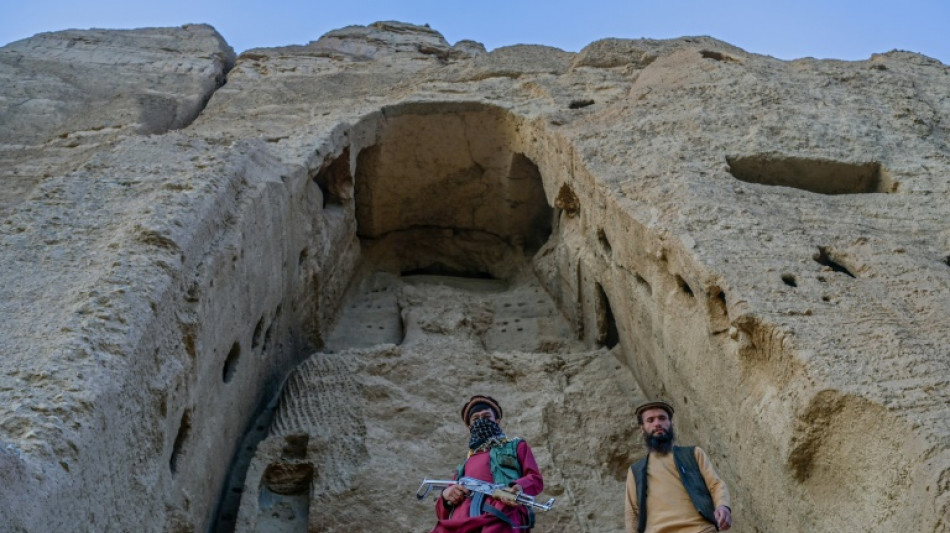
Shortly before their first stint in power came to an end in 2001, the Taliban destroyed two giant centuries-old Buddha statues carved out of a cliff face in Bamiyan, sparking global outrage.

And local officials and former UNESCO employees formerly based in Afghanistan told AFP that around a thousand priceless artifacts once stored in warehouses near the statutes were stolen or destroyed following the 2021 Taliban takeover.

"I confirm that looting did take place, but it was before our arrival," local Taliban member Saifurrahman Mohammadi told AFP in October, blaming the thefts on the vacuum left by the old authorities after they fled.

"We are investigating and we are trying to get them back," he added.

The group has promised a softer version of rule this time around, and Taliban fighters now guard what remains of the Buddhist statues.

M.Delgado--TFWP