'It's always scary': medics in Ukraine's 'meat grinder' / Photo: © AFP

As Russian forces poured across Ukraine's borders, Palych knew that pain, suffering and injuries would follow in the ensuing war and his training as a paramedic would be needed.
"I could not sit on the sidelines, so I went to the front as a volunteer," says Palych, the nom de guerre for the 35-year-old medic working near the frontline in the eastern Ukrainian city of Bakhmut.
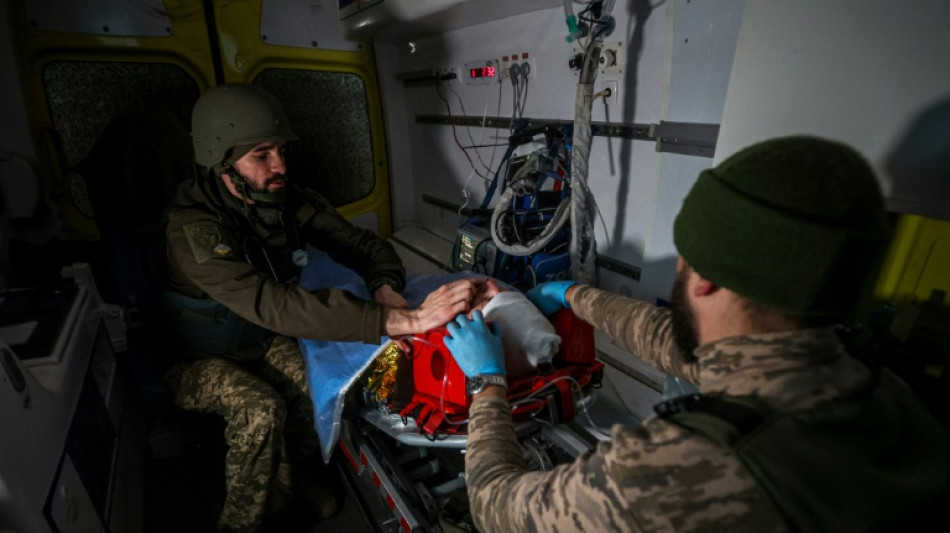
Day after day, he and his team skirt the front, collecting the wounded and rushing them back to the main hospital in Bakhmut just a couple of kilometres away from the line of contact.
"It's always scary," he tells AFP during a recent trip transporting a wounded soldier suffering from a brain injury and a broken leg from Bakhmut to a nearby medical centre in the town of Chasiv Yar.
"You never feel relaxed. Every time we are afraid."
Once known for its vineyards and cavernous salt mines, Bakhmut has been dubbed "the meat grinder" due to the brutal trench warfare, artillery duels and frontal assaults that have defined the fight for the city for the past six months.
On the Russian side, mercenaries, prison conscripts and newly mobilised troops are believed to comprise the fighting force that has launched waves of attacks on Bakhmut.
Ukrainian forces are largely positioned in and around the city, including in mud-soaked trenches bisecting shattered swathes of land pummelled by relentless shelling.
"We can compare the fighting with the Second World War, as (both sides) use standard methods of conducting combat operations without any special technological means," said Sergiy Zgurets, a military analyst at Defense Express Media & Consulting Company.
- 'Destruction' -
The goal however may not just be the capture of the city.
Yevgeny Prigozhin, founder of Russia's Wagner mercenary group that is helping lead the fight, said his forces are mostly focusing their efforts on destroying the Ukrainian army.
"The Ukrainian army is well prepared and offers worthy resistance," said the Kremlin-linked businessman in a recent statement released by his company, Concord.
"Our task is not Bakhmut itself, but the destruction of the Ukrainian army and the reduction of its combat potential, which has an extremely positive effect on other areas, which is why this operation was dubbed the 'Bakhmut meat grinder'".
Nine months into the conflict, the medics working on the frontlines have been transformed into battle-hardened veterans, for many a vast departure from their former lives.
Before the war, Malysh was a delivery driver -- just an "ordinary" job that he left to join an ambulance team after the invasion in February.
"I pray to the lord for things to slow down in the coming days. I wish we didn't have work like this at all," the ambulance driver says, while waiting outside Bakhmut's main hospital.
The facility is the first stop for many of the injured at the front.
The explosion of artillery, mortars and Grad rocket volleys along with the lurching rattle of nearby tanks echo in the streets around the hospital as ambulances drop patients to waiting doctors.
Blood-stained stretchers are stacked against the walls where at least two black body bags could be seen nearby during AFP's visit.
"The hardest thing for any doctor is when a 300 (an injured patient) turns into a 200 (a fatality)," Maryana, a 30-year-old anaesthesiologist, tells AFP during a shift break, using Soviet-era military code words.
"Our morale is high, but physically it can be tough when we have a lot of injured people during one shift," she adds.
"When I get back to our place, I'm hungry, but I'm just too tired to eat."
- 'Not in vain' -
In recent days, a number of the new medics have arrived in Bakhmut after being redeployed from the southern front near Kherson, where a Ukrainian counter-offensive succeeded in liberating the city.
For many, the fighting in Bakhmut is some of the worst they have seen yet.
"Before coming here we used to work in the Kherson area. It was tough but not this tough," says an ambulance driver who goes by the call sign Octane.
Following Kherson's liberation, the epicentre of the war firmly shifted to the eastern Donbas region where Bakhmut is located.
The smaller frontline and a greater density of forces have paved the way for ferocious battles along the Donbas's open steppe, pine forests and on the edges of cities like Bakhmut.
Speculation has swirled on pro-Kremlin social media posts about continued Russian advancements around the city along with ultimatums issued to Ukrainian units at risk of encirclement.
However, analysts have dismissed the claims.
"Even if Russian forces have indeed succeeded in taking control of settlements south of Bakhmut, these gains do not threaten the critical" supply lines into the city used by Ukraine, said The Institute for the Study of War in an assessment published this week.
Holding the line will likely come at a steep cost, putting further pressure on the medical teams on the ground.
But for Palych and other first responders the gruesome nature of the job provides them with a chance to bolster the front.
"If it saves at least one life of a soldier who will later join the ranks, then my work was not in vain," he says.
ds-est-dg-sd/as/imm
G.Dominguez--TFWP