The Fort Worth Press - New NASA tool helps detect 'super-emitters' of methane from space

USD -
AED 3.672799
AFN 65.99971
ALL 82.250073
AMD 381.509666
ANG 1.790403
AOA 916.999792
ARS 1450.255101
AUD 1.511842
AWG 1.8
AZN 1.700846
BAM 1.669612
BBD 2.015307
BDT 122.367966
BGN 1.66904
BHD 0.377022
BIF 2965
BMD 1
BND 1.291862
BOB 6.914156
BRL 5.523094
BSD 1.00061
BTN 90.277748
BWP 13.222922
BYN 2.935756
BYR 19600
BZD 2.012438
CAD 1.37775
CDF 2263.999524
CHF 0.794402
CLF 0.023226
CLP 911.140223
CNY 7.04125
CNH 7.0339
COP 3863.71
CRC 498.555129
CUC 1
CUP 26.5
CVE 94.449703
CZK 20.77365
DJF 177.719768
DKK 6.37278
DOP 62.549583
DZD 129.70444
EGP 47.5175
ERN 15
ETB 155.20232
EUR 0.85296
FJD 2.29175
FKP 0.746872
GBP 0.74726
GEL 2.690175
GGP 0.746872
GHS 11.525023
GIP 0.746872
GMD 73.504195
GNF 8685.000082
GTQ 7.663578
GYD 209.345507
HKD 7.78085
HNL 26.17983
HRK 6.426297
HTG 131.049996
HUF 330.744035
IDR 16697.1
ILS 3.208805
IMP 0.746872
INR 90.257802
IQD 1310
IRR 42124.999467
ISK 125.900902
JEP 0.746872
JMD 160.101077
JOD 0.708964
JPY 155.670986
KES 128.916407
KGS 87.450245
KHR 4010.000605
KMF 421.000229
KPW 899.993999
KRW 1477.029993
KWD 0.306903
KYD 0.833782
KZT 516.249648
LAK 21655.999804
LBP 89549.9999
LKR 309.584176
LRD 177.409781
LSL 16.735011
LTL 2.95274
LVL 0.60489
LYD 5.420329
MAD 9.174976
MDL 16.874536
MGA 4528.00019
MKD 52.517746
MMK 2100.057046
MNT 3547.602841
MOP 8.019874
MRU 39.760162
MUR 46.039697
MVR 15.460098
MWK 1737.999549
MXN 17.99581
MYR 4.088497
MZN 63.910281
NAD 16.740299
NGN 1457.880156
NIO 36.705219
NOK 10.15375
NPR 144.441314
NZD 1.731615
OMR 0.384416
PAB 1.000627
PEN 3.366009
PGK 4.24925
PHP 58.590525
PKR 280.249967
PLN 3.58505
PYG 6680.126517
QAR 3.641199
RON 4.342397
RSD 100.164267
RUB 79.923749
RWF 1452
SAR 3.750821
SBD 8.140117
SCR 14.801353
SDG 601.502223
SEK 9.279302
SGD 1.289997
SHP 0.750259
SLE 24.163599
SLL 20969.503664
SOS 571.495018
SRD 38.677961
STD 20697.981008
STN 21.2
SVC 8.755448
SYP 11058.365356
SZL 16.740532
THB 31.40326
TJS 9.240587
TMT 3.51
TND 2.904505
TOP 2.40776
TRY 42.8063
TTD 6.789428
TWD 31.529104
TZS 2489.999871
UAH 42.262365
UGX 3574.401243
UYU 39.209995
UZS 12024.999911
VES 279.213404
VND 26325
VUV 121.372904
WST 2.784715
XAF 559.97217
XAG 0.015246
XAU 0.000231
XCD 2.702551
XCG 1.803297
XDR 0.69494
XOF 558.000173
XPF 102.202348
YER 238.449949
ZAR 16.73368
ZMK 9001.199023
ZMW 22.76404
ZWL 321.999592
  • SCS

    0.0200

    16.14

    +0.12%

  • RBGPF

    -1.7900

    80.22

    -2.23%

  • VOD

    -0.0100

    12.8

    -0.08%

  • RYCEF

    0.6300

    15.4

    +4.09%

  • NGG

    -0.7700

    76.39

    -1.01%

  • CMSC

    0.0300

    23.29

    +0.13%

  • BTI

    -0.1300

    57.04

    -0.23%

  • RELX

    0.0900

    40.65

    +0.22%

  • RIO

    0.4400

    77.63

    +0.57%

  • BCC

    1.4100

    77.7

    +1.81%

  • GSK

    -0.4200

    48.29

    -0.87%

  • BCE

    -0.3000

    22.85

    -1.31%

  • JRI

    0.0000

    13.43

    0%

  • CMSD

    0.0000

    23.28

    0%

  • AZN

    0.7500

    90.61

    +0.83%

  • BP

    -1.1600

    33.31

    -3.48%

New NASA tool helps detect 'super-emitters' of methane from space
New NASA tool helps detect 'super-emitters' of methane from space / Photo: © NASA/JPL-Caltech/AFP

New NASA tool helps detect 'super-emitters' of methane from space

NASA scientists, using a tool designed to study how dust affects climate, have identified more than 50 spots around the world emitting major levels of methane, a development that could help combat the potent greenhouse gas.

Text size:

"Reining in methane emissions is key to limiting global warming," NASA Administrator Bill Nelson said in a press release on Tuesday.

"This exciting new development will not only help researchers better pinpoint where methane leaks are coming from, but also provide insight on how they can be addressed -- quickly."

NASA said its Earth Surface Mineral Dust Source Investigation (EMIT) is designed to foster understanding of the effects of airborne dust on climate.

But EMIT, which was installed on the International Space Station in July and can focus on areas as small as a soccer field, has also shown the ability to detect the presence of methane.

NASA said more than 50 "super-emitters" of methane gas in Central Asia, the Middle East, and the southwestern United States have been identified so far. Most of them are connected to the fossil-fuel, waste or agriculture sectors.

Kate Calvin, NASA's chief scientist and senior climate advisor, said EMIT's "additional methane-detecting capability offers a remarkable opportunity to measure and monitor greenhouse gases that contribute to climate change."

- 'Exceeds our expectations' -

Methane is responsible for roughly 30 percent of the global rise in temperatures to date.

While far less abundant in the atmosphere than CO2, it is about 28 times more powerful as a greenhouse gas on a century-long timescale. Over a 20-year time frame, it is 80 times more potent.

Methane lingers in the atmosphere for only a decade, compared to hundreds or thousands of years for CO2.

This means a sharp reduction in emissions could shave several tenths of a degree Celsius off of projected global warming by mid-century, helping keep alive the Paris Agreement goal of capping Earth's average temperature increase to 1.5C, according to the UN Environment Programme (UNEP).

"EMIT will potentially find hundreds of super-emitters – some of them previously spotted through air-, space-, or ground-based measurement, and others that were unknown," NASA said.

Andrew Thorpe, a research technologist at the Jet Propulsion Laboratory leading the EMIT methane effort, said some of the methane plumes detected by EMIT are among the largest ever seen.

"What we've found in a just a short time already exceeds our expectations," Thorpe said.

NASA said a methane plume about two miles (3.3 kilometers) long was detected southeast of Carlsbad, New Mexico, in the Permian Basin, one of the largest oilfields in the world.

It said 12 plumes from oil and gas infrastructure were identified in Turkmenistan, east of the Caspian Sea port city of Hazar.

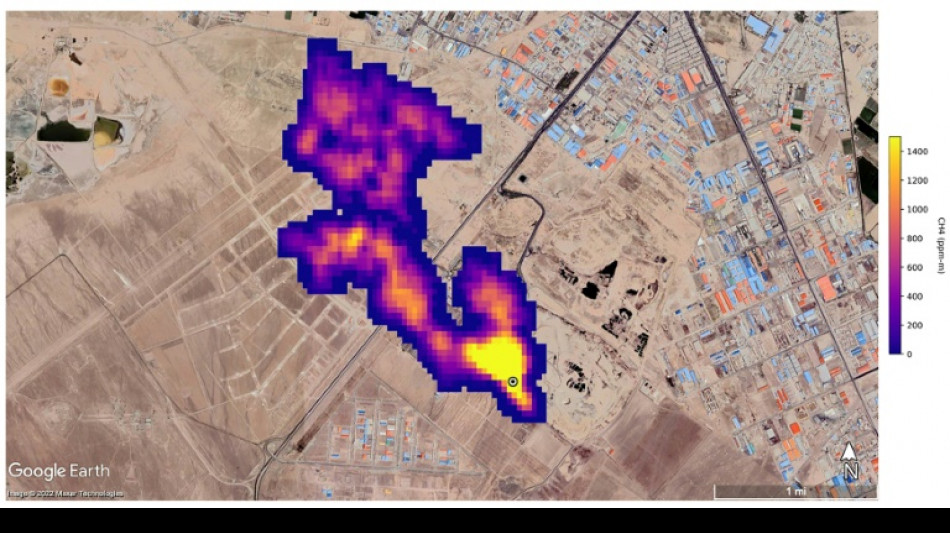
A methane plume at least three miles (4.8 kilometers) long was detected south of Tehran from a major waste-processing complex, NASA said.

S.Palmer--TFWP