The Fort Worth Press - Restored Cheshire wetland becomes key UK breeding site for black-necked grebes

USD -
AED 3.672504
AFN 65.000368
ALL 79.60134
AMD 362.536449
ANG 1.790365
AOA 918.000367
ARS 1514.503978
AUD 1.400168
AWG 1.8
AZN 1.70397
BAM 1.702398
BBD 2.01149
BDT 122.644384
BGN 1.683441
BHD 0.376463
BIF 3002.654829
BMD 1
BND 1.276233
BOB 9.812421
BRL 5.142041
BSD 0.998738
BTN 95.698307
BWP 13.543979
BYN 3.021108
BYR 19600
BZD 2.008617
CAD 1.39985
CDF 2311.000362
CHF 0.822497
CLF 0.024299
CLP 959.460396
CNY 6.69765
CNH 6.703907
COP 3159.072116
CRC 446.794621
CUC 1
CUP 26.5
CVE 95.978587
CZK 21.197204
DJF 177.847413
DKK 6.508104
DOP 58.945902
DZD 133.76304
EGP 52.053097
ERN 15
ETB 163.132872
EUR 0.870604
FJD 2.215904
FKP 0.747943
GBP 0.74691
GEL 2.603861
GGP 0.747943
GHS 11.505418
GIP 0.747943
GMD 73.503851
GNF 8780.084432
GTQ 7.621535
GYD 208.948079
HKD 7.84505
HNL 26.810289
HRK 6.559704
HTG 130.530531
HUF 317.150388
IDR 17812.1
ILS 3.03663
IMP 0.747943
INR 95.935504
IQD 1308.35183
IRR 1374600.000352
ISK 121.190386
JEP 0.747943
JMD 157.705532
JOD 0.70904
JPY 156.880385
KES 129.329329
KGS 87.450384
KHR 4047.525787
KMF 428.00035
KPW 900.000318
KRW 1386.040383
KWD 0.30816
KYD 0.832311
KZT 446.516081
LAK 22379.771075
LBP 89435.000218
LKR 330.574052
LRD 172.781477
LSL 16.23702
LTL 2.95274
LVL 0.60489
LYD 6.343735
MAD 9.462593
MDL 17.552335
MGA 4329.546938
MKD 53.553554
MMK 2099.853501
MNT 3598.053261
MOP 8.069983
MRU 40.178439
MUR 47.570378
MVR 15.450378
MWK 1731.818775
MXN 17.228804
MYR 4.083704
MZN 63.910377
NAD 16.23702
NGN 1331.730377
NIO 36.749793
NOK 9.410376
NPR 153.117465
NZD 1.735659
OMR 0.384504
PAB 0.998738
PEN 3.37024
PGK 4.445315
PHP 62.910375
PKR 276.819167
PLN 3.79885
PYG 5920.703312
QAR 3.65052
RON 4.582404
RSD 102.180441
RUB 84.084084
RWF 1467.119293
SAR 3.757625
SBD 8.000512
SCR 13.77917
SDG 601.503676
SEK 9.829604
SGD 1.276204
SHP 0.747524
SLE 24.650371
SLL 20969.491881
SOS 570.744658
SRD 37.945504
STD 20697.981008
STN 21.325673
SVC 8.739174
SYP 13002.000254
SZL 16.231884
THB 33.323038
TJS 9.213126
TMT 3.51
TND 2.937894
TOP 2.40776
TRY 48.767038
TTD 6.779823
TWD 31.780367
TZS 2646.559603
UAH 44.62123
UGX 3939.591766
UYU 40.161901
UZS 11824.868347
VES 847.485104
VND 26022
VUV 118.239179
WST 2.750232
XAF 571.078855
XAG 0.015096
XAU 0.000228
XCD 2.70255
XCG 1.799974
XDR 0.707052
XOF 571.078855
XPF 103.808156
YER 236.550363
ZAR 16.26987
ZMK 9001.203584
ZMW 19.630065
ZWL 321.999592
SSP 5704.181901
MXV 1.953264
  • RBGPF

    -1.6900

    68.3

    -2.47%

  • CMSC

    0.0400

    20.71

    +0.19%

  • CMSD

    0.0000

    20.45

    0%

  • GSK

    -0.8400

    50.22

    -1.67%

  • BTI

    -0.1900

    55.83

    -0.34%

  • NGG

    -0.8000

    76.8

    -1.04%

  • BP

    -0.8400

    44.58

    -1.88%

  • RIO

    -0.6700

    97.37

    -0.69%

  • RYCEF

    0.7100

    20

    +3.55%

  • BCC

    0.1600

    75.69

    +0.21%

  • RELX

    -0.9700

    33.41

    -2.9%

  • JRI

    -0.0600

    11.55

    -0.52%

  • VOD

    -0.5700

    16.95

    -3.36%

  • BCE

    -0.2200

    22.06

    -1%

  • AZN

    -0.0600

    166.08

    -0.04%

Restored Cheshire wetland becomes key UK breeding site for black-necked grebes


Restored Cheshire wetland becomes key UK breeding site for black-necked grebes

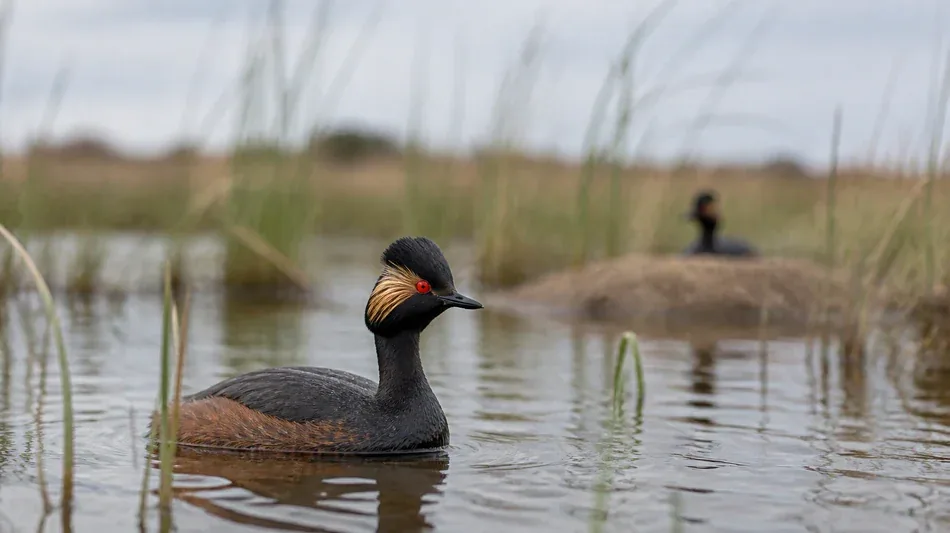
Habitat restoration at Woolston Eyes in Warrington has turned former canal-dredging lagoons into Britain's strongest breeding site for the rare black-necked grebe.

Text size:

Woolston Eyes in Warrington, Cheshire, has become Britain's most important breeding site for the rare black-necked grebe after a multi-year restoration of former settlement lagoons used for dredgings from the Manchester Ship Canal.Since 2021, the RSPB and the Woolston Eyes Conservation Group have restored and expanded the site into a mixture of freshwater pools, reedbeds, willow scrub and rough grassland. Managers revived dried and overgrown wetland areas and created nesting islands intended to attract black-headed gulls, which can provide protection for nesting grebes from predators.The results have been rapid. In 2023, four pairs of black-necked grebes bred in the restored area and raised 15 young. By 2025, 35 breeding pairs had been recorded at Woolston Eyes, including 29 pairs nesting on the newly restored habitat. That total represented 64% of the average number of black-necked grebe breeding pairs recorded annually across the UK.The site, designated as a Site of Special Scientific Interest, also supports other scarce species including willow tit, pochard and grasshopper warbler. Woolston Eyes depends on rainfall to remain wet, but managers can move water between sections so that individual pools can be dried, refreshed and flooded again. That rotation is important because black-necked grebes tend to leave wetlands that become too mature and densely vegetated.RSPB ecologist Gavin Thomas said the increase showed that targeted habitat management can support species recovery and argued that similar wetland restoration should be expanded elsewhere in the UK.

K.Ibarra--TFWP