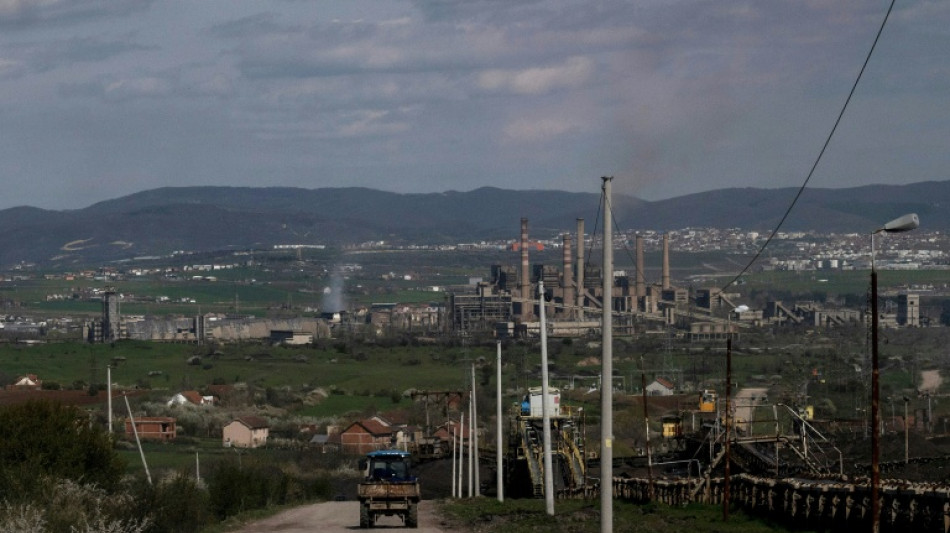
Cancer fears stalk Kosovo's coal heartland / Photo: © AFP

In the small town of Obilic, overshadowed by the smokestacks of Kosovo's largest coal-fired power plants, locals say it is hard to find a family untouched by cancer.
Jovan Zivic, whose cafe sits on the road to one of the power plants, lost his teenage son to the disease in 2010, and then his wife 14 years later. Many of his customers have similar stories.
"There is no family that has not been affected," Zivic told AFP, as he watched a plume rise from a plant chimney in the nearby settlement of Plemetina.
The town, just a short drive from the capital, Pristina, produces almost all of the country's electricity by burning lignite, the lowest-quality and dirtiest coal, dug from nearby pits.
Kosovo's parliament has formally declared Obilic, sandwiched between two plants, an "environmentally endangered zone" because of persistent pollution.
Locals report numerous health problems, while the dangers posed by the area's air pollution are well documented.
But patchy cancer data makes it hard to know whether residents develop the disease at a higher rate than elsewhere in the country.
Retired local mechanic Brahim Gashi, whose brother died from throat cancer, said locals didn't need statistics to know what they were breathing in was hazardous.
"Wait just for the women to spread the laundry out to dry in the yard," the 68-year-old said, suggesting it would be speckled with black in minutes.
- 'More dust than bread' -
Safet Haziri, 63, spent most of his life working at the plants for Kosovo Energy Corporation (KEK).
For decades, he supervised the coal conveyor belt that fed generators, breathing in dust and gas that "nipped his throat".
The father of two has since lost part of his bowel to cancer and remains too ill to work.
"I have swallowed more dust than bread," he said in his living room, as he showed the stoma bag he now has to use.
According to the union representing plant workers, chronic illness is widespread among Haziri's former colleagues.
"KEK workers are the most at risk in Europe, perhaps even in the world," said union vice-president Nexhat Llumnica.
Citing the last data shared by the employer in 2021, Llumnica said that there were 35 deaths out of 3,300 workers that year and most of the deaths were cancer-related.
KEK did not respond to AFP's request for comment or an interview.
- 'Urgent' health warnings -
Official monitoring in 2025 recorded an annual average concentration of fine particles in Obilic's air more than twice the level recommended by the World Health Organization.
These tiny particles can penetrate deep into the lungs, enter the bloodstream and have been linked to cardiovascular and respiratory diseases, lung cancer and premature death.
Concentrations of coarser particles, which are also linked to respiratory illness, exceeded Kosovo's daily legal limit on 16 days.
International donors and the government have committed tens of millions of euros to reducing pollution, including through the modernisation of one of the plants, which is expected to cut emissions.
But Kosovo's National Institute of Public Health said in April that "urgent measures" were still needed to curb pollution from thermal power plants.
Without action, it warned of increased deaths from cardiovascular and respiratory diseases.
Weeks later, Chief State Prosecutor Zejnulla Gashi announced an investigation into state-run power plants over suspected criminal "contamination, degradation and destruction of the environment".
"This is the first case of this nature to be handled in the prosecutorial system," Gashi told AFP.
- 'Too late' -
For Haziri, the probe offers little solace.
"It's like when there were no masks. When they appeared at KEK, it was too late because we had already inhaled it," he said.
"There is no worker at KEK who is healthy."
Many of those living near the plants also depend on them for work. According to Zivic, this leaves them with a stark choice: leave or live with the pollution.
"Plemetina had about 200 houses. Now every third one is empty. People are leaving for a better life."
But he insists this isn't an option for him.
"My wife is buried here, my son is buried here, so I will be buried next to them."
G.Dominguez--TFWP