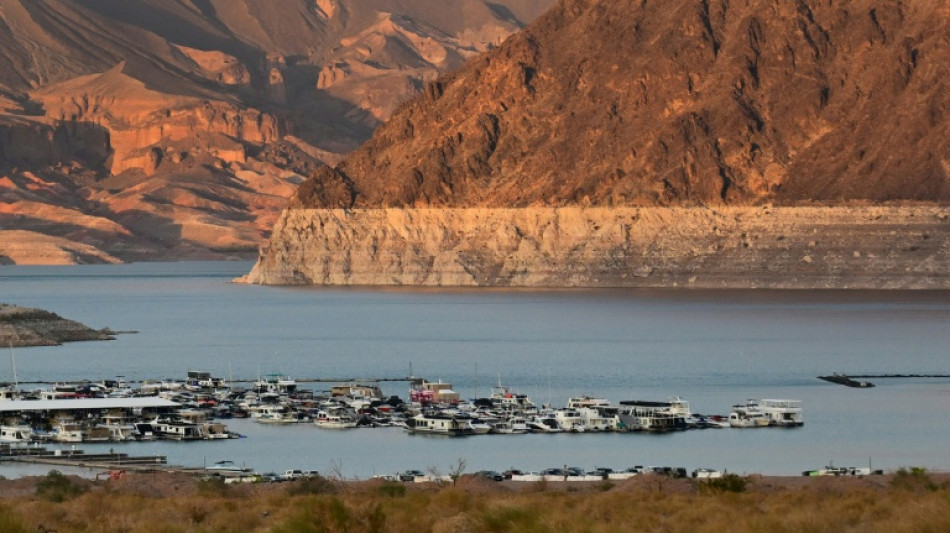
Climate change leaves its mark on America's largest reservoir / Photo: © AFP

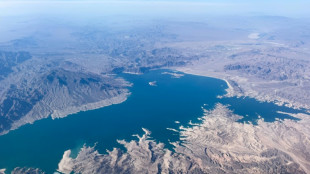
From high in the hills around Las Vegas, tourist Choune Osterero gazes down at the line of chalky mineral deposits left on the rocks around Lake Mead as the level of America's largest reservoir has dropped over the last quarter of a century of drought.
The bathtub ring, which now hovers 186 feet (57 meters) above the surface of the water is a vivid illustration of the reality of a changing climate.
"It's truly striking; it really makes you wonder," Osterero, who had travelled from France with her husband, told AFP.
"In the few days we've been here, it's become clear that you can see the effects of climate change with the naked eye."
The receding waters are revealing boat wrecks and occasional human remains -- including a suspected victim of the Las Vegas mob -- but also a threat to the very foundations of the American West.
To build cities like Las Vegas, Los Angeles, and Phoenix in this desert region, the United States developed a vast system drawing from the Colorado River, which rises in the Rocky Mountains and winds its way to the sea in Mexico.
The river supplies water to more than 40 million Americans across seven states.
Along the way it is stoppered by the two massive dams 300 miles (480 kilometers) apart that created Lake Mead and Lake Powell, which store the snowmelt-fed river water for year-round distribution, and whose huge turbines generate electricity for hundreds of thousands of households.
- Crisis -
But the Colorado River is in trouble.
Way back in 1922, the interstate treaty governing its use allocated more water every year than the river can give.
Now human-caused global warming, which alters rainfall patterns and makes hot periods longer and drier while unleashing powerful storms elsewhere on the planet, is exacerbating this problem.
In the blistering heat of 2026, where climate records are tumbling all over the world, the river is under attack on two fronts, said David Kreamer, a hydrology professor at the University of Las Vegas.
An abnormally dry winter resulted in a much-diminished snowpack in the Rocky Mountains, while the scorching temperatures of the hottest July ever recorded in the US have increased evaporation from the lake, he said.
"As climate change is affecting things, and it gets more intense, the challenges become greater," he said.
Lake Mead is now just a quarter full, while Lake Powell hit an all-time low in August.
Both lakes are dangerously close to the threshold where electricity generation would be affected.
A further drop could result in so-called "deadpool", where the water no longer flows through the dams at all, leaving a swathe of the West without water, with possibly catastrophic results far beyond the great cities of the region.
"The majority of the winter vegetables in the United States are grown in California, and so if the irrigation systems in Southern California are impacted, it would impact people beyond just the Colorado River Basin, but throughout the United States," said Kreamer.
- Cuts -
Faced with the effects of a crisis whose human-sparked cause they nevertheless deny, Donald Trump's administration this month published a 10-year plan that imposes big restrictions on the amount of water California, Arizona, and Nevada can use.
The three "lower basin states" must cut their take by a total of 3.7 billion cubic meters per year, or the equivalent of 1.5 million Olympic-sized swimming pools, while the "upper basin states" of Colorado, Utah, Wyoming, and New Mexico have been spared.
The imbalance prompted Nevada to file a lawsuit on Monday.
Like the authorities, recreational boaters on the lake prefer to point the finger elsewhere.
"Las Vegas has done a phenomenal job in preserving and... reclaiming water," said Bruce Nelson, whose family has owned the lake's marina for almost 70 years.
Over the past two decades, Sin City has cut its water consumption by a third, by promoting wastewater recycling and restricting lawn watering and swimming pool sizes.
In contrast, neighboring Utah recycles very little of its water and is even constructing artificial recreational projects far inland, he said.
"Cities like St. George...(are) building surf communities, so maybe they need to think about how they're conserving water."
Waterskiing enthusiast Brian Essex agrees.
"It's not our problem, really," he told AFP as he sat in his inflatable boat on the lake.
Unchecked real estate growth in Phoenix, and the appetite of California farmers for alfalfa -- a lucrative, highly water-intensive crop that feeds livestock -- are both sucking up resources.
"What do you want to do?" he asks.
"Do you want to build houses or do you want to sell alfalfa? You can't do both."
J.M.Ellis--TFWP