The Fort Worth Press - World's biggest ice sheet could cause massive sea rise without action: study

USD -
AED 3.672503
AFN 64.501461
ALL 81.350154
AMD 368.601612
ANG 1.789884
AOA 917.999754
ARS 1395.500175
AUD 1.386963
AWG 1.8
AZN 1.697502
BAM 1.664922
BBD 2.017519
BDT 122.90693
BGN 1.668102
BHD 0.378325
BIF 2981.344252
BMD 1
BND 1.268148
BOB 6.921708
BRL 4.9429
BSD 1.001694
BTN 94.415643
BWP 13.412506
BYN 2.830826
BYR 19600
BZD 2.014625
CAD 1.36635
CDF 2316.000097
CHF 0.780103
CLF 0.022639
CLP 891.00002
CNY 6.80185
CNH 6.80805
COP 3739.23
CRC 459.54114
CUC 1
CUP 26.5
CVE 93.86572
CZK 20.719799
DJF 178.37594
DKK 6.370898
DOP 59.575193
DZD 132.081983
EGP 52.734703
ERN 15
ETB 156.416039
EUR 0.85258
FJD 2.189202
FKP 0.735472
GBP 0.73757
GEL 2.680233
GGP 0.735472
GHS 11.269164
GIP 0.735472
GMD 72.999755
GNF 8791.554931
GTQ 7.648696
GYD 209.575129
HKD 7.83295
HNL 26.609949
HRK 6.422498
HTG 131.198897
HUF 304.471019
IDR 17346.8
ILS 2.901355
IMP 0.735472
INR 94.489903
IQD 1310
IRR 1312899.999648
ISK 122.580604
JEP 0.735472
JMD 157.783169
JOD 0.709057
JPY 156.878993
KES 129.320525
KGS 87.4205
KHR 4018.030059
KMF 419.000407
KPW 900.010907
KRW 1456.630427
KWD 0.30795
KYD 0.834759
KZT 463.893216
LAK 21982.446732
LBP 89702.650016
LKR 322.556205
LRD 183.81558
LSL 16.370136
LTL 2.95274
LVL 0.60489
LYD 6.336032
MAD 9.142505
MDL 17.234041
MGA 4159.536883
MKD 52.55597
MMK 2099.841446
MNT 3580.445259
MOP 8.079611
MRU 40.080024
MUR 46.720266
MVR 15.455036
MWK 1741.999816
MXN 17.309199
MYR 3.909794
MZN 63.902625
NAD 16.370095
NGN 1359.90979
NIO 36.704978
NOK 9.286615
NPR 151.073086
NZD 1.68241
OMR 0.384499
PAB 1.001694
PEN 3.457501
PGK 4.359596
PHP 60.849843
PKR 279.114204
PLN 3.607315
PYG 6130.874854
QAR 3.642981
RON 4.487498
RSD 100.07798
RUB 74.650223
RWF 1468.60767
SAR 3.775297
SBD 8.032258
SCR 13.91784
SDG 600.500135
SEK 9.25346
SGD 1.268103
SHP 0.746601
SLE 24.597294
SLL 20969.496166
SOS 571.503383
SRD 37.430964
STD 20697.981008
STN 20.857277
SVC 8.764716
SYP 110.548305
SZL 16.369767
THB 32.259764
TJS 9.360949
TMT 3.51
TND 2.869502
TOP 2.40776
TRY 45.324698
TTD 6.77614
TWD 31.413504
TZS 2599.010035
UAH 43.865066
UGX 3746.456572
UYU 40.052438
UZS 12138.314988
VES 496.20906
VND 26310
VUV 118.093701
WST 2.711513
XAF 558.427617
XAG 0.012755
XAU 0.000213
XCD 2.70255
XCG 1.805297
XDR 0.694505
XOF 558.399094
XPF 101.522929
YER 238.601107
ZAR 16.445801
ZMK 9001.198349
ZMW 19.082156
ZWL 321.999592
  • RBGPF

    0.0000

    63.18

    0%

  • RYCEF

    -0.0500

    17.45

    -0.29%

  • CMSC

    -0.0400

    22.97

    -0.17%

  • NGG

    -1.9400

    85.91

    -2.26%

  • BTI

    -1.4800

    58.08

    -2.55%

  • GSK

    -0.0300

    50.5

    -0.06%

  • RELX

    -1.5900

    34.16

    -4.65%

  • RIO

    -2.4000

    103.11

    -2.33%

  • BCE

    0.3400

    24.57

    +1.38%

  • CMSD

    0.0000

    23.42

    0%

  • AZN

    -2.4000

    182.52

    -1.31%

  • BCC

    -1.4800

    72.76

    -2.03%

  • JRI

    -0.0200

    13.15

    -0.15%

  • BP

    -0.8200

    43.81

    -1.87%

  • VOD

    -0.4400

    15.69

    -2.8%

World's biggest ice sheet could cause massive sea rise without action: study
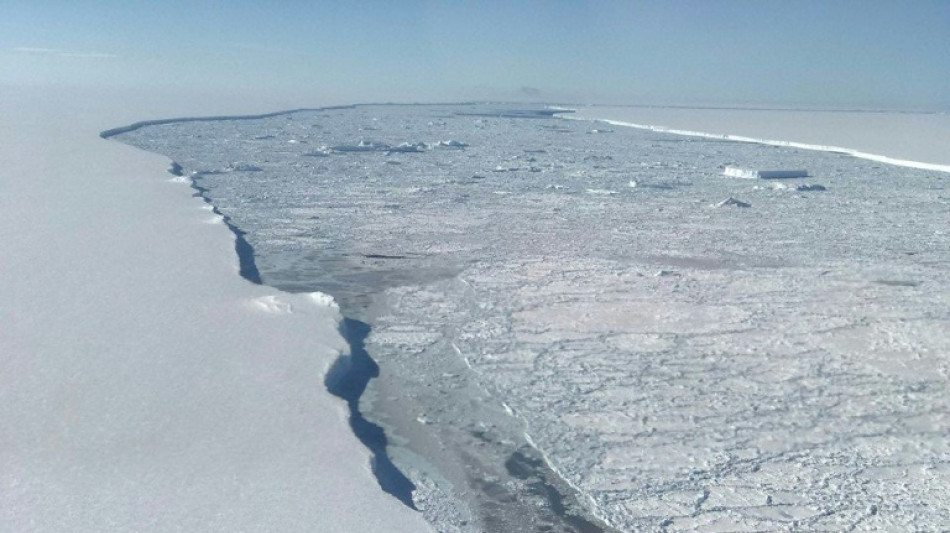
World's biggest ice sheet could cause massive sea rise without action: study / Photo: © NASA/AFP/File

World's biggest ice sheet could cause massive sea rise without action: study

The world's biggest ice sheet could cause "several metres" of sea-level rise over centuries if the global temperature rises more than 2°C, according to a British study published Wednesday.

Text size:

Researchers at Durham University concluded that if global greenhouse emissions remain high, the melting East Antarctica Ice Sheet (EAIS) could cause nearly half a metre of sea-level rise by 2100. Their analysis was published in the scientific journal Nature.

If emissions remain high beyond that, the EAIS could contribute around one to three metres to global sea levels by 2300, and two to five metres by 2500, they said.

However, if emissions were dramatically reduced, EAIS could contribute around two centimetres of sea level rise by 2100, according to the assessment.

This would represent far less than the ice loss expected from Greenland and West Antarctica.

"A key conclusion from our analysis is that the fate of the East Antarctic Ice Sheet remains very much in our hands," said lead author Chris Stokes, from Durham University's Department of Geography.

"This ice sheet is by far the largest on the planet, containing the equivalent of 52 metres of sea level and it's really important that we do not awaken this sleeping giant.

"Restricting global temperature increases to below the 2°C limit set by the Paris Climate Agreement should mean that we avoid the worst-case scenarios, or perhaps even halt the melting of the East Antarctic Ice Sheet, and therefore limit its impact on global sea level rise," he added.

- Computer simulations -

The study did note that the worst scenarios projected were "very unlikely".

World leaders agreed at the 2015 UN Climate Change Conference in Paris to limit global warming to well below 2°C and pursue efforts to limit the rise to 1.5°C.

The research team, which included scientists from the UK, Australia, France and the US, analysed how the ice sheet responded to past warm periods when making their predictions.

They ran computer simulations to model the effects of different greenhouse gas emission levels and temperatures on the ice sheet by the years 2100, 2300 and 2500.

They found evidence to suggest that three million years ago, when temperatures were around 2-4°C higher than present, part of the EAIS "collapsed and contributed several metres to sea-level rise".

"Even as recently as 400,000 years ago -- not that long ago on geological timescales -- there is evidence that a part of the EAIS retreated 700 km inland in response to only 1-2°C of global warming," they added.

Nerilie Abram, a co-author of the study from the Australian National University in Canberra, warned the sheet "isn't as stable and protected as we once thought."

C.Dean--TFWP