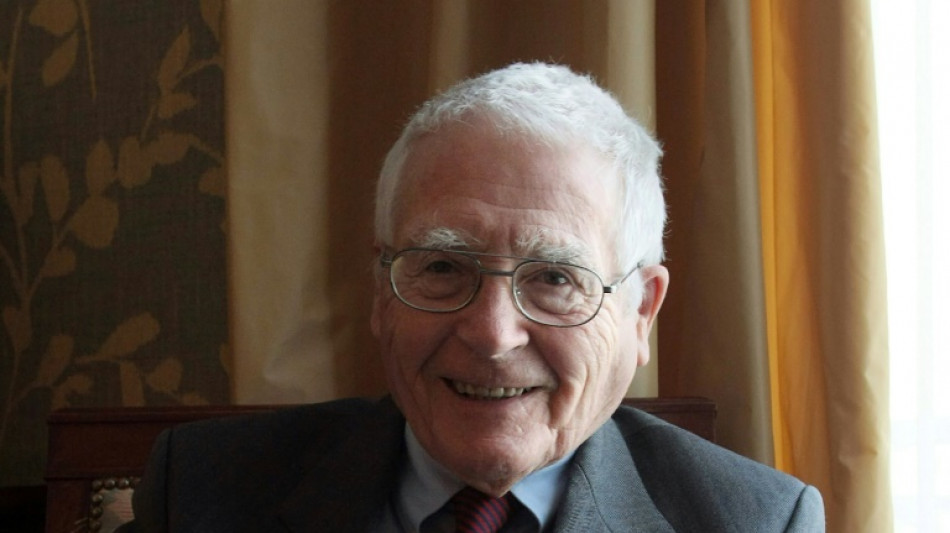
James Lovelock, famed UK scientist behind Gaia theory / Photo: © AFP/File

The independent British scientist James Lovelock, who has died on his 103rd birthday, was hugely influential for his Gaia theory that Earth is a single self-regulating system -- and later his dire warnings about climate change.
In a wide-ranging career that lasted more than three quarters of a century, Lovelock worked on viruses, the ozone layer, told NASA there was no life on Mars and helped shape -- even sometimes reluctantly -- the environmental movement.
His ideas were often at odds with conventional wisdom -- generating admiration and sometimes vilification from his peers. He often had to wait for the world to catch up.
The unorthodox scientist, inventor and author worked in a barn-turned-laboratory for decades, though the price for that freedom was a lack of institutional backing.
On the eve of his 101st birthday in 2020, Lovelock told AFP he was enjoying being in lockdown with his wife in southern England as the coronavirus pandemic swept the country.
"I grew up as an only child hardly meeting anyone -- it isn't any great hardship for me," he said, adding that the sunny weather and lack of other people were "maximally desirable".
Despite his declared antisocial tendencies, Lovelock was unfailingly polite and almost impishly charming.
And as ever forging his own path, he said that the world had "overreacted" to Covid.
"Climate change is more dangerous to life on Earth than almost any conceivable disease," he said.
"If we don't do something about it, we will find ourselves removed from the planet."
- 'Giant' -
Born on July 26, 1919, Lovelock grew up in south London between the two World Wars, starting out as a photographic chemist.
In 1948, he earned a PhD in medicine and worked in the virus department of Britain's National Institute for Medical Research for two decades.
In 1957, he invented the machine used to detect the hole in the ozone layer.
In the early 1960s, as NASA were determined to find life on Mars, Lovelock was under contract at the Jet Propulsion Lab in California.
But Lovelock told his employers there almost certainly wasn't any life Mars -- then designed an experiment to prove it.
A decade later he announced his Gaia theory, describing Earth as an interconnected superorganism.
At a stroke, it helped redefine how science perceives the relationship between our inanimate planet and the life it hosts.
At first the notion was ridiculed by his peers and was even embraced by "Mother Earth" environmentalists, which further annoyed the hard-nosed empiricist.
By the 1990s, however, the complex interplay of all life forms with the water, air and rocks around them -- Earth's geo-bio-chemical balancing act -- was accepted by many as self-evident.
Johan Rockstrom, director of the Potsdam Institute for Climate Impact Research, said the Gaia theory had galvanised a new generation of prominent Earth system scientists.
"Our academic careers are all inspired, in one way or another, by James Lovelock," he told AFP just a few months before the scientist's death.
"He was one of the giants on whose shoulders we all stand."
- Along with Darwin -
Lovelock later became known as something of a prophet of climate doom with his 2006 book "The Revenge of Gaia" and its 2009 sequel "The Vanishing Face of Gaia", though he later walked back his most dire predictions.
Never one to shy away from unconventional thinking, Lovelock said humanity might be able to buy time with ambitious technological solutions -- many of which remain deeply controversial in climate circles.
"Many different ways to keep Earth cool have been suggested," he mused to AFP in 2020.
"One idea I find attractive is a sunshade in heliocentric orbit" -- essentially a giant sun umbrella in space.
While Lovelock was known for his willingness to take an unorthodox position, fellow scientists said that he was also eager to collaborate with others.
"He will be remembered for his warm, fun-loving personality, his truly innovative thinking, his clarity of communication, his willingness to take bold risks in developing his ideas, and his abilities to bring people together and learn from them," said Richard Betts, Head of Climate Impacts Research at Britain's Met Office Hadley Centre.
In 2020, AFP asked Lovelock what he would most like to be remembered for.
"The concept of the self-regulating Earth, I suppose," he replied, saying he had his career at NASA to thank for "stumbling" upon Gaia.
And he was sanguine about the significance of his legacy.
"It is as important, in its own way, as Darwin's thoughts on evolution," he said.
"We are both students of this great system that we happen to live in."
M.McCoy--TFWP