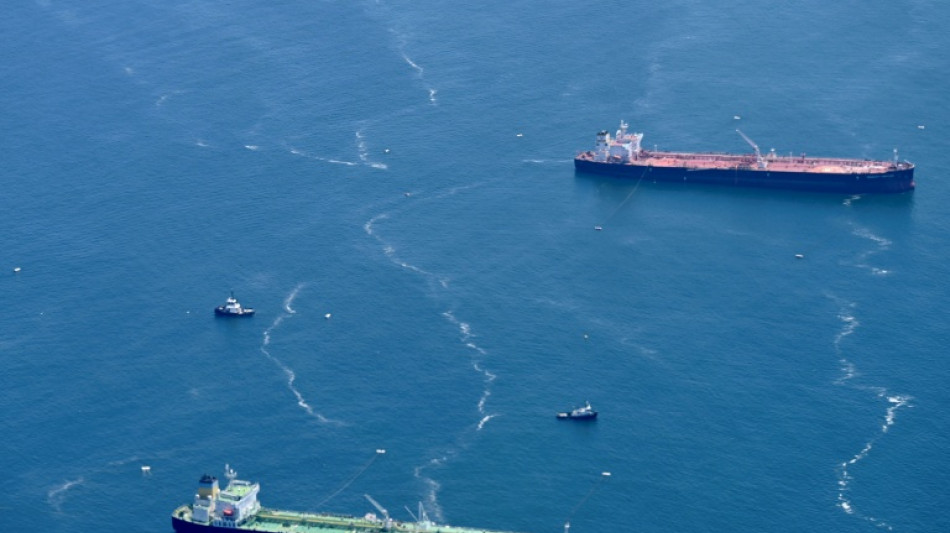
US sinks international deal on decarbonising ships / Photo: © AFP/File

An international vote to formally approve cutting maritime emissions was delayed by a year Friday, in a victory for the United States which opposes the carbon-cutting plan.
The London-based International Maritime Organization (IMO), which is the shipping body of the United Nations, voted in April for a global pricing system to help curb greenhouse gases.
But a vote on whether to formally approve the deal was cancelled on Friday until next year after US President Donald Trump threatened sanctions against countries backing the plan.
Increased divisions, notably between oil producing nations and non-oil producers, emerged this week at meetings leading up to Friday's planned follow-up vote to approve the scheme.
Delegates instead voted on a hastily-arranged resolution to postpone proceedings, which passed by 57 votes to 49.
Trump on Thursday said the proposed global carbon tax on shipping was a "scam" after the United States withdrew from IMO negotiations in April.
A Russian delegate described proceedings as "chaos" as he addressed the plenary Friday after talks had lasted until the early hours.
Russia joined major oil producers Saudi Arabia and the United Arab Emirates in voting against the carbon-reduction measure in April, arguing it would harm the economy and food security.
IMO Secretary-General Arsenio Dominguez, representing 176 member states, pleaded Friday that he hoped there would be no repeat of how the week's discussions had gone.
"It doesn't help your organisation, it doesn't help yourself," he told delegates.
- Trump 'outraged' -
Since returning to power in January, Trump has reversed Washington's course on climate change and encouraged fossil fuel use by deregulation.
"I am outraged that the International Maritime Organization is voting in London this week to pass a global Carbon Tax," Trump wrote on his Truth Social platform Thursday.
"The United States will NOT stand for this Global Green New Scam Tax on Shipping," he added, urging countries to vote against it.
Washington threatened to impose sanctions, visa restrictions and port levies on those supporting the Net Zero Framework (NZF), the first global carbon-pricing system.
Liberia and Saudi Arabia called for Friday's vote to be postponed.
"We agree with the United States that it's important that these conversations are brought to light," a Saudi representative said.
Ahead of this week's London gathering, a majority 63 IMO members that in April voted for the plan had been expected to maintain their support and to be joined by others to formally approve the NZF.
Argentina, which in April abstained from the vote, now opposes the deal.
Leading up to Friday's decision -- China, the European Union, Brazil, Britain and several other members of the IMO -- reaffirmed their support.
The NZF requires ships to progressively reduce carbon emissions from 2028, or face financial penalties.
Shipping accounts for nearly three percent of global greenhouse gas emissions, according to the IMO, while the CO2 pricing plan should encourage the sector to use less polluting fuels.
The Philippines, which provides the most seafarers of any country, and Caribbean islands focused on the cruise industry, would be particularly impacted by visa restrictions and sanctions.
The plan would charge ships for emissions exceeding a certain threshold, with proceeds used to reward low-emission vessels and support countries vulnerable to climate change.
Pacific Island states, which abstained in the initial vote over concerns the proposal was not ambitious enough, had been expected to support it this time around.
If the global emissions pricing system was adopted, it would become difficult to evade, even for the United States.
IMO conventions allow signatories to inspect foreign ships during stopovers and even detain non-compliant vessels.
burs-pml/bcp/ode/jkb/giv
C.Dean--TFWP