India plans mega-dam to counter China water fears / Photo: © AFP

On a football field ringed by misty mountains, the air rang with fiery speeches as tribesmen protested a planned mega-dam -- India's latest move in its contest with China over Himalayan water.
India says the proposed new structure could counteract rival China's building of a likely record-breaking dam upstream in Tibet by stockpiling water and guarding against releases of weaponised torrents.
But for those at one of the possible sites for what would be India's largest dam, the project feels like a death sentence.
"We will fight till the end of time," said Tapir Jamoh, a resident of the thatch-hut village of Riew, raising a bow loaded with a poison-tipped arrow in a gesture of defiance against authorities. "We will not let a dam be built."
Jamoh's homelands of the Adi people are in the far-flung northeastern corner of India, divided from Tibet and Myanmar by soaring snowy peaks.
Proposed blueprints show India considering the site in Arunachal Pradesh for a massive storage reservoir, equal to four million Olympic-size swimming pools, behind a 280-metre (918-foot) high dam.
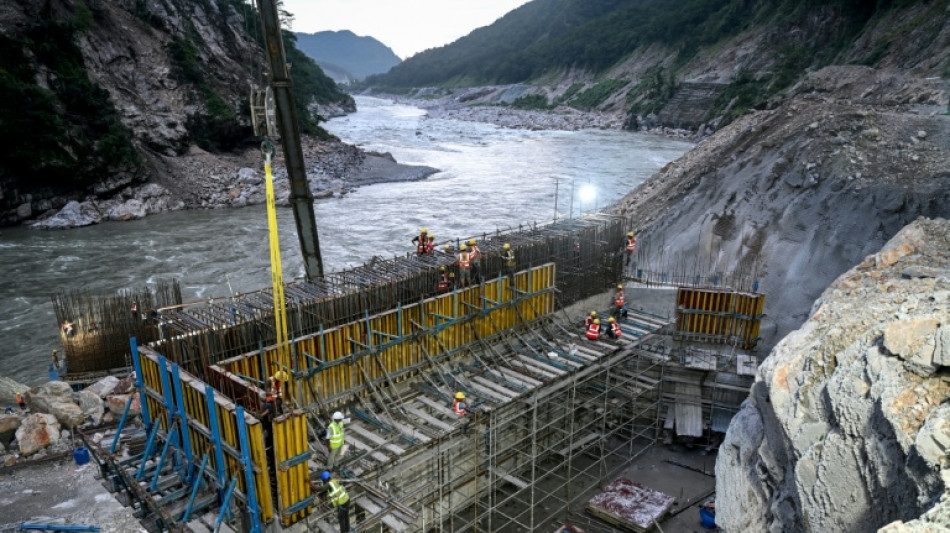
The project comes as China presses ahead with the $167 billion Yaxia project upstream of Riew on the river known in India as the Siang, and in Tibet as the Yarlung Tsangpo.
China's plan includes five hydropower stations, that could produce three times more electricity than its vast Three Gorges dam -- the world's largest power station -- though other details remain scant.
Beijing -- which lays claim to Arunachal Pradesh, fiercely rejected by India -- says it will have no "negative impact" downstream.
"China has never had, and will never have, any intention to use cross-border hydropower projects on rivers to harm the interests of downstream countries or coerce them," Beijing's foreign ministry told AFP.
Chinese media reports suggest the project may be more complex than a single giant dam, and could involve diverting water through tunnels.
The area around the village of Riew is one of the shortlisted sites for India's response mega-dam, a project that people like Jamoh feel is the more immediate threat to them.
"If the river is dammed, we also cease to exist," the 69-year-old told AFP, saying that the arrow's tip was dipped in poisonous herbs foraged from the mountains.
"Because it is from the Siang that we draw our identity and culture," he added.
-'Water bomb'-
Despite a thaw between New Delhi and Beijing, the two most populous nations have multiple areas of disputed border manned by tens of thousands of troops, and India has made no secret of its concerns.
The river is a tributary of the mighty Brahmaputra, and Indian officials fear China could use its dam as a control tap -- to create deadly droughts or release a "water bomb" downstream.
China rejects that, saying that the "hype surrounding the Yaxia Hydropower Project as a 'water bomb' is groundless and malicious".
But Arunachal Pradesh state Chief Minister Pema Khandu said protective action against China's dam is a "national security necessity", and sees India's dam as a safety valve to control the water.
"China's aggressive water resource development policy leaves little room for downstream riparian nations to ignore it," said Maharaj K. Pandit, a Himalayan ecology specialist at the National University of Singapore.
India's dam could produce 11,200-11,600 megawatts of hydropower, making it the country's most powerful by a huge margin, and helping scale back emissions from its coal-dependent electricity grid.
But generating power is not the priority, acknowledged a senior engineer from National Hydropower Corporation (NHPC) -- the federal agency contracted to develop the dam.
"It is meant for water security and flood mitigation -- if China seeks to weaponise their dam and use it like a water bomb," the engineer said on condition of anonymity as he was not authorised to talk to reporters.
"During the lean season, the reservoir will be filled to capacity, so that it can add in if water is diverted upstream," the officer said. "That is the calculation."
In the rains, water will only reach up two-thirds of the dam wall -- so there is capacity to absorb water if released suddenly by China.
India's former ambassador to Beijing, Ashok K. Kantha, called China's dam project "reckless" and said that India's dam, as well as generating power, would be a "defensive measure" against potential attempts "to regulate the flow of water".
- 'Identity and culture' -
India's dam would create a giant storage reservoir of 9.2 billion cubic metres, but the exact area flooded depends on the final location of the dam.
The Adi people, like Jamoh, consider the river sacred and depend on its life-giving waters for their lush lands dotted with orange and jackfruit trees.
They fear the dam will drown their world.
"We are children of the Siang," said Jamoh, who was the former headman of Riew -- before being forced to quit by local government authorities for protesting against the dam.
In May, furious Adi villagers blocked NHPC from surveying a proposed site.
Today, government paramilitary forces watch over the charred remains of the drilling machines that protesters torched. But the protests have not stopped.
When AFP visited, thousands gathered to hold a traditional court-style meeting of Adi clans to condemn the proposed dam.
"We are asking for a project plan to have an idea of the magnitude of the dam," said Bhanu Tatak of the Siang Indigenous Farmer's Forum (SIFF), a local protest group.
"Instead they have militarised us, treating us like extremists," she said.
The dam, the local residents are convinced, would drown dozens of villages.
"If they build a huge dam, the Adi community will vanish from the map of the world," said Likeng Libang, from Yingkiong, a town that even officials say is likely to be entirely underwater.
"The Adi will be totally displaced," he added. "We will be nowhere."
NHPC did not respond to AFP's requests for comment.
- 'Dam-for-dam'-
India's "dam-for-dam" approach may be counterproductive, said Anamika Barua, a transborder water governance expert at the Indian Institute of Technology Guwahati.
"Diplomatic engagement, transparent water-sharing agreements, and investment in cooperative river basin management would yield more durable and equitable outcomes than reactive infrastructure building," she said.
Building mega-dams in earthquake-prone Arunachal Pradesh is also risky, said Barua.
But India's construction drive of massive dams suggests it will not back down on this project. Two other major dams overcame local resistance.
"If the dam must be built, I hope I die before that day comes," said bow-and-arrow-wielding Jamoh.
H.Carroll--TFWP