'Let's go fly a kite': Capturing wind for clean energy in Ireland / Photo: © AFP

On Ireland's blustery western seaboard researchers are gleefully flying giant kites -- not for fun but in the hope of generating renewable electricity and sparking a "revolution" in wind energy.
"We use a kite to capture the wind and a generator at the bottom of it that captures the power," Padraic Doherty of Kitepower, the Dutch firm behind the venture, told AFP.
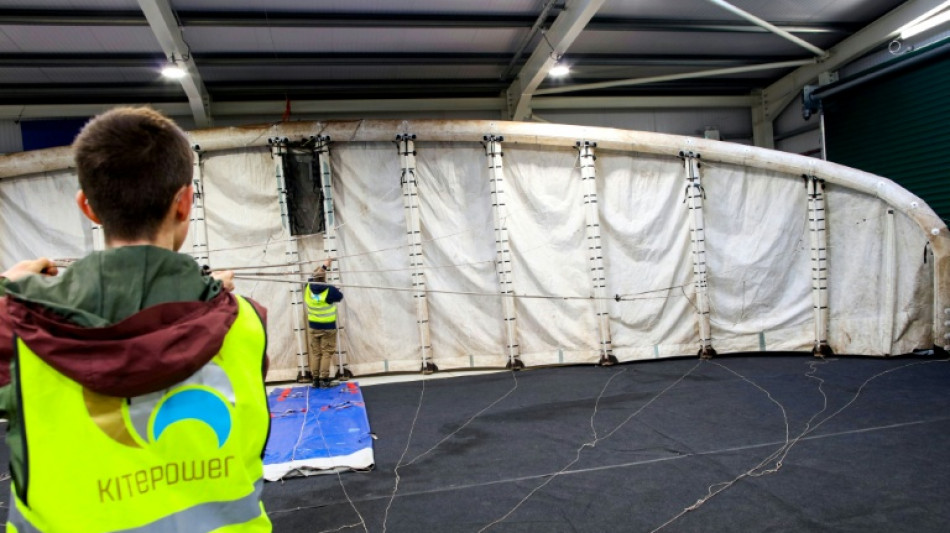
At its test site in operation since September 2023 near the small town of Bangor Erris, the team transports the vast 60-square-metre (645,000-square-feet) kite from a hangar across the lunar-like bogland to a generator.
The kite is then attached by a cable tether to the machine and acts like a "yo-yo or fishing reel", Doherty said.
"It gets cast out and flies up, the tether pulls it back in, over and over again, creating energy," he said, testing the kite's ropes and pulleys before a flight.
The sparsely populated spot near the stormy Atlantic coast is the world's first designated airborne renewable energy test site.
And although the idea is still small in scale, it could yet prove to be a mighty plan as Ireland seeks to cut its reliance on fossil fuels such as oil and gas.
"We are witnessing a revolution in wind energy," said Andrei Luca, operations head at Kitepower, a zero-emissions energy solutions spin-off from the Delft University of Technology.
"It took nearly 25 years for wind turbines to evolve from 30 kilowatt prototypes to megawatt scale, and decades to offshore wind farms we see today," he added.
The system flies autonomously, driven by software developed at the university in the Netherlands, but Doherty acts as the kite's "pilot" on the ground, monitoring its flight path for efficiency.
The kite flies up around 400 metres (1,300 feet) and reels in to about 190 metres, generating around 30 kilowatts per hour for storage.
The force spins "like a dynamo on a bike", Doherty said, adding that "it generates up to two and a half tonnes of force through each turn".
The electricity is stored in batteries, similar to solar photovoltaic systems, with the kite currently able to fully charge a 336 kilowatt per hour battery.
"That's a meaningful amount of energy, sufficient for powering a remote outpost, a small island, polar station, or even a construction site," Luca said.
"Add additional kites and we can power a bigger island."
- 'Mobile, flexible' -
According to Doherty, a chief advantage of the kite system is its flexibility and swift start-up capability.
"We can set up in 24 hours and can bring it anywhere, it's super mobile, and doesn't need expensive, time- and energy-consuming turbine foundations to be built," he said.
A kite system is "way less invasive on the landscape (than wind turbines), produces clean energy and doesn't need a supply chain of fuel to keep running", Luca added.
During January's Storm Eowyn, which caused widespread and long-lasting power outages in Ireland, the system showed its value in Bangor Erris, according to Luca.
"Paired with a battery, it provided uninterrupted electricity before, during and after the storm," he said.
Ireland's wind energy sector has long been touted as full of potential.
But progress on large-scale delivery of onshore and offshore turbines has been held up by planning delays and electricity grid capacity constraints.
The Irish government has set ambitious targets for offshore wind energy to deliver 20 gigawatts of energy by 2040 and at least 37 gigawatts by 2050.
In 2024, Irish wind farms provided around a third of the country's electricity according to Wind Energy Ireland (WEI), a lobby group for the sector.
This compares to the UK where, according to trade association RenewableUK, wind energy from the country's combined wind farms first reached 20 gigawatts in November 2022.
The ability of airborne wind energy (AWE) systems to harness high-altitude winds with relatively low infrastructure requirements "makes them particularly suitable for remote, offshore or mobile applications," Mahdi Salari, an AWE researcher at University College Cork, told AFP.
But he said Kitepower would face challenges on "regulation, safety, and system reliability".
Such technology however could plug gaps in places where "land availability, costs or logistical constraints hinder the deployment of traditional wind turbines", Salari said.
By the 2030s, he said: "I expect AWE to contribute meaningfully to diversified, flexible and distributed renewable energy networks".
F.Carrillo--TFWP