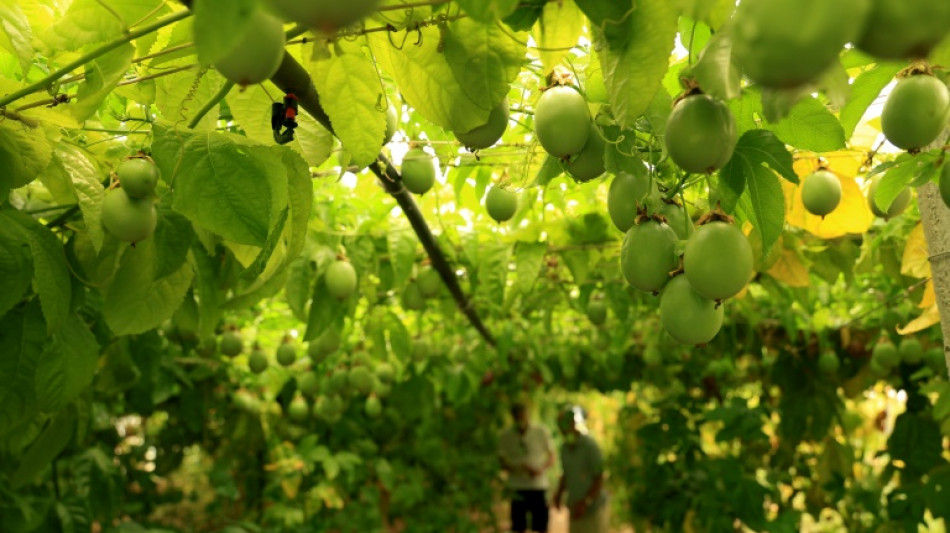
'Garden of Eden': Albania eyes up growing exotic fruit for Europe / Photo: © AFP

Passion fruit, guava, dragon fruit or kiwano -- climate change is sparking Albanian farmers to start growing exotic fruits to sell to Europe.
Veteran agronomist Irakli Shkoza's small farm not far from sea in central Albania is a kind of Garden of Eden in the Adriatic sun.
With temperatures rising every year, Shkoza hit upon the idea to diversify back in 2019 at a time in his life when others would already have been long retired.
The 75-year-old first brought seeds from Africa and America and planted them on his two-hectare (4.9-acre) plot.
All plants have adapted very well to the warm local climate.
Nestled between rolling farmland and the sea, the Divjaka region was the granary of Albania, with farmers there now growing vegetables and watermelons for local and export markets.
- Warming planet -
But rising temperatures and a worker shortage -- the small Balkan nation of 2.7 million has lost 400,000 people in a decade -- have taken their toll on farms.
"Exotic fruits need less water and maintenance which makes production costs lower," Shkoza said.
Albania's typical Mediterranean climate, with hot, dry summers and mild winters, has changed due to global warming.
By the end of the century, average temperatures in the Western Balkans are projected to rise between 3.5 and 8.8 degrees Celsius, based on a 2022 study, assuming moderate to high greenhouse gas emissions continue.
Heatwaves "will probably damage crop yields, particularly in Albania, where average temperatures are highest during the summer", according to researchers Daniel Muller and Max Hofmann from the Leibniz Institute of Agricultural Development in Transition Economies.
Agriculture, forestry and fishing accounted for 19 percent of Albania's gross domestic product in 2020.
But climate change need not be completely disastrous, Shkoza said, if we adapt to take advantage of it.
Albanian farmers need to start producing a lot of exotic fruit crops to profit from their favourable climate, he insisted.
"These fruits are very much in demand on the European market, but they come from far away, Latin America, Southeast Asia, New Zealand, Australia."
Their transport to Europe has a cost, both financially and in terms of freshness.
If they came from Albania not only would they be cheaper, they would be fresher, argued agronomist Altin Hila.
The papayas found on European markets are harvested while still green and then brought to Europe where they ripen artificially, said Vasil Nikolovski, a production manager from North Macedonia who has been working in Divjaka for several years.
"Here, they can ripen on the trees," he added.
"Albania has the capacity to meet European market demands and with exotic fruits exports and could make a turnover of 100 to 200 million euros annually."
- Abundant harvest -
Shkoza is already exporting dragon fruit, passion fruit and pepinos, or melon pears which originate in Latin America, to European markets.
With other farmers in the Divjaka region, he recently sent 30 tons of kiwano, also known as the African horned cucumber, to buyers in Croatia.
"And this year's harvest looks set to be abundant," he said looking at the buds on his dragon fruit flowers.
Some 55 kilometres (34 miles) to the west near Elbasan, Lulzim Bullari has started growing kiwis.
"We cannot complain about the high temperatures, the last two years kiwi production has been a blessing," he told AFP standing in the middle of his 40 hectares of orchards.
The kiwis he grows are almost exclusively for export to Switzerland and the Netherlands.
Recently, Bullari has also started growing fig trees from North Africa, which are highly resistant to the mild winter climate, on around 15 hectares.
"Luck favours the bold and you have to run to catch it," Bullari said.
J.P.Cortez--TFWP