The Fort Worth Press - US moves to protect all species of pangolin, world's most trafficked mammal

USD -
AED 3.672498
AFN 66.374624
ALL 82.891062
AMD 382.105484
ANG 1.790055
AOA 917.000062
ARS 1446.012497
AUD 1.507159
AWG 1.80125
AZN 1.696321
BAM 1.678236
BBD 2.018646
BDT 122.628476
BGN 1.678799
BHD 0.377004
BIF 2961.256275
BMD 1
BND 1.297979
BOB 6.925579
BRL 5.308276
BSD 1.002244
BTN 90.032049
BWP 13.315657
BYN 2.90153
BYR 19600
BZD 2.015729
CAD 1.39434
CDF 2229.999722
CHF 0.803265
CLF 0.023388
CLP 917.48999
CNY 7.07165
CNH 7.06845
COP 3796.99
CRC 491.421364
CUC 1
CUP 26.5
CVE 94.616395
CZK 20.780297
DJF 178.481789
DKK 6.41071
DOP 63.686561
DZD 130.095982
EGP 47.573803
ERN 15
ETB 156.280403
EUR 0.85834
FJD 2.25895
FKP 0.748861
GBP 0.749415
GEL 2.702791
GGP 0.748861
GHS 11.416779
GIP 0.748861
GMD 73.000197
GNF 8709.00892
GTQ 7.677291
GYD 209.68946
HKD 7.78486
HNL 26.389336
HRK 6.469717
HTG 131.282447
HUF 327.824502
IDR 16672.15
ILS 3.227675
IMP 0.748861
INR 89.943497
IQD 1312.956662
IRR 42125.000154
ISK 127.891881
JEP 0.748861
JMD 160.623651
JOD 0.708935
JPY 155.116016
KES 129.350006
KGS 87.450106
KHR 4014.227424
KMF 422.000183
KPW 899.993191
KRW 1472.790097
KWD 0.30692
KYD 0.83526
KZT 506.587952
LAK 21742.171042
LBP 89752.828464
LKR 309.374155
LRD 176.902912
LSL 17.013777
LTL 2.95274
LVL 0.60489
LYD 5.447985
MAD 9.247548
MDL 17.048443
MGA 4457.716053
MKD 52.892165
MMK 2099.939583
MNT 3546.502114
MOP 8.035628
MRU 39.710999
MUR 46.070021
MVR 15.410227
MWK 1737.95151
MXN 18.18323
MYR 4.110977
MZN 63.897632
NAD 17.013777
NGN 1451.00023
NIO 36.881624
NOK 10.10595
NPR 144.049872
NZD 1.731465
OMR 0.384521
PAB 1.002325
PEN 3.37046
PGK 4.251065
PHP 59.062503
PKR 283.139992
PLN 3.631096
PYG 6950.492756
QAR 3.663323
RON 4.372698
RSD 100.76903
RUB 76.754244
RWF 1458.303837
SAR 3.753032
SBD 8.223823
SCR 13.591833
SDG 601.506379
SEK 9.409525
SGD 1.295095
SHP 0.750259
SLE 23.000169
SLL 20969.498139
SOS 571.823287
SRD 38.643499
STD 20697.981008
STN 21.023817
SVC 8.769634
SYP 11058.244165
SZL 17.008825
THB 31.850427
TJS 9.210862
TMT 3.5
TND 2.941946
TOP 2.40776
TRY 42.51338
TTD 6.795179
TWD 31.288803
TZS 2440.000231
UAH 42.259148
UGX 3553.316915
UYU 39.265994
UZS 11939.350775
VES 248.585899
VND 26360
VUV 122.070109
WST 2.790151
XAF 562.862377
XAG 0.017179
XAU 0.000237
XCD 2.70255
XCG 1.806356
XDR 0.70002
XOF 562.867207
XPF 102.334841
YER 238.40123
ZAR 16.92185
ZMK 9001.199161
ZMW 23.026725
ZWL 321.999592
  • RYCEF

    0.0500

    14.7

    +0.34%

  • BCC

    -0.4900

    73.77

    -0.66%

  • NGG

    0.0500

    75.96

    +0.07%

  • RIO

    -0.0750

    73.655

    -0.1%

  • CMSD

    0.0200

    23.34

    +0.09%

  • RELX

    0.1600

    40.7

    +0.39%

  • GSK

    -0.2400

    48.33

    -0.5%

  • VOD

    -0.1620

    12.471

    -1.3%

  • RBGPF

    0.0000

    78.35

    0%

  • BTI

    -0.8650

    57.175

    -1.51%

  • AZN

    0.9500

    90.98

    +1.04%

  • SCS

    -0.0400

    16.19

    -0.25%

  • BCE

    0.1930

    23.413

    +0.82%

  • JRI

    0.0330

    13.783

    +0.24%

  • CMSC

    -0.0450

    23.43

    -0.19%

  • BP

    -0.6050

    36.625

    -1.65%

US moves to protect all species of pangolin, world's most trafficked mammal
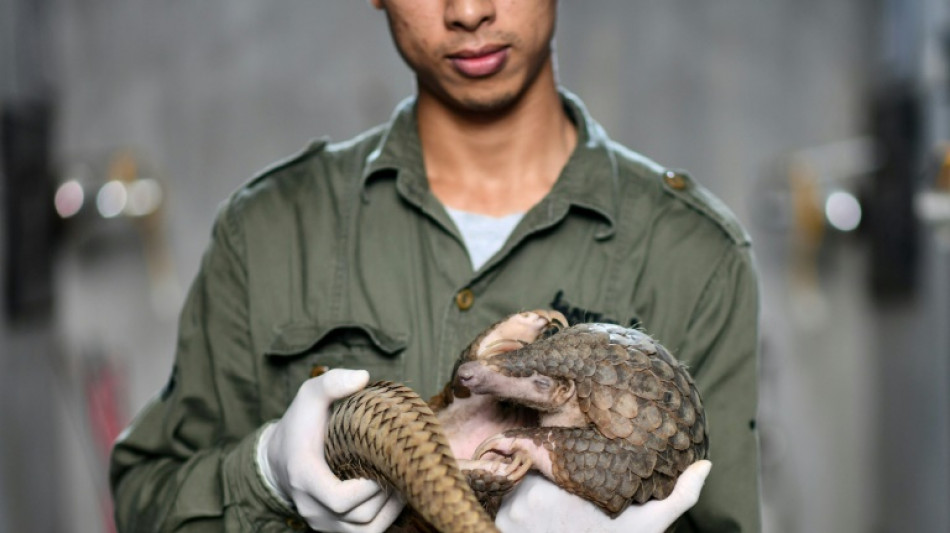
US moves to protect all species of pangolin, world's most trafficked mammal / Photo: © AFP/File

US moves to protect all species of pangolin, world's most trafficked mammal

The United States on Monday moved to extend federal protections to all species of pangolins -- a step that would tighten trade restrictions and highlight the urgent conservation plight of the world's only scaly mammals.

Text size:

Found in the forests, woodlands, and savannas of Africa and Asia, pangolins are small, nocturnal creatures known for their distinctive appearance, slow and peaceful demeanor, and habit of curling into a ball when threatened.

Often likened to a walking pinecone, they use long, sticky tongues to feast on ants and termites, give birth to a single pup each year -- and are the most heavily trafficked mammals on Earth. Their keratin scales are coveted in traditional medicine, and their meat is also considered a delicacy in some regions.

Despite steep population declines driven by poaching, habitat loss, and inbreeding, only one species — Temminck's pangolin of Africa -- is currently protected under the US Endangered Species Act. Monday's proposal by the US Fish and Wildlife Service would extend that status to all eight known species.

In a statement, the agency said it intends to list the four Asian species -- Chinese, Indian, Sunda, and Philippine -- as well as the three other African species: white-bellied, black-bellied, and giant pangolins.

"I'm delighted the United States is doing its part to save these adorably odd creatures," said Sarah Uhlemann, international program director at the Center for Biological Diversity.

"Pangolins are on the razor's edge of extinction, and we need to completely shut down any US market for their scales. There's no good reason for anybody to ingest any part of a pangolin."

Pangolins are currently protected under the Convention on International Trade in Endangered Species of Wild Fauna and Flora (CITES), which prohibits international trade for commercial purposes and allows it only under exceptional circumstances.

Still, the illegal trade persists.

In April, Nigerian authorities seized nearly four tons of trafficked pangolin scales — representing the slaughter of some 2,000 animals. In November 2024, Indonesian officials intercepted another 1.2 tons.

US demand remains a factor. Between 2016 and 2020, border officials intercepted 76 shipments of pangolin parts, including scales and products marketed for traditional medicine, according to public data.

T.Dixon--TFWP