RIO
-0.3300

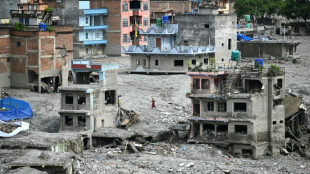
An artificial lake building up behind the rubble left by a glacier that dramatically plunged down a Swiss mountainside, destroying a village, is beginning to drain, authorities said Friday, reducing fears of a second catastrophe.
The huge barricade of debris formed when the Birch glacier collapsed on Wednesday has blocked the river Lonza in Switzerland's southern Wallis region, fuelling concern the dam of rubble could give way and flood the valley.
But as reconnaissance flights and inspections progressed, authorities said the water from the newly formed lake, which has been slowly submerging the remaining houses in the obliterated village of Blatten, was beginning to find its way over, through and around the blockage.
"This development is positive, but we remain cautious," said Stephane Ganzer, head of the regional security department.
"The risk remains, even if it is diminishing," he told a press conference, stressing that "no evacuations are planned" in the villages downstream in the Lotschental valley, one of the most beautiful in southern Switzerland.
The outflow "makes us optimistic and suggests that the water is finding a good path", explained Christian Studer of the Wallis canton's Natural Hazards Service.
However, work to pump water from the lake has still not begun as the ground remains too unstable, particularly on the mountainside.
The Lotschental valley stretches for just under 30 kilometres (20 miles) and is home to around 1,500 inhabitants.
It is renowned for the beauty of its landscapes dominated by snow-capped peaks, its small traditional villages, and its spectacular hiking trails.
But its face has been forever changed by the glacier collapse.
- One person still missing -
Authorities remain on alert, and communities downstream from the landslide, including in the Rhone Valley, which the Lonza flows into, are nonetheless preparing for a possible evacuation.
An artificial dam in the village of Ferden, downstream in the Lotschental valley, has been emptied and should be able to contain any downward rush of water, authorities say.
One 64-year-old man, believed to have been in the danger zone at the time, remains missing.
The collapsed glacier destroyed most of Blatten, which had been home to 300 people and was evacuated last week due to the impending danger.
"That shows the importance of early warnings and early action," Clare Nullis, spokeswoman for the World Meteorological Organization, told a press briefing in Geneva.
"The landscape will never be the same again. The village will never be the same again. But it is an example of how we can use forecasts and warnings to save people's lives," she said.
Nullis said the Swiss had provided a "textbook example" of what should be done, but stressed that not all countries had such highly developed early warning systems in place.
The landslide was so heavy it was even picked up by Switzerland's seismographs.
"This is probably the most catastrophic event for the last 150 years in Switzerland and probably in the whole Alps," in terms of a rock and ice avalanche, Christophe Lambiel, senior lecturer at the University of Lausanne's Institute of Earth Surface Dynamics, told AFP.
- 'Erased within seconds' -
The glacier was below the 3,342-metre (10,965-foot) high Kleines Nesthorn peak.
In the fortnight before its collapse, a series of falls from the mountain dumped three million cubic metres of rock onto the ice surface.
That increased the weight, and with the glacier on a steep slope, it ultimately gave way in dramatic fashion, plunging down on Blatten, at 1,540 metres' altitude in the valley floor.
Experts said it was too early to make a direct link to climate change, but told AFP that thawing permafrost in the cracks in the rock likely played a role in destabilising the mountain.
Matthias Huss, the director of Glacier Monitoring Switzerland (GLAMOS), said the drastic collapse might bring global attention to the Alpine glaciers, and ultimately the impact of climate change on them.
"Often a big disaster has to strike before people realise that something is going on," he told AFP.
"It's very tangible: the destruction of a whole village is easily understandable to everybody. People have lived there for hundreds of years -- and everything has been erased within seconds."
H.M.Hernandez--TFWP