The Fort Worth Press - Toxic algae killing marine life off Australian coast

USD -
AED 3.672505
AFN 64.999617
ALL 81.873378
AMD 378.439629
ANG 1.79008
AOA 917.000017
ARS 1444.993898
AUD 1.424623
AWG 1.8025
AZN 1.698328
BAM 1.658498
BBD 2.01317
BDT 122.152876
BGN 1.67937
BHD 0.37697
BIF 2962.5
BMD 1
BND 1.270543
BOB 6.906845
BRL 5.239098
BSD 0.999546
BTN 90.307481
BWP 13.806116
BYN 2.86383
BYR 19600
BZD 2.010235
CAD 1.36445
CDF 2199.999975
CHF 0.776105
CLF 0.021794
CLP 860.539972
CNY 6.938197
CNH 6.93502
COP 3646.93
CRC 496.408795
CUC 1
CUP 26.5
CVE 93.750278
CZK 20.60345
DJF 177.720253
DKK 6.32319
DOP 63.000254
DZD 129.900254
EGP 47.009197
ERN 15
ETB 155.042675
EUR 0.846625
FJD 2.198801
FKP 0.732491
GBP 0.730199
GEL 2.695012
GGP 0.732491
GHS 10.944975
GIP 0.732491
GMD 73.000094
GNF 8753.999774
GTQ 7.666672
GYD 209.120397
HKD 7.813115
HNL 26.408086
HRK 6.376701
HTG 131.107644
HUF 322.478502
IDR 16766
ILS 3.082015
IMP 0.732491
INR 90.36925
IQD 1309.380459
IRR 42125.000158
ISK 122.749952
JEP 0.732491
JMD 156.640605
JOD 0.709028
JPY 155.879497
KES 129.000415
KGS 87.449822
KHR 4081.504905
KMF 417.999853
KPW 899.987247
KRW 1450.779878
KWD 0.30715
KYD 0.83298
KZT 501.119346
LAK 21499.832523
LBP 89508.041026
LKR 309.380459
LRD 185.911623
LSL 16.009531
LTL 2.95274
LVL 0.60489
LYD 6.319217
MAD 9.168716
MDL 16.926717
MGA 4429.877932
MKD 52.189044
MMK 2100.119929
MNT 3568.429082
MOP 8.04357
MRU 39.901294
MUR 45.890045
MVR 15.450054
MWK 1733.257012
MXN 17.245898
MYR 3.932499
MZN 63.750319
NAD 16.009531
NGN 1391.85959
NIO 36.785781
NOK 9.627875
NPR 144.492309
NZD 1.656195
OMR 0.384498
PAB 0.999521
PEN 3.364907
PGK 4.282347
PHP 59.040236
PKR 279.545138
PLN 3.57644
PYG 6631.277242
QAR 3.634567
RON 4.313702
RSD 99.384049
RUB 76.999691
RWF 1458.783824
SAR 3.750106
SBD 8.058101
SCR 13.748799
SDG 601.49205
SEK 8.90851
SGD 1.270205
SHP 0.750259
SLE 24.475005
SLL 20969.499267
SOS 570.272883
SRD 38.114499
STD 20697.981008
STN 20.775741
SVC 8.746163
SYP 11059.574895
SZL 16.015332
THB 31.639928
TJS 9.340767
TMT 3.51
TND 2.890372
TOP 2.40776
TRY 43.496603
TTD 6.770319
TWD 31.588801
TZS 2584.040204
UAH 43.256279
UGX 3563.251531
UYU 38.49872
UZS 12236.487289
VES 371.640565
VND 26002
VUV 119.537583
WST 2.726316
XAF 556.244594
XAG 0.011767
XAU 0.000201
XCD 2.70255
XCG 1.801384
XDR 0.691072
XOF 556.244594
XPF 101.131218
YER 238.374992
ZAR 15.96902
ZMK 9001.202602
ZMW 19.615608
ZWL 321.999592
  • RBGPF

    0.1000

    82.5

    +0.12%

  • CMSC

    -0.0900

    23.66

    -0.38%

  • RYCEF

    0.2800

    16.95

    +1.65%

  • NGG

    1.6200

    86.23

    +1.88%

  • GSK

    0.8700

    53.34

    +1.63%

  • BTI

    0.8800

    61.87

    +1.42%

  • BP

    1.1200

    38.82

    +2.89%

  • RIO

    3.8500

    96.37

    +4%

  • AZN

    -4.0900

    184.32

    -2.22%

  • RELX

    -5.0200

    30.51

    -16.45%

  • SCS

    0.0200

    16.14

    +0.12%

  • VOD

    0.3400

    15.25

    +2.23%

  • CMSD

    -0.1400

    23.94

    -0.58%

  • JRI

    -0.0300

    13.12

    -0.23%

  • BCE

    0.2700

    26.1

    +1.03%

  • BCC

    3.1800

    84.93

    +3.74%

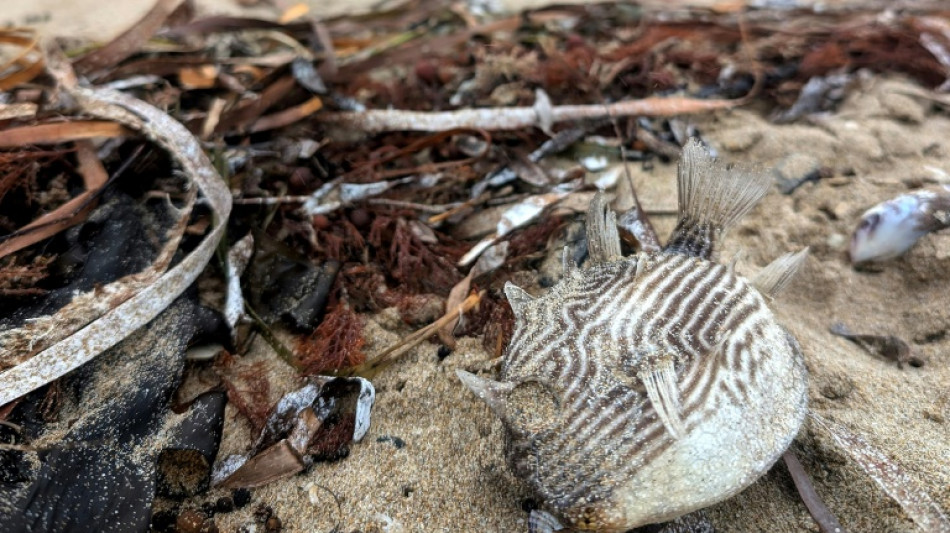
Toxic algae killing marine life off Australian coast
Toxic algae killing marine life off Australian coast / Photo: © OZFISH/AFP

Toxic algae killing marine life off Australian coast

A vast bloom of toxic algae is killing more than 200 species of marine life off the southern coast of Australia, scientists and conservation groups say.

Text size:

The algae -- Karenia mikimotoi -- appeared in waters around South Australia state in March, causing mass deaths in species including sharks, rays, crabs and octopuses.

"There are carcasses littering beaches," said Brad Martin, a manager of the non-profit fish conservation group Ozfish.

"It is common for our volunteers to say: 'We walked for one kilometre along the beach and saw 100 dead rays and other marine life'," he told AFP.

Beaches on wildlife-rich tourist draws such as Kangaroo Island, Yorke Peninsula and Fleurieu Peninsula have been affected.

The bloom stretches across 4,400 square kilometres (1,700 square miles), Martin said -- an area larger than Japan or Germany.

Karenia mikimotoi has been detected around the world since the 1930s, including off Japan, Norway, the United States and China where it has disrupted local tourism and fishery industries, causing millions of dollars worth of damage.

But Martin said South Australia had not previously experienced a toxic algae bloom of this scale or duration.

The South Australian government said the event is thought to have been driven by a marine heatwave, as well as relatively calm marine conditions.

Marine biologist Shauna Murray, who identified the algae species for the authorities, said it damages the gills of fish and prevents them from breathing.

"It is not pleasant," said Murray, from the University of Technology Sydney.

"It will probably take some time for the ecosystem to recuperate."

While conditions usually ease towards the end of April, there had been no relief yet, South Australian Environment Minister Susan Close said this month.

"We need a big change in weather to break this thing up -- there is nothing we can do to precipitate this," she told national broadcaster ABC.

In the meantime, South Australian authorities have urged beachgoers to avoid swimming in water that is discoloured or foamy, warning that it can irritate the skin and affect breathing.

Climate change has led to an increase in the frequency and duration of marine heatwaves across Australia, which significantly affects marine ecosystems.

D.Johnson--TFWP