UK towns harness nature to combat rising flood risk / Photo: © AFP

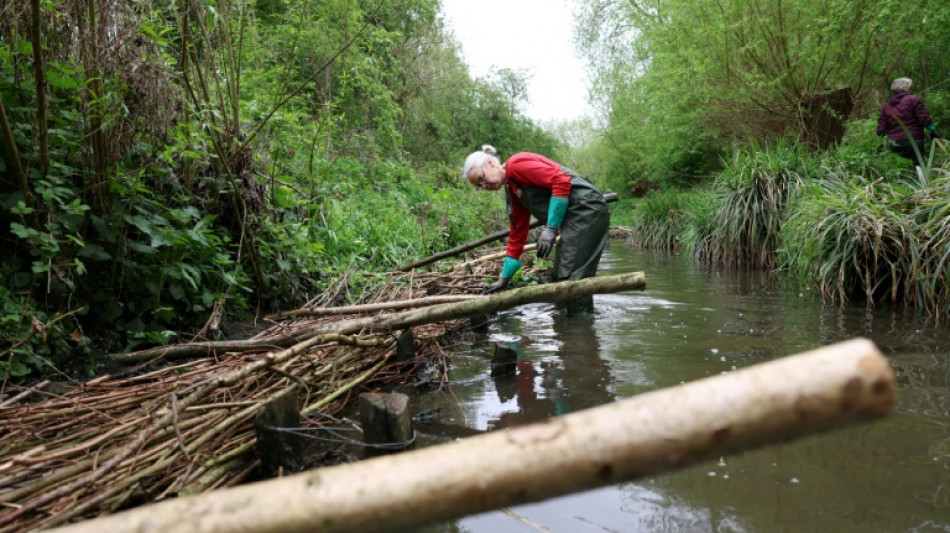
In a stream near Leicester in central England, six volunteers in waterproof overalls and boots busily reinforced mini wooden structures designed to combat the rising flooding threat.
The city, like many others in the UK, has experienced several intense rainfall events in recent years, which have caused significant damage.
Alert to climate change, which intensifies these events, authorities are strengthening their defences and turning to solutions more sympathetic with the environment.
With their feet firmly planted on the bed of the Saffron Brook, a tributary of the River Soar that runs through Leicester, the volunteers ensured the structures' wooden bundles were securely anchored.
These structures create bends that "change the behaviour of the river" and slow down water in stretches where it currently flows "straight and very fast," said Dan Scott, who leads the programme at the Trent Rivers Trust, a local group working to protect rivers.
He regularly oversees the installation of new facilities.
A few months ago, the trust dug a pond on a river near the town of Loughborough and installed dozens of leaky wooden barriers to better protect downstream houses that flooded in the past.
These techniques are "complementary to traditional flood defences" such as retention basins and canals that are increasingly under strain, Scott said.
They "help to store some of that water upstream so that those traditional flood defences don't get overwhelmed, and if they do, it's not as quickly as if these features weren't in place," he added.
They also help to maintain biodiversity.
- 'Urgent problem' -
More than 6.3 million properties are at risk of flooding in the UK, and this figure will rise to more than eight million by 2050, according to a recent government report.
"Flooding is a really urgent societal problem," said Steven Forest, director of the Flood Risk Management Program at the University of Hull.
Climate events resulted in UK insurance payouts of more than £400 million ($532 million) in 2022 and more than £570 million in 2023 and 2024, half of which was related to flooding, according to the Association of British Insurers.
Beyond traditional defences, "we need to think about living with water, and we need to think about integrating water within our urban spaces," Forest added.
He cited the Netherlands, which allocates space for rivers to drain during heavy rainfall, and the United States, where vegetation "buffer zones" were created after Hurricane Sandy in 2012.
"Straight-jacketing" waterways with various infrastructure is no longer sufficient, Forest said, especially since seven percent of such structures were assessed to be in "poor" or "very poor" condition by the UK Environment Agency in 2022.
- Overcoming scepticism -
But convincing residents and authorities is not always an easy task as it often needs explaining that "just because we've not built a concrete solution, that it isn't going to be as effective," Scott said.
"It's also about re-educating people in government because it's easier for them to sell something (to voters) that's physical and much more prominent within the landscape," he added.
Traditional developments attracted the lion's share of the £2.6 billion announced by the government in March to fund new flood defence systems over the next two years.
But Scott noted a greater interest in natural flood management over the past five years, with the previous government launching a £25 million program last year.
As a result, Leicester will be able to develop several waterways southeast of the city, and 35 other projects have been selected in England.
"It is encouraging that our successful approach to natural flood management measures is continuing to be supported," Geoff Whittle, a local councillor responsible for the environment, told AFP.
Contemplating the fruits of her labour in Saffron, 50-year-old volunteer Lis Gibbs told AFP that "it feels like you can make a difference," in contrast to climate change in general, which "can feel really overwhelming".
G.George--TFWP