The Fort Worth Press - What the shell: scientists marvel as NZ snail lays egg from neck

USD -
AED 3.672498
AFN 65.498816
ALL 80.778943
AMD 366.249949
AOA 918.000153
ARS 1499.7458
AUD 1.422111
AWG 1.8
AZN 1.701353
BAM 1.694243
BBD 2.013626
BDT 123.754743
BHD 0.37711
BIF 2990
BMD 1
BND 1.281981
BOB 12.092258
BRL 5.1235
BSD 0.999753
BTN 95.145446
BWP 13.521485
BYN 2.960018
BYR 19600
BZD 2.010681
CAD 1.401435
CDF 2260.00015
CHF 0.812655
CLF 0.023195
CLP 915.880427
CNY 6.74905
CNH 6.747951
COP 3160.36
CRC 454.762008
CUC 1
CUP 26.5
CVE 96.149866
CZK 21.04075
DJF 177.720321
DKK 6.487735
DOP 58.29816
DZD 132.880362
EGP 49.6944
ERN 15
ETB 161.364703
EUR 0.86783
FJD 2.214449
FKP 0.742819
GBP 0.743335
GEL 2.615024
GGP 0.742819
GHS 11.735003
GIP 0.742819
GMD 74.000428
GNF 8780.000142
GTQ 7.628337
GYD 209.158083
HKD 7.84455
HNL 26.796086
HRK 6.538298
HTG 130.718954
HUF 316.998001
IDR 17919
ILS 3.007697
IMP 0.742819
INR 95.31225
IQD 1310.5
IRR 1374850.00036
ISK 123.589409
JEP 0.742819
JMD 158.474679
JOD 0.709016
JPY 158.445499
KES 129.359763
KGS 87.450205
KHR 4053.497124
KMF 426.999919
KRW 1424.140286
KWD 0.30966
KYD 0.833171
KZT 468.495939
LAK 22602.503172
LBP 89550.000065
LKR 335.825291
LRD 181.625033
LSL 16.339942
LTL 2.95274
LVL 0.60489
LYD 6.36971
MAD 9.329497
MDL 17.39541
MGA 4298.392651
MKD 53.396226
MMK 2099.443841
MNT 3595.840223
MOP 8.078327
MRU 40.101867
MUR 46.940215
MVR 15.459941
MWK 1736.000059
MXN 17.20735
MYR 4.093968
MZN 63.903992
NAD 16.340306
NGN 1362.889861
NIO 36.790312
NOK 9.538038
NPR 152.231048
NZD 1.704195
OMR 0.384497
PAB 0.999749
PEN 3.37939
PGK 4.41709
PHP 60.790954
PKR 277.55765
PLN 3.73435
PYG 5946.889469
QAR 3.654602
RON 4.560957
RSD 101.875989
RUB 82.998217
RWF 1468.660802
SAR 3.755132
SBD 8.068348
SCR 14.420084
SDG 600.498527
SEK 9.514745
SGD 1.283497
SLE 24.597666
SOS 571.386496
SRD 37.866497
STD 20697.981008
STN 21.223422
SVC 8.747553
SZL 16.339898
THB 33.119789
TJS 9.222706
TMT 3.505
TND 2.932323
TRY 47.691299
TTD 6.768972
TWD 32.219902
TZS 2654.997968
UAH 44.766628
UGX 3724.060864
UYU 40.264038
UZS 11914.620835
VES 754.21125
VND 26235
VUV 119.344278
WST 2.729216
XAF 568.230703
XAG 0.016234
XAU 0.000235
XCD 2.70255
XCG 1.801841
XDR 0.705886
XOF 568.233164
XPF 103.310868
YER 236.850097
ZAR 16.35625
ZMK 9001.202312
ZMW 19.020435
ZWL 321.999592
  • RBGPF

    0.0000

    69.74

    0%

  • CMSC

    -0.0100

    21.72

    -0.05%

  • RYCEF

    -0.0500

    20.95

    -0.24%

  • NGG

    0.1500

    80.41

    +0.19%

  • VOD

    0.6900

    16

    +4.31%

  • RELX

    -0.8600

    35.75

    -2.41%

  • GSK

    0.7100

    52.17

    +1.36%

  • AZN

    -0.4300

    161.07

    -0.27%

  • BP

    1.0200

    42.23

    +2.42%

  • BTI

    -0.5400

    58.73

    -0.92%

  • RIO

    -1.8600

    99.65

    -1.87%

  • BCE

    0.7100

    22.77

    +3.12%

  • CMSD

    -0.0600

    21.98

    -0.27%

  • BCC

    -0.5400

    84.26

    -0.64%

  • JRI

    -0.0100

    12.66

    -0.08%

What the shell: scientists marvel as NZ snail lays egg from neck
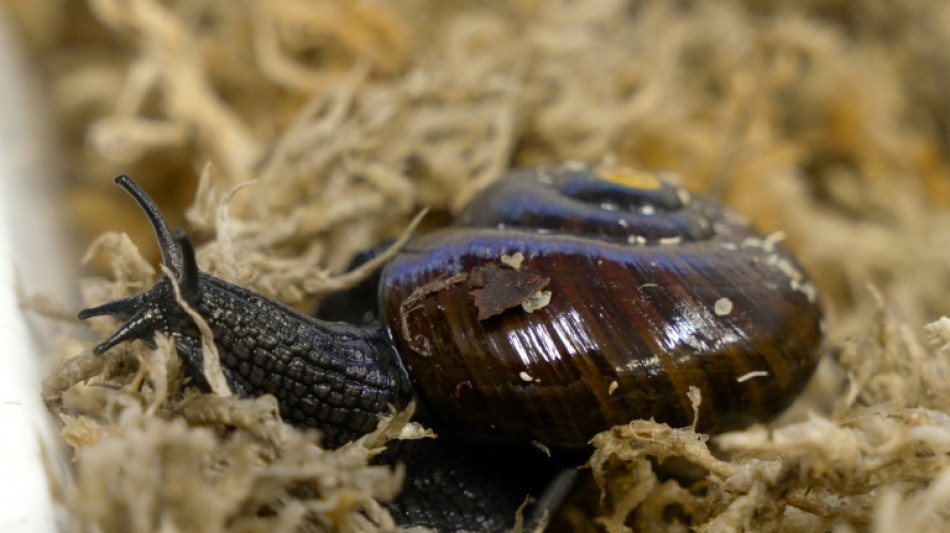
What the shell: scientists marvel as NZ snail lays egg from neck / Photo: © New Zealand Department of Conservation/AFP

What the shell: scientists marvel as NZ snail lays egg from neck

A rare New Zealand snail has been filmed for the first time squeezing an egg from its neck, delighting scientists trying to save the critically endangered meat-eating mollusc.

Text size:

Threatened by coal mining in New Zealand's South Island, a small population of the Mount Augustus snail was transplanted from its forest habitat almost 20 years ago to live in chilled containers tended by humans.

Little is known about the reproduction of the shellbound critters, which can grow so large that New Zealand's conservation department calls them "giants of the snail world".

A conservation ranger said she was gobsmacked to witness a captive snail laying an egg from its neck -- a reproductive act well documented in other land snails but never filmed for this species.

"It's remarkable that in all the time we've spent caring for the snails, this is the first time we've seen one lay an egg," conservation ranger Lisa Flanagan said this week.

"We caught the action when we were weighing the snail. We turned it over to be weighed and saw the egg just starting to emerge from the snail."

Conservation department scientist Kath Walker said hard shells made it difficult to mate -- so some snails instead evolved a special "genital pore" under their head.

The Mount Augustus snail "only needs to peek out of its shell to do the business," she said.

The long-lived snails can grow to the size of a golf ball and their eggs can take more than a year to hatch.

They eat earthworms, according to New Zealand's conservation department, which they slurp up "like we eat spaghetti".

Conservation efforts suffered a drastic setback in 2011, when a faulty temperature gauge froze 800 Mount Augustus snails to death inside their climate-controlled containers.

Fewer than 2,000 snails currently live in captivity, while small populations have been re-established in the New Zealand wild.

K.Ibarra--TFWP