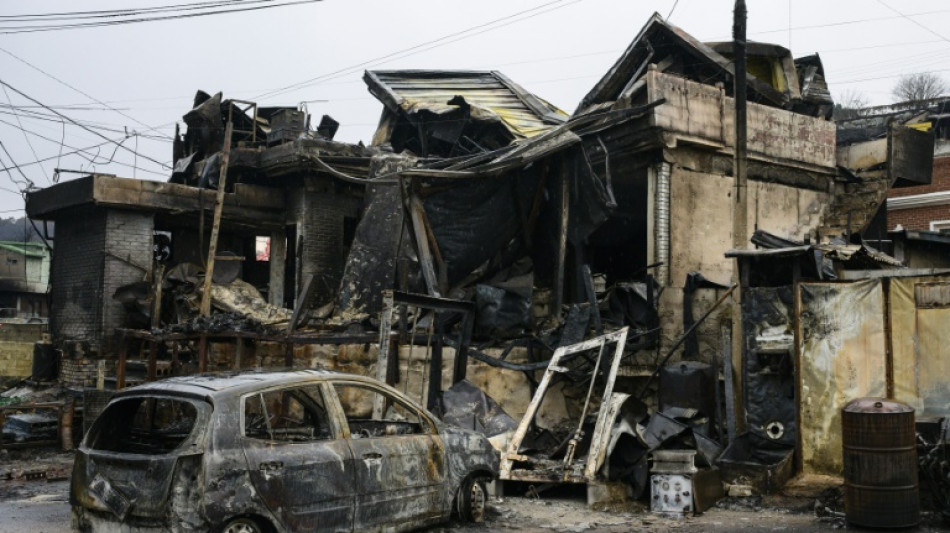
Climate change made fire conditions twice as likely in South Korea blazes: study / Photo: © AFP/File

Human-induced climate change made the ultra-dry and warm conditions that fanned South Korea's deadliest wildfires in history this March twice as likely and more intense, researchers said Thursday.
Vast swaths of the country's southeast were burned in a series of blazes in March, which killed 31 people and destroyed historic sites, including a some thousand-year-old temple site.
The affected area had been experiencing below-average rainfall for months and was then hit by strong winds, local officials said, following South Korea's hottest year on record in 2024.
The hot, dry and windy conditions that fed the flames were "twice as likely and about 15 percent more intense" due to human-caused climate change, said World Weather Attribution, a scientific network that studies the influence of global warming on extreme weather.
"South Korea's deadliest wildfires were made much more likely by climate change," said Clair Barnes, a WWA researcher from the Centre for Environmental Policy, Imperial College London.
Officials said at the time that the conditions made it very hard for conventional firefighting methods to control the blazes, which leapt from pine tree to pine tree across dried-out hillsides.
"These unprecedented conditions exposed the limits of even well-developed suppression systems," WWA said in a report of its findings.
"With fires increasingly likely to exceed control capacity, the emphasis must shift toward proactive risk reduction," it added.
More than 62 percent of South Korea is covered in forest, the report said, with dense tree cover especially prominent along the eastern coast and in mountainous regions, landscapes that significantly influence how wildfires spread.
Around 11 percent of South Korea's forested areas border human settlements, the study said.
"These areas are particularly susceptible to ignition and have accounted for nearly 30 percent of wildfires recorded between 2016 and 2022."
The researchers' findings were most conclusive regarding the increased likelihood of fire weather -- which is measured by the Hot-Dry-Windy Index (HDWI) -- and higher maximum temperatures.
But they found no attributable link between climate change and rainfall levels during the period surrounding the fires.
- Fires rage -
South Korea has few energy resources of its own and relies on imported coal -- a cheap but dirty fuel -- for around a third of the electricity powering it, according to figures from the International Energy Agency.
The inferno in March also laid bare the country's demographic crisis and regional disparities, as rural areas are both underpopulated and disproportionately home to senior citizens.
Many of the dead were seniors, and experts have warned that it will be hard for people to rebuild their lives in the burn zone.
In the weeks and months since, South Korea has recorded a string of wildfires.
In April, helicopters were deployed to contain a wildfire within the DMZ, the buffer zone separating the South from nuclear-armed North Korea.
This week, more than 2,000 people were forced to evacuate after wildfires occurred in parts of the southeastern city of Daegu, after a blaze broke out on Mount Hamji in the region.
WWA is a pioneer in attribution science, which uses peer-reviewed methods to quickly assess the possible influence of climate change on extreme weather events.
This allows a comparison of observations from today's climate, with some 1.3 degrees Celsius of warming, against computer simulations that consider the climate before humanity started burning fossil fuels in the 1800s.
A.Nunez--TFWP