Iraq farmers turn to groundwater to boost desert yield / Photo: © AFP

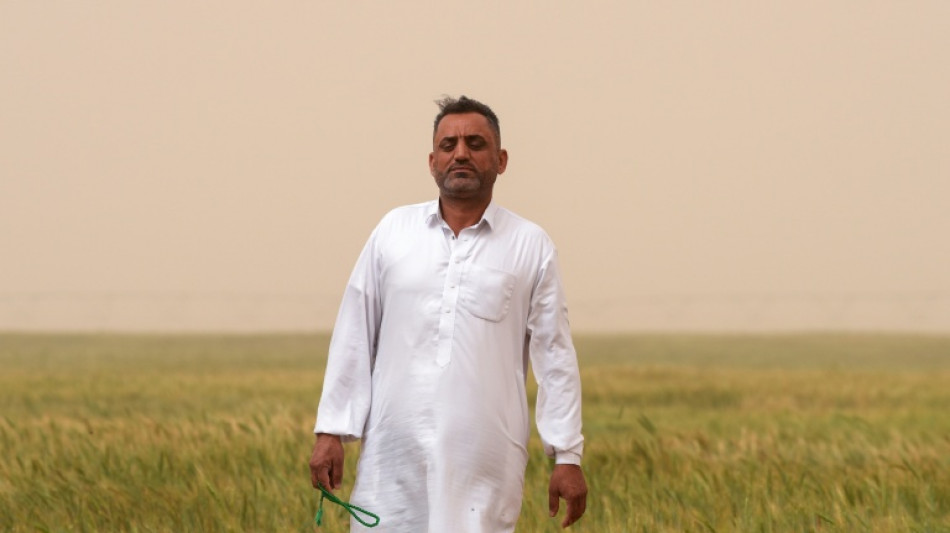
Farmer Hadi Saheb cannot wait to see his wheat fields flourish in the heart of the desert after he tapped into groundwater reserves in water-starved Iraq.
He is just one of many Iraqis who have turned to drilling wells in the desert to help sustain the country's agriculture.
It is a risky move that threatens to deplete the groundwater in a nation already battered by frequent drought and scarce rainfall.
Although Iraq's fertile plains traditionally stretch along the once-mighty Tigris and Euphrates -- the two rivers whose levels have plummeted -- Saheb's vast lands lie in the heart of the southern Najaf desert.
"Year after year the drought worsens, and the desertification intensifies," said the 46-year-old, dressed in a white abaya as a duststorm swept through the area.
So he has turned to groundwater, taking advantage of a government initiative.
This leases desert land to farmers at a symbolic price of one dollar per dunum (0.25 hectares in Iraq's measurement), provides subsidised irrigation systems, and buys their harvest at a preferential rate.
Now that he doesn't have to rely solely on rainfall, Saheb said he cultivates 20 times more land than before, and his harvest has increased to 250 tons.
"It would be impossible to continue without groundwater, which we cannot extract without drilling wells," he said.
Like many other farmers, Saheb has upgraded his irrigation techniques.
- 'Strategic reserve' -
He now relies on a centre-pivot method involving equipment rotating in a circle to water crops through sprinklers.
This uses at least 50 percent less water than flooding -- the vastly more wasteful traditional way used for millennia, during which the land is submerged.
According to the agriculture ministry, Iraq cultivated 3.1 million dunums (775,000 hectares) this winter using groundwater and modern irrigation systems, while the rivers watered only two million dunums.
In Najaf, desert farming has expanded significantly.
According to Moneim Shahid from Najaf's agriculture authorities, crop yields have been boosted by new irrigation methods, tougher seeds and fertilisers suitable for arid soils.
Shahid said he expects a harvest in Najaf this year of at least 1.7 tonnes of wheat per dunum in the desert, compared with 1.3 tonnes in areas irrigated by rivers.
Last year Iraq had a very good harvest, exceeding self-sufficiency with a production of 6.4 million tonnes of wheat, according to agriculture ministry figures.
Religious institutions such as the Imam Hussein Shrine in the holy city of Karbala back the authorities and also support desert farming.
Qahtan Awaz from the shrine's agriculture department said the institution, which employs families to farm desert areas, is cultivating 1,000 hectares and aims to more than triple that amount.
Today, groundwater reservoirs help mitigate agricultural losses caused by drought, an already frequent phenomenon in Iraq that is worsened by a warming planet.
But preserving those resources is proving to be a challenge.
Shahid from Najaf's agriculture authorities, said "we should be vigilant" in protecting groundwater, calling it "a strategic reserve for future generations".
Its use "should be rationed ... and sprinklers could help regulate consumption", he said.
- Depleting supplies -
The Najaf desert lies above the Umm el-Radhuma and the Dammam aquifers, which Iraq shares with neighbouring Saudi Arabia and Kuwait.
Water levels in both aquifers have declined, according to the United Nations which has also voiced caution that aquifers worldwide are depleting faster than they can be replenished naturally.
A 2023 UN report warned that Saudi Arabia used much of its groundwater to grow wheat in the desert, depleting more than 80 percent of its resources and forcing authorities to stop cultivating wheat after 2016.
Sameh al-Muqdadi, a water politics and climate security expert, warned that Iraq's groundwater levels have already dropped.
Water used to be found 50 or 100 metres deep (165-330 feet), but today wells are dug 300 metres deep, he said.
"People believe that these resources will stay forever... which is not true," Muqdadi warned.
Authorities have no estimates for Iraq's groundwater, and the most recent figures date back to the 1970s, he said.
"If you don't have any estimation, you cannot manage your resources."
"Groundwater is a contingency measure, and it should be used only in urgent cases" such as droughts "to sustain food security only", not to expand farmland for commercial purposes, Muqdadi said.
But unfortunately, "this is what we have nowadays".
D.Johnson--TFWP