Cuba looks to sun to solve its energy crisis / Photo: © AFP

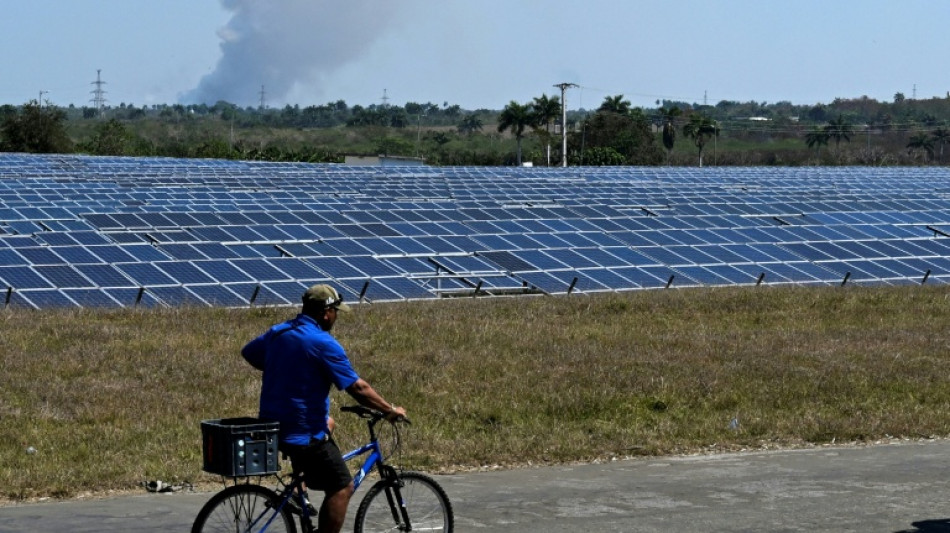
Not far from the ruins of an unfinished nuclear power plant in the Cuban province of Cienfuegos, hundreds of workers are hastily installing 44,000 solar panels as the island seeks once again to reduce its reliance on oil to escape an energy crisis.
Forty years ago, the solution was thought to be Russian nuclear energy. This time, it is the sun. With help from China.
Dozens of containers with Chinese inscriptions are lined up at the "La Yuca" photovoltaic park, where forklifts loaded with solar panels weave between the concrete frames that will hold them.
"We are laying wires, digging trenches and installing panels," a worker on the project, to be completed in May, explained of the frenetic activity.
Cuba, an island of some 10 million inhabitants, remains highly dependent on fossil fuels to operate its eight outdated thermoelectric power plants, most of them online since the 1980s and '90s and prone to frequent breakdowns.
The communist government has approved the construction of 55 solar parks by 2025.
Five of them will be in the central province of Cienfuegos, that also hosts an industrial port and a refinery, and was chosen in the 1980s to host a Soviet-funded nuclear power plant that was aborted mid-build when the USSR collapsed.
Cuba's fragile electric grid has gone offline four times in the past six months, plunging the majority of the country into darkness, sometimes for days on end.
Most of the country faces near-daily outages blamed mainly on fuel shortages.
"More than half of all the fuel consumed by the country goes towards electricity production," Energy and Mines Minister Vicente de la O Levy recently told state-run newspaper Granma.
- Millions of dollars -
Most of the oil has come from Venezuela which, like Cuba, is under US sanctions and has seen the administration of President Donald Trump recently revoke licences that allowed transnational companies to extract crude there.
The country also uses floating electric plants rented from a Turkish company, and generators fueled by crude oil even as there is not enough petrol for the island's cars, tractors and ambulances.
The country produces about a third of the fuel it consumes, and buys the rest.
De la O Levy has said solar parks are at the heart of Cuba's renewable energy goals because the "investments are cheaper, they are built more quickly, and can be spread throughout the country."
The communist island, grappling with its worst economic crisis in decades, aims to generate 12 percent of its energy from renewable sources by 2025 and 37 percent by 2030.
By the end of this year, it hopes to produce 1,200 MW in solar energy per day -- almost equal to its daily electricity deficit of 1,500 MW.
The ambitious project requires an investment of several million dollars, and with few Western friends, Cuba has gladly accepted support from what the presidency described in February as "the sister nation of #China."
A total cost estimate has not been made public.
- 'The quickest way' -
Just 15 kilometers (9.3 miles) from "La Yuca" stands an imposing steel dome designed to protect what was going to be a nuclear reactor -- the last large-scale attempt to change Cuba's energy mix.
On its thick concrete walls, Russian inscriptions are still visible.
The project was canceled in 1992 by then-president Fidel Castro after the fall of the USSR, a Cuban ally, which had largely financed the project and provided physicists and engineers.
Eliecer Machin, a thermophysicist trained in the USSR who still lives in the "nuclear city" built to house the personnel of the would-be power plant, recalls the "hard blow" when it was shuttered.
The 60-year-old now makes a living as a pig farmer.
Today, as a result of mistakes made in the past, he said, solar is "the quickest way to obtain energy."
University of Texas researcher Jorge Pinon said the solar energy would mean little if Cuba doesn't have batteries to store it for use in periods of darkness.
A.Williams--TFWP