Climate: Africa's energy future on a knife's edge / Photo: © AFP

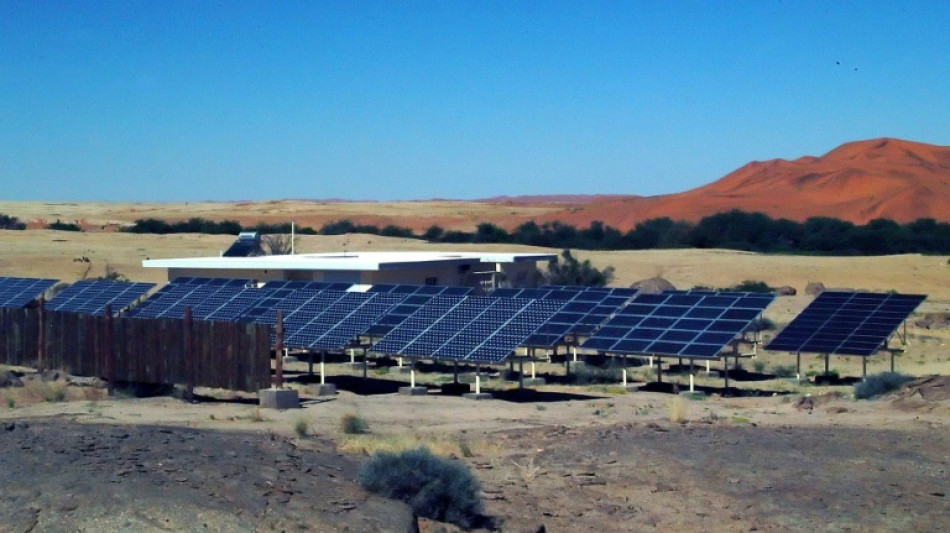
With more than half its population lacking mains electricity and still using charcoal and other damaging sources for cooking, Africa's energy future –- torn between fossil fuels and renewables -- is up for grabs.
As nations discuss the climate crisis at the UN's mid-year negotiations in Bonn, AFP spoke to Mohamed Adow, founder of think tank Power Shift Africa, about the forces pulling the continent in opposing directions.
The stakes, he warns, are global.
Q. You have said rich nations owe the rest of the world a climate debt
"The prosperity they enjoy was, in effect, subsidised by the rest of the world because they polluted without paying the cost for doing so.
"Africa is home to 17 percent of Earth's population but accounts for less than four percent of global greenhouse-gas emissions and only half-a-percent of historic emissions. The continent emits less than 1 tonne of CO2 per person, compared to seven in Europe or China, and more than 15 in the United States.
"If the least-developed continent on our planet is going to leapfrog fossil fuels to renewables, rich nations must pay the climate debt they owe."
Q. How will Africa's energy choices impact the rest of the world?
"My continent is at a crossroads with two possible futures. Africa can become a clean energy leader with decentralised renewables powering a more inclusive society and a greener economy, or it can become a large polluter that is burdened with stranded assets and economic instability.
"We have the opportunity to make a difference for Africa and for the world."
Q. US envoy John Kerry says climate change in Africa could see "hundreds of millions of people looking for a place to live." Is he right?
"Absolutely. It is important to acknowledge that climate-induced migration is a threat. As climate impacts increase, people in Africa -- where almost all agriculture is rain-fed -- will be forcefully displaced from their land.
"In wealthy nations, that is seen mostly as a security issue. But this is a humanitarian disaster in which people are already losing lives, homes and livelihoods.
"The only way to prevent climate-induced migration in the long-run is to reduce carbon pollution at the scale needed."
Q. Is the war in Ukraine affecting energy development in Africa?
"To attain energy security after Russia's invasion, Europe is effectively pushing Africa to pour its limited financial resources into developing its fossil gas extraction and export industry, primarily for consumers in Europe."
"Last month German Chancellor Olaf Scholz, during a three-day tour of Senegal, said his country wants to 'intensively pursue' projects to develop and import Senegal's huge gas reserves. Germany, of course, has been especially dependent on Russian gas.
"So now Europe wants to shackle Africa with new fossil fuel infrastructure that we know will be redundant within a few years, not to mention self-harming for the continent. And lest we forget: gas from Africa will emit the same amount of emissions as gas from Russia."
Q. What is the balance of power in Africa between fossil-fuel interests and those striving to leapfrog to renewables?
"Last month, the Sustainable Energy for All summit in (Rwandan capital) Kigali issued a communique supporting 'Africa in the deployment of gas as a transition fuel'. But only 10 out of 54 African countries signed that statement.
"I think the majority of African nations recognise the tremendous opportunity that renewables present for job creation, innovation, reduced air pollution and sustainable industrialisation. But this majority is a silent majority -- they have not yet leveraged their moral voice to make a case for a cleaner, sustainable Africa.
"There are some leaders. My country, Kenya, is currently powered by 90-percent renewable energy and has set a target of 100 percent by 2030."
Q. The trillions needed to engineer a rapid transition to renewables will not come from public sources alone. How do you mobilise private capital?
"We need to think about long-term investment security in Africa. This is the most expensive continent for securing loans or credit. We need to introduce payment guarantee schemes that are backed by international finance to facilitate safe investment in renewable energy.
"But you still need public money to leverage international investment and finance. We also have to unlock Africa's domestic sources -- public funds, sovereign wealth funds. And then there's debt. If we could swap some foreign debt for the kinds of investment Africa needs, it could make a big difference."
J.Ayala--TFWP