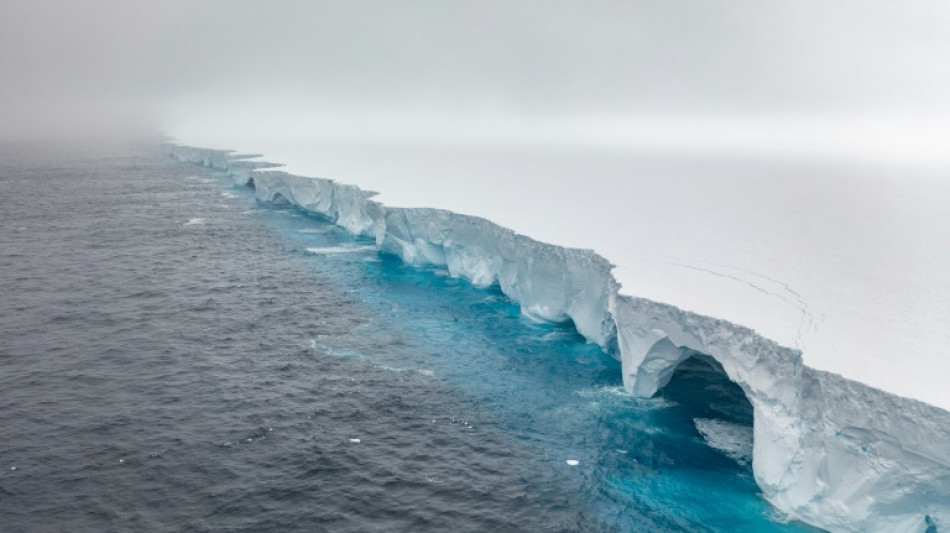
World's biggest iceberg runs aground, sparing wildlife haven island / Photo: © EYOS Expeditions/AFP

The world's biggest iceberg appears to have run aground roughly 70 kilometres from a remote Antarctic island, potentially sparing the crucial wildlife haven from being hit, a research organisation said Tuesday.
The colossal iceberg A23a -- which is more than twice the size of Greater London and weighs nearly one trillion tonnes -- has been drifting north from Antarctica towards South Georgia island since 2020.
This had raised fears it could collide with the island or run aground in shallower water near it, potentially disrupting the ability of penguins and seals to feed their young.
However, the gigantic wall of ice has been stuck 73 kilometres (45 miles) from the island since March 1, according to a statement from the British Antarctic Survey (BAS).
"If the iceberg stays grounded, we don't expect it to significantly affect the local wildlife," BAS oceanographer Andrew Meijers said.
"In the last few decades, the many icebergs that end up taking this route through the Southern Ocean soon break up, disperse and melt," added Meijers, who encountered A23a in late 2023 and has tracked its fate via satellite ever since.
Satellite images analysed by AFP showed that the closest edge of the iceberg had stopped more than 70 kilometres from the island in late February.
It remains unclear whether the iceberg is stuck for good.
"It will be interesting to see what will happen now," Meijers added.
- Potential upside for wildlife? -
The world's biggest and oldest iceberg calved from the Antarctic shelf in 1986.
It remained stuck for over 30 years before finally breaking free in 2020, its lumbering journey north sometimes delayed by ocean forces that kept it spinning in place.
Satellite imagery had previously suggested it was not crumbling into smaller chunks along the familiar path that such icebergs take. However a 19-kilometre chunk broke off in January.
There had been concerns for wildlife on the crucial breeding ground of South Georgia if the iceberg parked too close.
This would have forced animals like penguins and seals to travel much farther to get around the colossal block of ice.
"This could reduce the amount of food coming back to pups and chicks on the island, and so increase mortality," Meijers explained.
However in its current location, the iceberg could offer benefits to wildlife.
"Nutrients stirred up by the grounding (of the berg) and from its melt may boost food availability for the whole regional ecosystem, including for charismatic penguins and seals, Meijers said.
The seal and penguin populations on South Georgia had already had a "bad season" due to an outbreak of bird flu, Meijers told AFP in January.
- What about climate change? -
The iceberg poses no threat to shipping. It is so huge that vessels can easily avoid it.
However, as it breaks up into smaller pieces, certain areas could become off limits to commercial fishing ships "due to the number of smaller -- yet often more dangerous -- bergy bits", Meijers said.
There is no permanent human population on South Georgia, which the UK administers as a British overseas territory.
Argentina also claims the island -- along with the Falklands to the west.
Icebergs of this size are rare but not unheard of. There have been two of similar sizes in the same area over the last five years, Meijers said.
Such huge icebergs are a "completely normal part of the lifecycle" of the Antarctic ice sheets, Meijers emphasised.
But ice shelves have lost 6,000 billion tonnes of mass since 2000, which is matched by accelerating ice loss attributed to climate change, he added.
Researchers warned last month that a rise in the planet's average temperature to between 1.5 and 2.0 degrees Celsius above pre-industrial levels could melt enough frozen water to lift oceans by a dozen metres -- and beyond the point of no return.
Last year -- which smashed previous heat records as the world was battered by fires, floods and storms -- was the first calendar year above 1.5C.
C.M.Harper--TFWP