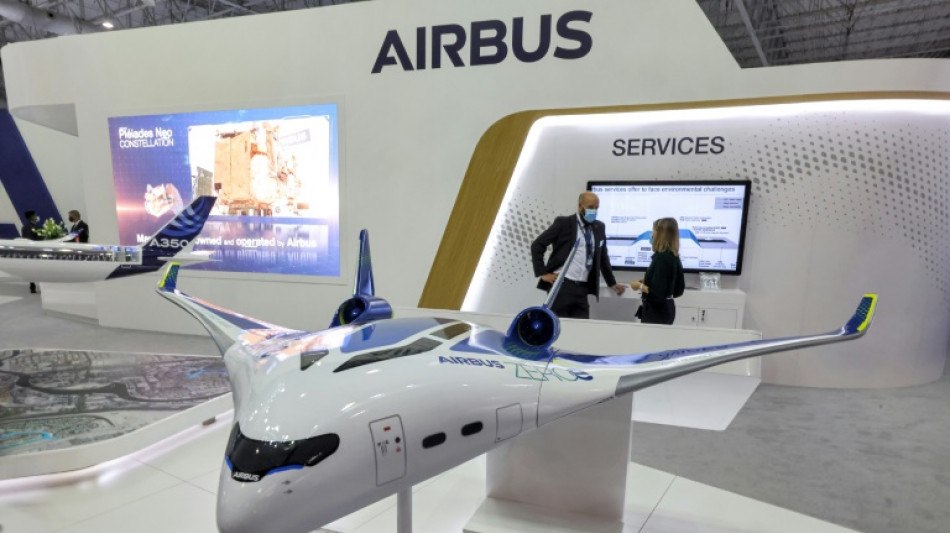
Airbus acknowledges slow progress on hydrogen plane / Photo: © AFP/File

Airbus acknowledged on Friday that progress on developing an aeroplane operating on hydrogen was slower than expected, but said it was not reviewing its approach to decarbonising aviation.
The European aircraft manufacturer had targeted producing a zero-emission plane within a decade to help the commercial aviation sector meet its pledge to becoming carbon neutral by mid-century.
Airbus did not set a new target date.
But according to the FO trade union, the manufacturer had pushed back by five to ten years the date it by which it would have a hydrogen plane ready, had cut the programme's budget by 25 percent and had decided to review its approach to decarbonisation.
Airbus denied it had made any changes to its decarbonisation approach.
"Our ambition and roadmap towards decarbonising the sector remain unchanged," an Airbus spokesman told AFP, adding that the company would adjust its hydrogen projects "in function with the maturity of the ecosystem and technologies".
In September 2020, Airbus unveiled three hydrogen-fuelled concept aircraft baptised ZEROe as its approach to decarbonise.
That set it apart from other players in the industry, which have looked towards renewable or synthetic fuels, or electric planes for aircraft serving on short routes.
Airbus said it remained committed to developing a commercially viable hydrogen-powered aircraft and defended the technology.
"Hydrogen has the potential to be a revolutionary energy source for aviation," the company said, although it acknowledged that developing a commercial ecosystem around the fuel was a major challenge.
"Recent developments show that progress on indispensable elements for this transition, including the large-scale availability of hydrogen from renewable sources, have been slower than expected," said Airbus.
- Practical challenges -
Hydrogen motors do not produce greenhouse gas emissions as its combustion produces water.
But not all hydrogen is clean. Much of it is currently produced from natural gas or even coal, which does result in carbon dioxide emissions.
It can be produced without direct emissions by running renewable electricity and water, but this process is generally more expensive.
Transport and storage of hydrogen also pose problems.
As a gas at room temperature it takes up such a large volume it is impractical to use as fuel. It needs to be chilled to -253°C (-423°F) to be liquefied and even then it takes up four times the space of jet fuel.
The liquefication process also requires expending considerable energy.
Airbus announced in 2022 that it wanted to conduct in 2025 a flight of an A380 with a fifth engine running on hydrogen to test both the storage and the burning of the fuel. FO, the largest trade union at Airbus, said this project had been cancelled.
The airline industry trade association IATA believes that the sector will attain most of its reduction in emissions via sustainable aviation fuel (SAF) before breakthrough technologies like hydrogen.
Airbus on Friday agreed that SAF had a key role to play.
"If hydrogen is destined to play a growing role in aviation in the second half of the century, its contribution for meeting the 2050 decarbonisation target will complement other solutions, in particular sustainable aviation fuels that will remain essential for medium and long-distance flights," said the company.
J.P.Cortez--TFWP