Cash-keen Taliban betting on Afghanistan's mines / Photo: © AFP

A miner in the mountains of eastern Afghanistan poured water over a block of jade, exposing the green stone that is part of the Taliban authorities' push to capitalise on the country's rich mineral resources.
Touting the return of security, the Taliban government is rushing to court local and foreign investors to exploit the country's underground wealth and secure a crucial revenue stream -- though experts warn of the risks of cutting corners.
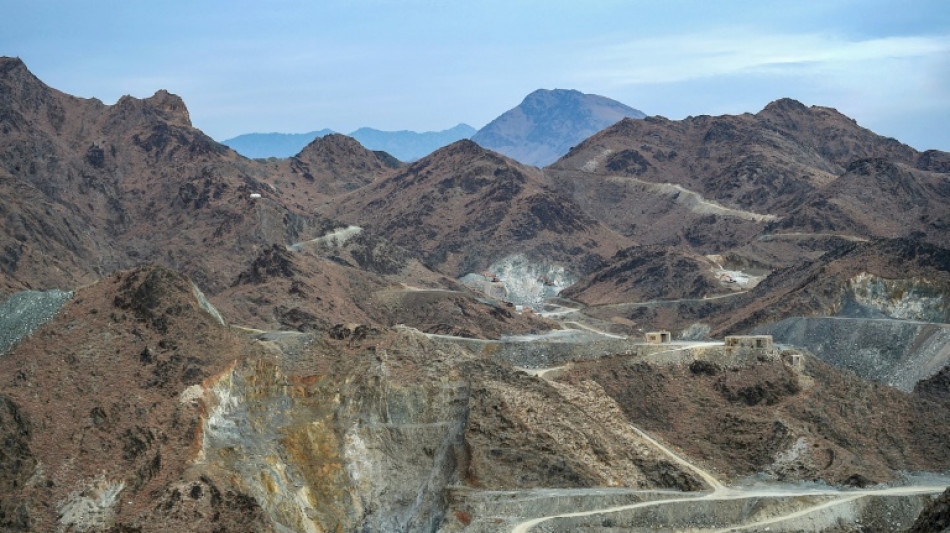
Emeralds, rubies, marble, gold and lithium: the resources buried across Afghanistan's rocky landscape are estimated to be worth a trillion dollars, according to US and UN assessments from 2010 and 2013.
Though decades of war spared these reserves from large-scale exploitation, roughly 200 contracts -- the majority with local companies -- worth billions of dollars in total have been signed since the Taliban's 2021 return to power, official figures show.
"We want Afghanistan to be self-sufficient but there are obstacles," Humayoun Afghan, the spokesman for the Ministry of Mines, told AFP.
"We have no experts, no infrastructure, no knowledge."
The Taliban authorities will "welcome anyone who wants to invest, especially those with mining experience", he added.
Many of these contracts focus on mining exploration, a process that can take years and yield little results, while loosely regulated extraction can leave behind environmental scars, experts caution.
The US Geological Survey (USGS) has noted the production of coal, talc and chromite, "sharply increased" in 2021 and 2022.
The authorities are prioritising resources that could lose value before tackling others, such as lithium, the prices of which may still rise on global markets.
The mines ministry regularly publishes tenders for exploration and extraction projects, sending their embassies lists of available mining projects to invite foreign companies to apply, according to documents reviewed by AFP.
The World Bank says the results are already visible: a 6.9 percent expansion of mining and quarrying drove an industrial sector increase of 2.6 percent in 2023-2024.
But while the government "has auctioned several small mining contracts to meet its cash requirements, many of these contracts have yet to commence operations", it said in a December report.
For mining sector expert Javed Noorani, authorities are tendering "maybe 10 times more than its own capacity to do things".
- 'Country is stabilised' -
The Taliban fought a two decade insurgency against the US and NATO-backed Afghan government in Kabul, seizing power in a rapid military campaign in 2021 after foreign forces withdrew.
Foreign investors had largely abandoned the country, but security has drastically improved and the country's road network has opened up.
Most now fear being associated with the "Islamic Emirate", which remains unrecognised internationally and under Western sanctions.
However, some countries that maintain diplomatic and economic ties with Kabul, such as Iran, Turkey, Uzbekistan and Qatar, have seized the opportunity, with China leading the way.
"The first thing investors say when they meet with us is that the county has been stabilised so now they want to invest," said Afghan, who estimates that 150,000 jobs have been created by the sector since 2021.
Despite improved stability in the mountainous country, there have been sporadic attacks on foreigners claimed by the Islamic State group -- including a Chinese mine worker killed while travelling in northern Takhar province in January.
- China in the lead -
The Chinese state-owned company MCC is already operating at the Mes Aynak copper deposit, the world's second-largest, located 40 kilometres (25 miles) from Kabul, under a 2008 contract revived by the Taliban government.
Chinese companies have secured at least three other major mining projects, particularly in gold and copper, Afghan said.
At a mine carved out of a mountainside in Goshta in eastern Nangarhar province, jade is extracted to be used in jewellery.
"The majority of our nephrite goes to China," said Habibrahman Kawal, co-owner of the mine.
Kawal is pleased with his thriving business, having never invested in mining before the Taliban takeover.
Only 14 mining companies currently active were operating under the previous government, according to the Britain-based Centre for Information Resilience.
"This suggests that a new set of companies dominates the mining sector in Afghanistan," it said.
The government declined to disclose revenue figures but it profits by taking stakes in some companies and collecting royalties.
- Environmental risks -
Shir Baz Kaminzada, president of the Afghanistan Chamber of Industries and Mines, said some investors disregard international sanctions knowing "they can make money". In countries with strict regulations, "you'll spend billions to start a mine".
"In a place like Afghanistan, where there's very little experience with mining and very few, if any, regulations for mining, that's an advantage to companies coming in," said geophysicist David Chambers, president of a non-profit providing technical assistance in mining activities.
This allows for faster work, but "could cause environmental or economic harm", he said.
The main danger lies in mine waste, as only one percent of what is excavated is removed.
The rest may contain iron sulfide minerals that contaminate the ground if it comes into contact with water.
The mines ministry claims to adhere to existing legislation to ensure that the mines are "cleaned" after extraction, without providing further details.
"Every dollar you don't spend in designing a safe tailings dam (to contain waste) or in cleaning up water, that's profit," said Chambers.
"But again, that leads to potential longer term costs."
In Afghanistan, Kaminzada admitted, "people are not taking care of the long term".
C.M.Harper--TFWP